In the fast-paced world of professional journalism and digital content creation, time is the ultimate currency. For freelance writers, independent journalists, and content strategists who rely on Subject Matter Expert (SME) interviews to build authoritative long-form pieces, the transcription bottleneck has historically been a major pain point. A standard 20-minute conversation with an industry insider easily yields upward of 3,000 words. Historically, capturing these insights accurately required meticulously reviewing raw audio recordings five or six times—turning what should be a streamlined production process into a tedious, hour-long chore.
Enter AI-driven transcription. Over the past several years, platforms like Otter.ai have transformed how independent professionals handle audio data. In this comprehensive review and industry analysis, we examine whether Otter.ai’s Pro tier—priced at approximately $100 annually—delivers genuine return on investment (ROI) for modern freelance writers. Through the lens of veteran fintech writer Liz Froment, who has tested the platform extensively since 2020, we explore how real-time transcription tools impact workflow efficiency, interview dynamics, financial metrics, and the overall quality of digital media.
Detailed Chronology: How AI Transformed the Writing Workflow
To understand the current impact of automated transcription, one must look at how the workflow of a freelance writer has evolved over the past decade.
The Pre-Automation Era
Before the widespread adoption of reliable speech-to-text artificial intelligence, conducting interviews for financial, technical, or corporate publications required an intense division of focus. Writers sat with recording devices running while frantically scribbling shorthand notes or typing directly into a document. This divided attention often resulted in subpar interviews. A writer preoccupied with catching a direct quote might miss a vital follow-up question or fail to notice when an expert glossed over a critical nuance.
Post-interview, the friction intensified. Writers faced the grueling task of manual transcription. Listening to a 20-minute audio file at normal speed while typing out the dialogue typically took between 60 and 90 minutes. Only then could the actual writing process begin.
The Shift to Real-Time AI (2020–Present)
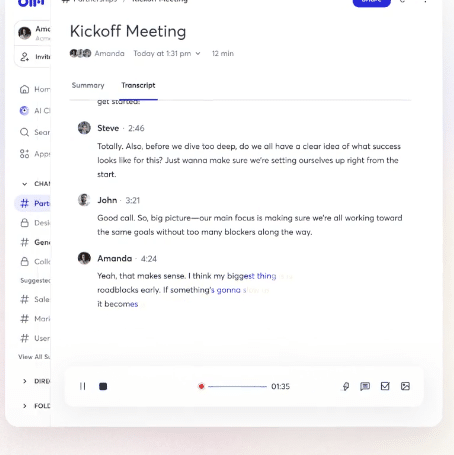
As machine learning models matured around 2020, tools like Otter.ai shifted the paradigm from post-production transcription to real-time collaboration. Writers no longer needed to choose between engaging fully in a conversation and capturing its details. By integrating AI transcription directly into virtual meeting spaces (such as Zoom, Microsoft Teams, and Google Meet) or capturing audio through dedicated mobile and desktop applications, the documentation process became entirely passive.
For professionals conducting multiple SME interviews per month—such as those writing for fintech publications like The Financial Brand—this chronological shift meant that raw transcripts were available the exact second a call ended. The workflow compressed from a multi-day ordeal involving manual logs or outsourced human typists to an instantaneous, streamlined pipeline.
Supporting Context & Metrics: The Financial and Temporal ROI
For freelancers operating on tight profit margins, software subscriptions must justify their cost. At roughly $100 a year for the Pro tier, Otter.ai requires a clear financial justification.
Breaking Down the Time Savings
On average, an experienced freelance writer using Otter.ai saves between three and five hours per month on transcription and quote-verification alone. For professionals managing heavy workloads or conducting daily client briefings, that figure can easily double or triple.
To appreciate the financial impact, consider a standard freelance assignment:
Project Scope: A 1,000-word article including one SME interview.
Compensation: $1,200.
Traditional Time Investment: 1 hour of research, 3 hours of outlining and writing, and 1 hour of manual transcript generation. Total: 5 hours ($240 effective hourly rate).
AI-Optimized Time Investment: 1 hour of research, 3 hours of outlining and writing, and near-zero manual transcription overhead (offset by a brief 10-minute cleanup phase). Total: ~4.1 hours ($292 effective hourly rate).
By reclaiming nearly an hour per article, writers can take on additional projects, invest more time in deep research, or simply improve their work-life balance. For a writer producing three to four interview-driven pieces monthly, the tool pays for itself within the first thirty days.
Feature Set Performance Analysis
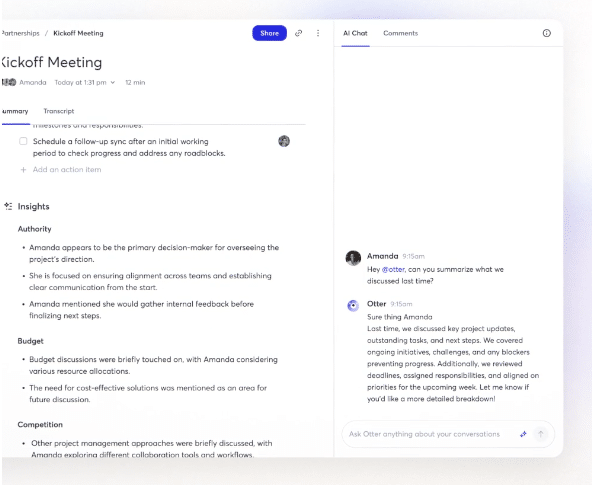
AI Chat Search: One of the platform’s standout features is its conversational AI search capability. Rather than scrolling endlessly through a text wall to find a specific comment on complex topics like "credit card fraud" or "AI-driven personalization," a writer can query the chatbot directly. The system extracts relevant passages and provides concise summaries.
Audio-to-Text Synchronization: The platform links the transcript text directly to the underlying audio file. Clicking any sentence in the transcript plays the exact corresponding audio snippet. This proves invaluable when automated models mishear technical jargon, ensuring verification takes seconds rather than minutes.
The Free Tier: The basic plan offers 300 minutes per month with a 30-minute limit per recording. This serves as a risk-free testing ground for new users to evaluate compatibility with their daily routines before committing funds.
Official Statements and Industry Feedback
While technology platforms market their products with claims of near-perfection, real-world users provide a more nuanced perspective.
Accuracy vs. Reality
While Otter.ai’s marketing materials cite high accuracy rates (often approaching 95% under optimal conditions), veteran users estimate real-world accuracy during complex SME interviews lands closer to 80% to 85%. Industry-specific terminology, acronyms, and proper nouns are frequently mangled, requiring human oversight.
As Froment notes in her workflow assessments:
"You never take a transcript exactly as written anyway. When I’m pulling a quote to use in an article, I click the transcript, listen to the audio, and verify it’s accurate before publishing. That process adds a little time, but at three to five calls per month, it’s not significant."
Human Transcription vs. AI Alternatives
Some traditionalists advocate for human transcription services, citing superior grammatical precision and handling of difficult accents. However, human transcription introduces a major structural flaw for modern journalists: latency. Human services typically require three to five days to return a completed file—unless the client pays steep rush fees. In modern media environments where assignments must be researched, reported, and written within a single week, waiting days for a transcript is rarely viable.
Furthermore, competition within the AI transcription market has heated up significantly. Alternatives such as Fireflies.ai, Fathom, and Rev offer competing feature sets tailored to different niches, ranging from corporate meeting management to heavy-duty legal transcription. Nevertheless, long-term users often stick with established platforms due to familiarity and consistent ecosystem integration.
Future Outlook: The Trajectory of Automated Voice Intelligence
As generative artificial intelligence continues to reshape the media landscape, tools like Otter.ai are moving beyond simple text generation toward predictive analysis and automated content structuring.
What Lies Ahead for Freelancers
Deeper Contextual Awareness: Future iterations of transcription engines will likely feature pre-loaded industry glossaries (e.g., medical, legal, or fintech dictionaries), drastically reducing the error rates associated with niche technical jargon.
Autonomous Synthesis: Rather than simply providing a searchable transcript, upcoming tools are expected to automatically generate article outlines, pull key soundbites, and draft executive summaries immediately upon call termination.
Cross-Platform Ecosystems: Integration between calendar management apps, project management software (like Notion or Asana), and publishing content management systems (CMS) will create fully automated pipelines from initial interview booking to final draft submission.
Final Verdict: Who Should Invest?
For professional freelance writers who conduct regular interviews, invest in the Pro tier ($100/year). The time saved easily justifies the nominal expense. Conversely, writers who rely solely on asynchronous communication, secondary research, or creative writing without interviews may find little use for the platform beyond the generous free tier.
Ultimately, while automated transcription is not entirely flawless—requiring basic hardware setups like speaker mode and occasional manual verification—it has cemented its place as an indispensable asset in the modern writer’s digital toolkit.