

Executive Overview
In the rapidly accelerating landscape of artificial intelligence and digital content creation, few brand revivals are as unexpected or as strategically fascinating as that of LimeWire. Once universally recognized in the mid-2000s as a notorious peer-to-peer file-sharing client that sat at the center of the digital music revolution—and subsequent copyright legal battles—LimeWire has completed a dramatic corporate metamorphosis. Today, it re-emerges not as a conduit for unauthorized media distribution, but as a cutting-edge, blockchain-integrated generative AI publishing platform and creator economy ecosystem.
The contemporary iteration of LimeWire bridges the gap between sophisticated machine learning synthesis and decentralized Web3 monetization. Designed as an all-in-one content hub known as LimeWire Studio, the platform empowers artists, designers, musicians, and everyday digital creators to generate high-fidelity AI imagery, automatically mint their outputs as Non-Fungible Tokens (NFTs), and monetize their portfolios through a combination of programmatic ad-revenue sharing, subscriber-exclusive content gates, and secondary-market royalties.
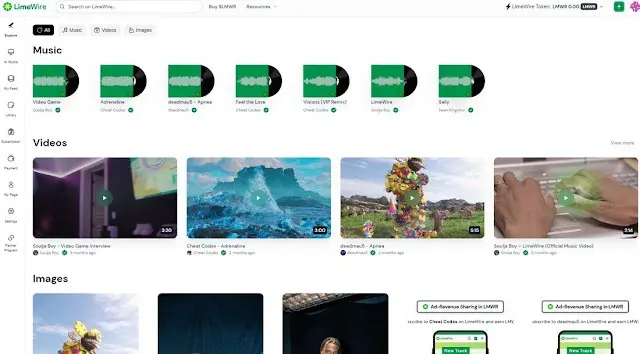
High-profile artists and public figures—including Deadmau5, Soulja Boy, and Sean Kingston—have already leveraged the ecosystem to publish NFT-backed media. By blending state-of-the-art text-to-image architectures (such as Stable Diffusion and DALL-E) with native cryptocurrency incentives driven by its proprietary token, LMWR, LimeWire has positioned itself as a unique nexus where artificial intelligence meets digital asset ownership. This comprehensive investigative report explores the technical architecture, monetization frameworks, structural pricing tiers, and future trajectory of LimeWire’s transformed ecosystem.
Detailed Chronology: The Transformation of a Brand
To understand LimeWire’s current footprint in the generative AI market, it is essential to trace its historical trajectory and the strategic pivot that brought it back to mainstream prominence.
The 2000s: The P2P File-Sharing Era
Founded in 2000 by Mark Gorton, LimeWire originally operated as a Java-based peer-to-peer file-sharing client utilizing the Gnutella network. At its peak, it was one of the most downloaded applications globally, facilitating the exchange of millions of music tracks, movies, and software files daily. However, the platform became the primary target of major record labels represented by the Recording Industry Association of America (RIAA). Following a landmark 2010 federal court ruling (Arista Records LLC v. Lime Group LLC), which found LimeWire and Gorton liable for copyright infringement and inducement, the original application was permanently shut down.
The 2022–2023 Pivot: Entering the Web3 Era
More than a decade after its shutdown, the LimeWire brand was acquired by Austrian entrepreneurs Julian and Paul Zehetmayr. Recognizing the enduring brand recognition, the new leadership team initially repositioned LimeWire as a digital collectibles marketplace for music and art in mid-2022. Operating on blockchain networks like Algorand and Polygon, the platform sought to provide a safe, regulated environment for creators to sell digital merchandise and audio tracks to fans.
The AI Integration and Launch of LimeWire Studio
As the generative AI revolution gained momentum in late 2022 and 2023 with the mainstreaming of models like Midjourney, Stable Diffusion, and OpenAI’s DALL-E, LimeWire executed its most ambitious pivot yet. The platform integrated advanced text-to-image engines directly into its interface, transforming from a passive marketplace into an active, creation-first studio. Users were no longer just buyers and sellers of digital art; they were empowered to manufacture their own AI-generated assets using simple text prompts, seamlessly turning prompts into minted digital assets with zero prior graphic design experience.
Supporting Context & Metrics: Architecture and Features of LimeWire AI Studio
LimeWire Studio differentiates itself from standalone text-to-image web applications by creating a closed-loop economic ecosystem where creation, distribution, monetization, and community engagement occur under a single digital roof.
Advanced AI Image Generation Tools
At its core, LimeWire provides a robust suite of image generation tools built on top of some of the industry’s most capable open-source and proprietary foundation models, including:
- Stable Diffusion 2.1 & Stable Diffusion XL (SDXL): Offering high-resolution outputs, incredible prompt adherence, and vast stylistic flexibility.
- DALL-E 2: Integrated to provide users with alternative rendering styles and conceptual breadth.
Unlike rigid software that locks users into a single aesthetic, LimeWire allows creators to seamlessly switch between multiple AI models and aesthetic filters. Users can experiment with diverse design paradigms, including:
- Cinematic realism
- Digital art and concept painting
- Pixel art for retro gaming aesthetics
- Anime and manga styles
- Analog film photography effects
Furthermore, the platform incorporates advanced controls such as samplers and prompt guidance parameters, enabling both novice users and experienced digital artists to fine-tune sharpness, color palettes, and structural composition. LimeWire has also announced ongoing development toward its own proprietary AI model, signaling a transition from a software aggregator to an independent AI developer.
Automated NFT Minting via Polygon and Algorand
Once a user generates an image, graphic, or digital asset within LimeWire Studio, the platform offers a streamlined publishing workflow. Upon hitting "publish," LimeWire automatically mints the creation as an NFT on either the Polygon or Algorand blockchain.
This automated process removes the technical hurdles typically associated with Web3 development—such as setting up external cryptocurrency wallets, purchasing native gas tokens, and writing smart contracts. Every asset receives a verifiable digital signature, establishing provenance and true digital ownership.
Creators retain granular control over how their minted content is distributed:
- Public Discovery: Assets can be published openly to the public feed, allowing any user to discover, view, and trade the NFTs on secondary markets.
- Subscriber-Only Exclusivity: Creators can gate specific posts behind a paywall, ensuring that high-value or intimate creations are accessible exclusively to dedicated, paying subscribers.
Monetization Frameworks and the LMWR Token Economy
What truly separates LimeWire from traditional creative suites like Adobe Photoshop or standalone AI generators like Midjourney is its multi-layered revenue-sharing model. LimeWire has engineered a system designed to financially reward creators based on both audience engagement and asset appreciation.
1. Ad-Revenue Sharing Model
When creators publish content—whether images, music, or forthcoming video assets—to LimeWire Studio, they become eligible for programmatic advertising revenue. LimeWire shares up to 70% of all ad revenue generated from views on a creator’s published portfolio. This creates a passive income stream for designers and digital artists who can experiment with AI generation tools and earn continuous revenue as their galleries attract traffic.
2. Secondary-Trading Royalties
When digital assets are minted as NFTs and traded within the LimeWire community or across supported marketplaces, original creators are hardcoded to receive a 2.5% royalty on every subsequent transaction. This ensures that successful artists continue to benefit financially as the secondary-market value of their digital collectibles appreciates.
3. The LMWR Utility Token
All financial earnings distributed by LimeWire are paid out monthly in LMWR, the platform’s native utility token. LMWR serves several critical functions within the ecosystem:
- Payout Currency: Creators receive their ad revenue shares and secondary royalties directly in LMWR.
- Exchange Liquidity: LMWR is listed on multiple tier-one cryptocurrency exchanges, including Kraken, ByBit, and Uniswap, allowing users to easily convert their earnings into fiat currency (USD, EUR) or other digital assets.
- Platform Utility: Token holders can use LMWR to purchase generation credits, pay for prompt bundles, and unlock premium creator tiers within the LimeWire ecosystem.
Pricing Plans and Tiered Ecosystem Access
To accommodate everyone from casual hobbyists to professional digital agencies, LimeWire offers a free tier alongside four distinct monthly subscription packages. Each tier scales in terms of monthly generation credits, image caps, revenue-share percentages, and exclusive platform privileges.
| Subscription Tier | Monthly Price | Monthly Credits | Max Image Generations | Ad Revenue Share | Pro Benefits & Features |
|---|---|---|---|---|---|
| Free Tier | $0 | 10 credits | Up to 20 images/day | 50% | Basic community access, standard generation speed. |
| Basic Plan | $9.99 | 1,000 credits | Up to 2,000 images | 50% | Pro profile badge, full creation history, faster rendering, ad-free. |
| Advanced Plan | $29.00 | 3,750 credits | Up to 7,500 images | 60% | Pro profile badge, priority rendering queue, early access to models, ad-free. |
| Pro Plan | $49.00 | 5,000 credits | Up to 10,000 images | 70% | Pro profile badge, maximum priority queue, early model access, ad-free. |
| Ultimate Plan | $99.00 | 11,250 credits | Up to 22,500 images | 70% | Pro profile badge, enterprise-grade generation speed, early access, ad-free. |
Key Inclusions Across All Paid Plans
Every paid tier (ranging from $9.99 to $99 per month) equips creators with standardized professional advantages:
- Pro Profile Badge: Enhances credibility and visibility across the LimeWire Studio feed.
- Full Creation History: Allows users to audit, re-edit, and re-download past iterations seamlessly.
- Faster Image Generation: Bypasses standard server queues to deliver prioritized GPU rendering.
- Ad-Free Browsing: Ensures an uninterrupted creative workspace.
Future Outlook and Industry Implications
As generative artificial intelligence matures, the friction between open-source content creation and copyright governance remains a central debate. LimeWire’s model offers an intriguing blueprint for how platforms can navigate this new paradigm. By baking blockchain verification (NFTs) and programmatic monetization directly into the AI generation pipeline, LimeWire attempts to solve the attribution and compensation crisis facing modern digital artists.
Upcoming Expansions: Music and Video Generation
While LimeWire’s current generative capabilities are anchored primarily in advanced text-to-image synthesis, the platform’s roadmap includes ambitious expansions into AI-powered music and video generation tools. Given the founders’ historical roots in the music industry and the platform’s early adoption by musicians like Soulja Boy and Deadmau5, the introduction of native AI audio and video production suites could dramatically broaden LimeWire’s market appeal.
If executed successfully, creators will soon be able to compose entire multimedia projects—combining AI-generated art, synthesized soundtracks, and automated video loops—all within a single decentralized studio environment.
Conclusion
LimeWire has successfully divorced its modern identity from its controversial 2000s P2P legacy, transforming into a sophisticated, forward-thinking player in the generative AI economy. By democratizing access to high-end AI models, automating blockchain-based authentication, and offering lucrative ad-revenue and royalty models paid out in LMWR tokens, LimeWire provides a compelling ecosystem for the next generation of digital creators.
For artists, designers, and enthusiasts looking to explore the frontiers of generative art while retaining true digital ownership of their work, LimeWire Studio stands as a multifaceted platform worth watching closely as it continues to expand into audio and video production domains.