

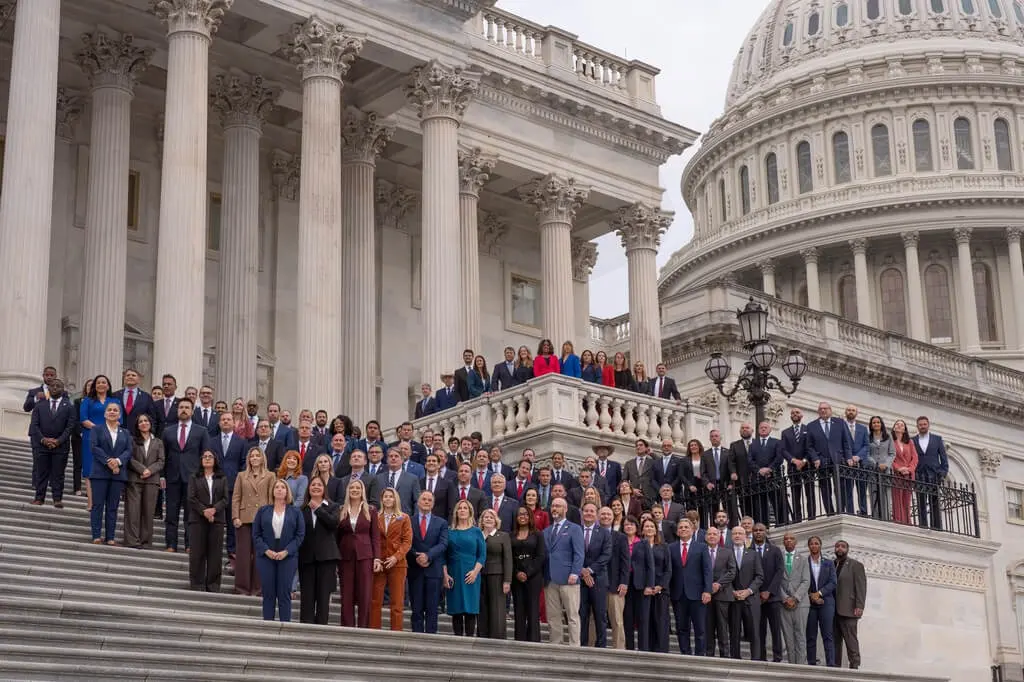
WASHINGTON — In the immediate wake of a decisive midterm election that handed congressional control to the Democratic Party, Capitol Hill is bracing for a profound constitutional clash over the future of the First Amendment.
Scarcely 48 hours after the final ballots confirmed that Democrats had captured both chambers of Congress, Sen. Richard Blumenthal (D-Conn.) dispatched a formal, urgent records request to the Federal Communications Commission (FCC). The directive initiated a comprehensive congressional inquiry into what Democratic lawmakers on the Homeland Security and Governmental Affairs subcommittee have characterized as an unprecedented pattern of federal hostility toward freedom of speech and the press.
The move served as an unmistakable preview of the oversight mechanisms, investigative teeth, and legislative tools a newly empowered Democratic majority intends to deploy when the 119th Congress convenes on January 3. Vowing to push back against a second Trump administration that has aggressively targeted independent journalism, congressional leaders and press freedom advocates are mapping out an aggressive offensive to safeguard constitutional protections, overhaul government transparency laws, and pass long-stalled bipartisan protections for reporters.
Executive Overview: A New Balance of Power
The political landscape shifted dramatically on Election Night. Buoyed by what many are calling a blue “tsunami,” Democrats are poised to capitalize on robust majorities in both the House and the Senate. The shift brings an abrupt end to what critics condemned as an unproductive, partisan Republican-controlled Congress, replacing it with an aggressive legislative and oversight apparatus eager to utilize the subpoena power.
The tone for the upcoming term was set late Tuesday evening when Rep. Robert Garcia (D-Calif.), slated to chair the House Oversight Committee in the new year, published a blunt, two-word warning to administration officials on social media: “LAWYER UP.”
While the broad contours of the Democratic agenda are still taking shape, press freedom advocates have wasted no time initiating strategic consultations with key lawmakers. Far from viewing the protection of journalism as a secondary or niche issue, advocacy groups emphasize that a free and unencumbered press is foundational to effective governance. Seth Stern, chief of advocacy for the Freedom of the Press Foundation, noted that robust reporting is vital for exposing the very systemic inefficiencies and governmental abuses that reformers aim to fix.
“I don’t think press freedom needs to come at the expense of other congressional priorities,” Stern said. “If anything, it’s complementary to all of those other priorities. A free and unencumbered press is only going to help reformers implement reforms because it helps them expose the needs for those reforms.”
Detailed Chronology of Events
The escalation between the legislative branch and the administration’s regulatory machinery has accelerated rapidly in the days following the election:
- Election Night: Early results confirm a Democratic takeover of both the House and Senate, immediately altering the oversight dynamics for the remainder of President Donald Trump’s term. Rep. Robert Garcia issues his public warning to administration officials.
- Less Than 48 Hours Post-Election: Sen. Richard Blumenthal emails the Federal Communications Commission, demanding extensive internal records to investigate systemic actions that “erode and undermine freedom of speech and freedom of the press and bear on the laws governing media consolidation.”
- The Following Tuesday (Senate Hearing): During a high-stakes Senate committee hearing regarding the nomination of Danielle Thumann to the FCC, Sen. Ben Ray Luján (D-N.M.) delivers a direct, public warning to FCC Chairman Brendan Carr. Luján admonishes Carr that he will face rigorous congressional oversight come January, stripped of the protections of the agency’s gavel.
- Same Day (House Impeachment Vote): The House of Representatives narrowly defeats an immediate push to impeach Defense Secretary Pete Hegseth, voting 211 to 204 to refer eight articles of impeachment to committee, with only one Republican crossing party lines. Democratic lawmakers indicate the charges can be easily refiled under the new majority next year.
Supporting Context & Metrics: Investigations and Oversight
Armed with subpoena power and control of key committees, congressional investigators have compiled an extensive target list of administration officials and federal agencies. At the pinnacle of press freedom advocates’ scrutiny is FCC Chairman Brendan Carr.
The FCC and Media Consolidation
Under Carr’s tenure, the FCC—historically structured as an independent regulatory agency—has faced intense criticism for opening retaliatory investigations into news outlets that draw the ire of conservative figures. Most notably, the FCC’s ongoing dispute with ABC has escalated into federal litigation. In August, ABC filed a lawsuit accusing the commission of weaponizing its regulatory authority to censor and punish the network for its editorial content. Carr himself has repeatedly issued thinly veiled warnings that the agency possesses the discretionary power to strip broadcast networks of their operating licenses.
Concurrently, the FCC has gutted key broadcast ownership caps, greenlighting massive media consolidation. Critics argue that the agency’s leverage over broadcast license transfers has forced corporate media parents—such as Skydance Media, Paramount, and Warner Bros. Discovery—to bow to political pressure to secure regulatory approval for multibillion-dollar mergers.
Sen. Luján underscored the dramatic shift in accountability during Tuesday’s nomination hearing, telling Carr directly: “Mr. Carr, if you’re listening now, know you’re going to be in this body once a month, if not more, and in the House of Representatives as well, answering questions, and you don’t have the protection of the gavel any longer.”
Targeting the DOJ and Pentagon
Beyond the FCC, key administration figures slated for aggressive congressional inquiry include Attorney General Todd Blanche and Defense Secretary Pete Hegseth, according to Clayton Weimers, executive director of Reporters Without Borders’ North American branch.
Lawmakers are expected to question Attorney General Blanche regarding the Department of Justice and FBI’s controversial January raid on the home of a Washington Post journalist. Meanwhile, Secretary Hegseth faces fierce bipartisan blowback for systematically purging journalists from the Pentagon, censoring war-reporting details concerning Iran, and attempting to convert the historically independent military newspaper Stars and Stripes into an uncritical public relations mouthpiece for the Department of Defense.
The Transparency Crisis and FOIA
Investigative effectiveness relies heavily on public records laws, yet government transparency has suffered severe erosion. Lauren Harper, the Daniel Ellsberg Chain on Government Secrecy at the Freedom of the Press Foundation, notes that processing times under the Freedom of Information Act (FOIA) have ballooned to historic highs during the current administration.
Massive personnel cuts engineered by the Department of Government Efficiency resulted in widespread layoffs across agency FOIA offices, while career civil servants have faced termination for lawfully releasing public documents over the objections of political appointees.
Harper argues that Congress must take a page out of the post-Watergate playbook, enacting structural reforms that give FOIA genuine enforcement teeth. Potential legislative fixes include refining statutory language, permanently funding agency FOIA offices, imposing strict financial penalties on officials who obstruct document releases, and expanding FOIA jurisdiction to cover private prisons and detention facilities utilized by Immigration and Customs Enforcement (ICE).
Official Statements and Perspectives
Press freedom leaders emphasize that while the road ahead is fraught with partisan friction, the recent electoral mandate provides a vital window for systemic reform.
- José Zamora, Committee to Protect Journalists: “The midterms and the results really create an opportunity to strengthen freedom of the press. What matters now is whether Congress turns that opportunity into action.”
- Nora Benavidez, Free Press Senior Counsel: Highlighting the physical dangers faced by reporters covering aggressive federal law enforcement operations—such as the January arrests of independent journalists Don Lemon and Georgia Fort while covering an anti-ICE demonstration in Minnesota—Benavidez noted, “People on the ground covering what the Trump administration has done these last two years, where ICE and the National Guard and the military are being deployed
—those journalists often come under the most aggressive assault, scrutiny, and attempts to criminalize their activities.”
- Clayton Weimers, Reporters Without Borders: “My hope is that we get back to a place where press freedom is a nonpartisan American value that we can all get behind. We strayed away from that. Most of these things used to be common sense for just about every American… But politicians need to realize this is our First Amendment rights. This really matters, and we can’t take it for granted.”
Future Outlook: Legislative Priorities for the New Congress
Although Democrats will fall short of a veto-proof majority, advocates have identified several key pieces of legislation ripe for bipartisan reintroduction, driven by lawmakers eager to distance themselves from the administration’s overreaches.
1. The PRESS Act
Widely viewed as the “lowest-hanging fruit,” the Protect Reporters from Exploitative State Spying (PRESS Act) would establish a robust federal shield law preventing the government from forcing journalists to disclose confidential sources or compelling the seizure of reporters’ notes. Having passed the House unanimously in 2024 with broad bipartisan support in the Senate before stalling under White House pressure, advocates believe the bill’s renewed momentum could potentially clear the threshold for a veto override.
2. Espionage Act Reform
The aggressive federal crackdown on media leaks has renewed urgency for the Daniel Ellsberg Press Freedom and Whistleblower Protection Act. The measure aims to safeguard genuine whistleblowers and close loopholes that allow the executive branch to weaponize the 1917 Espionage Act against journalists and publishers. Because the act has historically been brandished against figures across the political spectrum—including political actors and former officials—advocates argue the issue commands natural bipartisan common ground.
3. Federal Anti-SLAPP Legislation
With 40 states—including many conservative-led jurisdictions—already enacting anti-SLAPP (Strategic Lawsuits Against Public Participation) statutes to dismiss meritless, retaliatory defamation suits designed to bankrupt and silence independent media, pressure is mounting for a federal equivalent. President Trump’s frequent defamation filings against major media organizations, including the BBC, The New York Times, and The Wall Street Journal, have made federal protections an urgent priority.
4. The Right to Record Act
To combat the escalating criminalization of frontline reporting, the Right to Record Act would institute strict financial penalties for federal law enforcement officers who threaten, detain, or impede citizens and journalists peacefully recording official actions, while heavily penalizing the unlawful seizure or destruction of media equipment and footage.
Conclusion
As the 119th Congress prepares to take office, the ideological battlelines over the First Amendment are drawn. While the executive branch retains formidable tools of censorship, visa restrictions, and veto power, the resurgence of congressional oversight promises a formidable counterweight. For press advocates and lawmakers alike, the coming two years will test whether the legislative branch can successfully restore press freedom as a core, nonpartisan pillar of American democracy.
