

Executive Overview
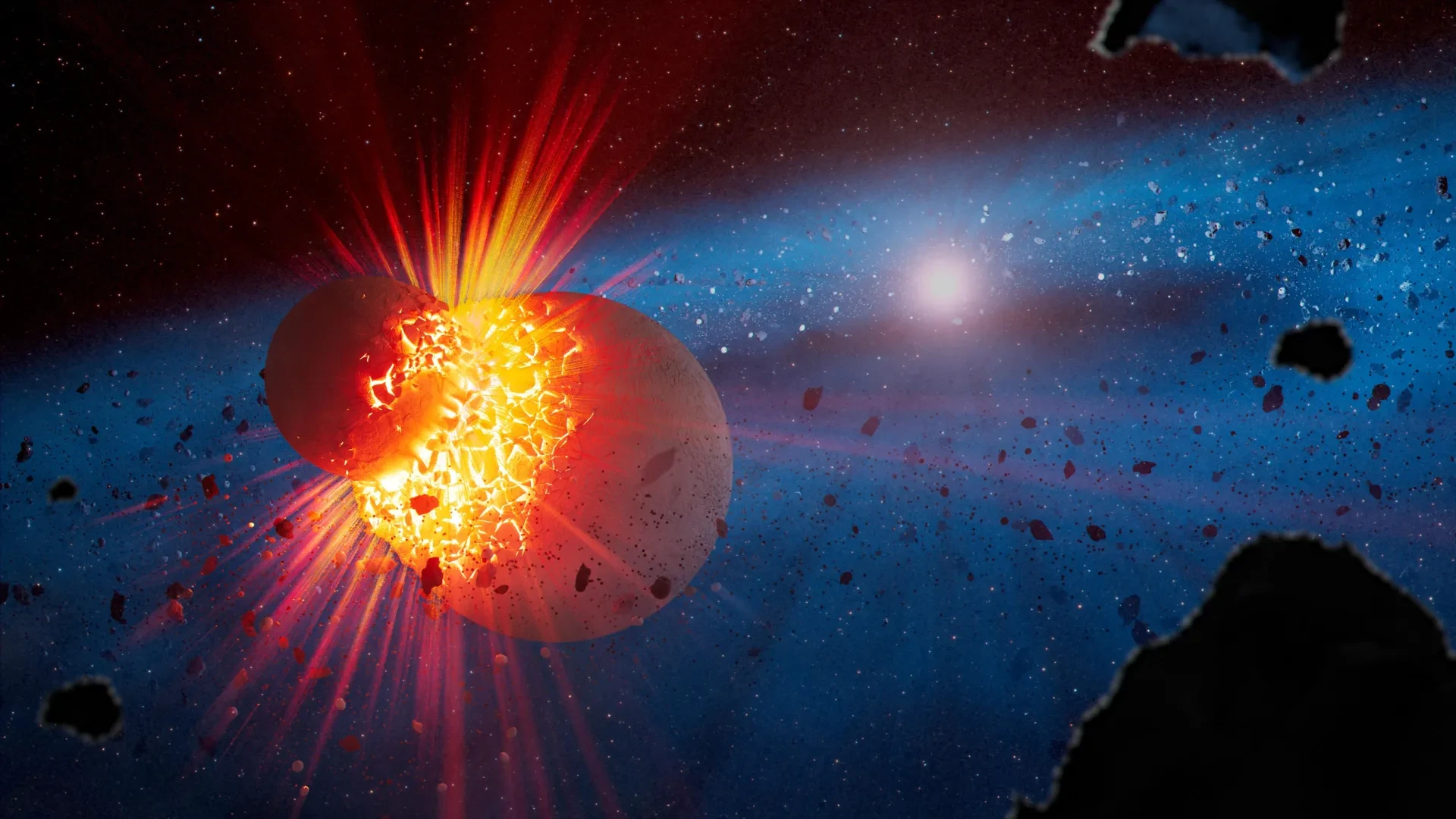
Long before the first single-celled organisms took hold in Earth’s primordial oceans, our cosmic neighborhood was a chaotic shooting gallery. Roughly 4.5 billion years ago, a planetary body roughly the size of Mars—cataloged by scientists as Theia—slammed into the young, molten Earth. This unimaginable, colossal impact vaporized colossal quantities of rock, hurling glowing debris into the vacuum of space. Over millions of years, that accretion disk of shattered fragments coalesced, gravitational attraction locking the material together to form our Moon.
Today, as NASA’s Artemis program looks toward returning humans to the lunar surface and preparing for crewed missions to Mars, humanity is increasingly focused on the Moon as a stepping stone for deep space exploration. Yet, the cataclysmic process that gave birth to our lunar companion was not a localized anomaly. It was a rite of passage for terrestrial worlds.
Now, astronomers leveraging the unprecedented mid-infrared vision of NASA’s James Webb Space Telescope (JWST) have opened a revolutionary window into this violent epoch of planetary genesis. By targeting rare, volatile star systems that are actively undergoing high-energy planetary collisions, researchers are no longer forced to rely solely on geological inference and computer models. They are observing the birth pangs of rocky worlds in real time.
Published on October 1 in The Astrophysical Journal, a landmark study led by Kate Su of the Space Science Institute in Boulder, Colorado, details the observation of 21 "extreme debris disks." By analyzing the mineralogy and thermal emission of these distant systems, an international team of astronomers has decoded the signatures of planetary embryos smashing into one another. The findings not only shed light on how rocky worlds assemble across the galaxy, but they also offer a cosmic mirror, helping scientists reconstruct the turbulent youth of our own solar system.
Detailed Chronology: From Protoplanetary Disks to Extreme Debris
To understand the significance of Webb’s latest observations, astronomers must trace the evolutionary arc of star and planet formation. The life cycle of a planetary system follows a well-defined, albeit perilous, temporal timeline.
The Protoplanetary Phase: A Gas-Rich Nursery
When stars first ignite, they are enveloped by massive, spinning clouds of gas and dust known as protoplanetary disks. These environments are chemically rich and dense, serving as the celestial nurseries where dust grains slowly collide, stick together, and grow into planetesimals, and eventually into planetary embryos. However, this gas-rich phase is fleeting on a cosmic scale. Stellar winds and intense ultraviolet radiation gradually blow away the remaining gas, leaving behind a maturing environment.
The Transition to Debris Disks
As the system matures, the gas-rich protoplanetary disk transforms into a gas-poor debris disk. Typical debris disks—such as those surrounding the famous stars Vega and Fomalhaut—are cold, stable, and relatively quiet. They consist of older planetesimals grinding down gently over eons, producing faint signatures of distant, cold dust.
The Extreme Anomaly
However, a tiny fraction of young stars take a far more violent path. During decades of operation, NASA’s retired Spitzer Space Telescope identified an unusual and enigmatic category of systems dubbed "extreme debris disks." These systems defy the standard evolutionary curve by housing exceptionally large amounts of warm dust located precisely in the zone where rocky, terrestrial planets are expected to orbit—the inner regions of the solar system.
Theoretical models of planetary formation suggest that this high-energy, dust-choked phase should be a relatively common developmental milestone. If terrestrial planets are built through a chaotic sequence of accretion and impact, many systems ought to display these dusty scars. Yet, observational reality has long baffled astronomers: data gathered prior to the JWST era indicated that only about 1% of young stars exhibit observable signs of this extreme debris stage.
Was our own solar system an extreme rarity, or were astronomers simply missing the data? Armed with the James Webb Space Telescope, researchers set out to solve this cosmic mystery.
Supporting Context & Metrics: Decoding the Composition of Cosmic Catastrophes
Before the launch of Webb, our understanding of extreme debris disks was severely bottlenecked by instrumental limitations. While Spitzer flagged their existence, it lacked the sensitivity and high-resolution mid-infrared spectroscopy required to peer deeply into their chemical makeup.
To bridge this knowledge gap, Su and her colleagues assembled a comprehensive sample of 21 extreme debris disks for comparative analysis. The dataset combined 5 historical observations from the Spitzer archives with 16 targeted observations executed by the James Webb Space Telescope. Among the Webb targets, 12 systems were observed for the very first time, while 4 served as high-resolution follow-ups to systems previously examined by Spitzer.
This combined sample represents a turning point in exoplanetary science. By securing a statistically viable cohort of extreme systems, the research team could finally move past speculation and categorize the physical nature of these violent environments.
The Three Defining Signatures
Through mid-infrared spectra gathered by Webb and Spitzer, the team confirmed that extreme debris disks share three distinct characteristics:
- Unusually Small Dust Grains: The particulate matter suspended in these disks is significantly smaller than the dust found in either gas-rich protoplanetary nurseries or typical, cold debris disks. This indicates fresh, pulverized material rather than aged, weathered grains.
- Elevated Warm Dust Concentrations: Massive amounts of thermal dust crowd the inner orbital zones, radiating substantial mid-infrared energy.
- Irregular Photometric Variability: The brightness of these systems fluctuates unpredictably over time, signaling active, ongoing disruption within the disk architecture.
Mineralogy as a Forensic Tool
To determine what kind of physical events were generating these characteristics, the researchers performed spectral decomposition to analyze the specific minerals present in the dust. The results revealed that extreme debris disks naturally segregate into two distinct chemical categories: silica-rich and silica-poor systems.
- Silica-Rich Systems: Approximately one-third of the disks in the sample are dominated by silica. On Earth, volcanic glass such as obsidian serves as a familiar example of silica-rich material.
- Silica-Poor Systems: Roughly two-thirds of the studied disks are silica-poor, characterized by minerals such as forsterite—a magnesium iron silicate that manifests as the striking green sand found on certain beaches in Hawaii.
This chemical divergence is more than a geochemical curiosity; it is a forensic timestamp. The presence or absence of silica directly correlates with the scale and energy of the planetary impacts that created the debris, offering astronomers a direct metric to gauge the violence of unseen worlds colliding light-years away.
Official Statements and Researcher Insights
The complexity and elegance of the study have drawn widespread praise within the astrophysical community, highlighting the collaborative, international effort required to interpret Webb’s unprecedented data streams.
"This is the first time we have gathered enough systems to truly understand this subclass that we call extreme debris disks," noted Kate Su, lead author of the study from the Space Science Institute in Boulder, Colorado.
Reflecting on the analytical leap forward provided by NASA’s flagship observatory, Su added: "Before Webb, we had limited information. We knew that they are weird and very different from the typical cold debris disks that we know, like Vega and Fomalhaut. Now that we have more data, we can pin down what these disks represent for planet formation and evolution."
Directly observing planetary embryos has historically been deemed nearly impossible because these bodies are exceptionally small, distant, and completely overshadowed by the glare of their parent stars. However, Webb’s mid-infrared instruments bypassed this hurdle by capturing the spectral fingerprints of the vaporized and pulverized rock thrown into space by their collisions.
"To just see their mid-infrared emission and beautiful spectral features with Webb, which allowed us to identify their compositions, was the most exciting thing for me," shared Agnes Kospal of the Konkoly Observatory in Budapest, Hungary, and a coauthor of the research. Emphasizing the inaccessible nature of the targets themselves, Kospal noted: "We have no other way to study these planetary embryos directly because they are too small."
As researchers continue to correlate the mineralogical data with stellar ages, a clearer narrative of planetary maturation is beginning to crystallize. The data shows a strict chronological divide: silica-rich disks—indicative of high-energy, Mars-scale impacts—have only been identified around stellar systems younger than 300 million years. Conversely, silica-poor disks appear around stars spanning a much wider, older range of ages and exhibit the most aggressive fluctuations in infrared brightness.
"How rocky planets formed and giant planets evolved are part of the broader story of the solar system’s formation. It’s all one story," Kate Su emphasized. "Our work on extreme debris disks helps us bring together the big picture of what we currently understand."
Future Outlook: Reconstructing Earth’s Violent Past and Beyond
The implications of this study stretch far beyond the immediate cataloging of distant star systems. By mapping the mechanics of extreme debris disks, astronomers are building a dynamic template that can be applied directly to the evolutionary history of our own solar system.
The Timeline of Terrestrial Genesis
Current astrophysical computer simulations dictate that terrestrial planets—Mercury, Venus, Earth, and Mars—should emerge within the first few hundred million years following the birth of a star. This theoretical timeline aligns impeccably with the demographic data retrieved by Webb.
For instance, isotopic and geological dating places the formation of the Earth-Moon system roughly 100 million years after the birth of the Sun, matching the prime age bracket for high-energy, silica-rich impacts observed in the JWST sample. The violent collision between Earth and Theia was likely not a statistical anomaly, but rather the standard mechanism by which planetary cores consolidate and volatiles are delivered or redistributed.
A Nod to the Late Heavy Bombardment?
The discovery of older, silica-poor extreme debris disks—and their erratic infrared variability—provides tantalizing clues regarding later dynamical instabilities. The research team suggests that the dramatic brightness fluctuations in these older systems stem from orbital chaos, where gravitational interactions between newly formed giant planets disrupt smaller bodies, triggering catastrophic cascades of secondary collisions.
This behavior bears a striking resemblance to the Late Heavy Bombardment hypothesis proposed for our own early solar system. Under this scenario, Jupiter and Saturn experienced significant orbital migration, destabilizing the asteroid and Kuiper belts, sending a barrage of rocky and icy bodies crashing into the inner planets, and briefly flooding the inner solar system with impact-generated dust.
Yet, mysteries remain. Attila Moor, also of the Konkoly Observatory and a coauthor of the paper, pointed out the necessity for continued observation:
"Of course, there’s many things we still don’t know about these disks. We expect no silica-rich systems among older extreme debris disks. We only have three disks in our sample that fit that age criteria, so it’ll be nice to observe more of these systems to confirm our hypothesis."
The Role of the James Webb Space Telescope
As the world’s premier space science observatory, the James Webb Space Telescope continues to exceed operational expectations. Operating as an international partnership led by NASA alongside the European Space Agency (ESA) and the Canadian Space Agency (CSA), Webb is uniquely equipped to resolve the faint thermal echoes of planetary construction.
By expanding their sample size and conducting targeted follow-up observations of aging stellar nurseries, astronomers aim to verify whether our Sun indeed passed through multiple extreme debris phases on its way to creating the stable, life-sustaining solar system we inhabit today. Every shattered rock and vaporized grain of silica captured by Webb’s golden mirrors brings humanity one step closer to answering the ultimate existential question: How did we get here?