

Executive Overview
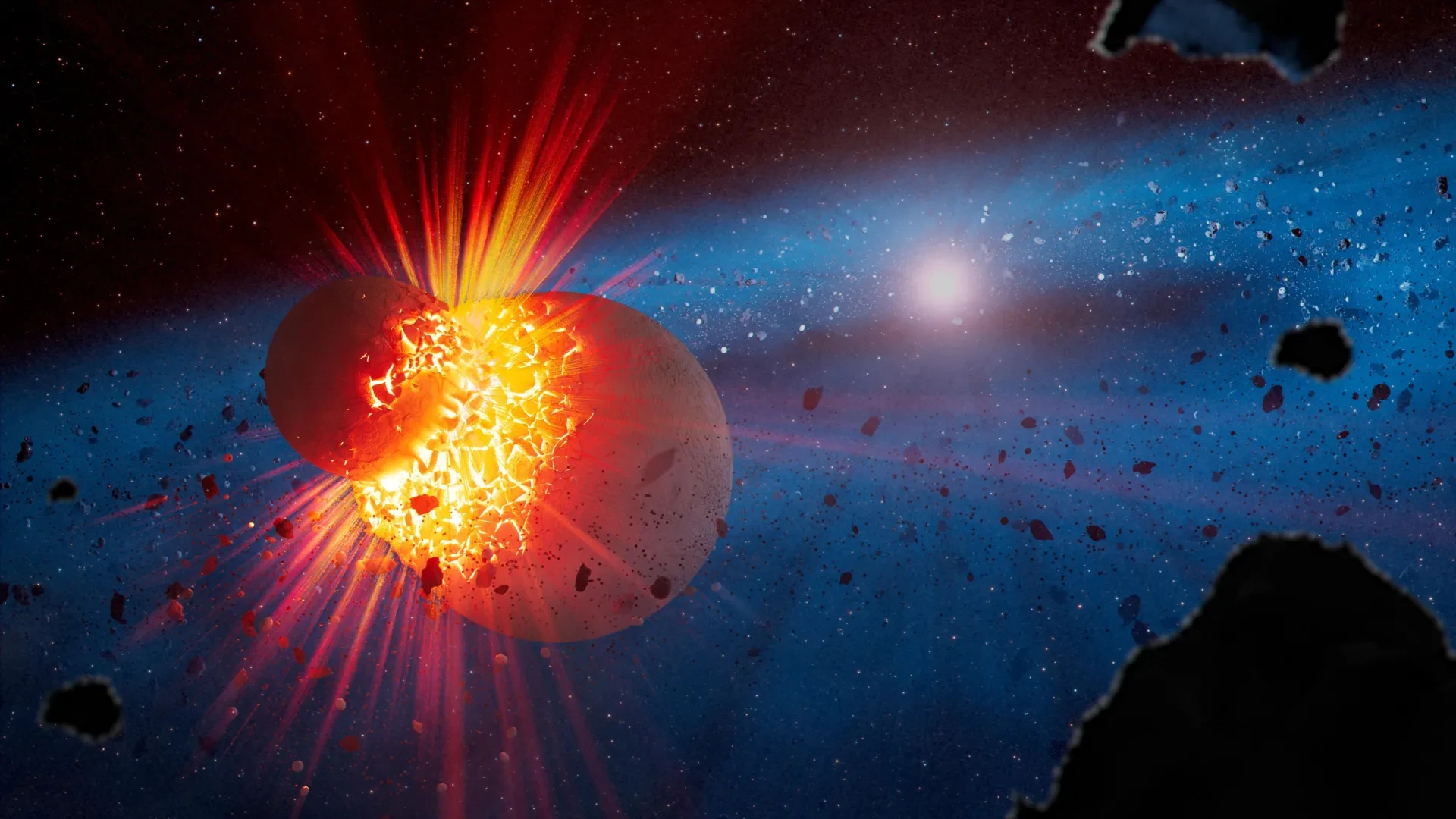
Billions of years ago, the infant solar system was a volatile theater of planetary construction, marked by titanic collisions that vaporized rock, melted iron, and ultimately forged the worlds we inhabit today. Among these foundational events, the most pivotal for Earth was a colossal, glancing blow from a Mars-sized planetary embryo known as Theia. This catastrophic impact hurled incandescent debris into orbit, material that eventually coalesced to form our Moon—a celestial anchor that now serves as the stepping stone for NASA’s Artemis program, future crewed missions to Mars, and the next era of human space exploration.
While the physical scars of this ancient violence are etched deep into the geological and cratered records of our inner solar system, witnessing these epochs in real-time has long remained beyond the reach of human observation. Now, astronomers leveraging the unprecedented mid-infrared sensitivity of NASA’s James Webb Space Telescope (JWST) have pierced the veil of cosmic history. By focusing on rare, highly active star systems light-years away, researchers are directly observing the aftermaths of similarly catastrophic planetary impacts.
Published on October 1 in The Astrophysical Journal, a landmark study led by Kate Su of the Space Science Institute in Boulder, Colorado, details the observation of 21 "extreme debris disks." These peculiar stellar environments are dense with warm, freshly pulverized dust situated squarely in the habitable zones where rocky planets typically form. By analyzing the infrared light and mineralogical composition of these distant systems, an international team of researchers has begun classifying the energy scales, mechanics, and temporal timelines of planetary smashes.
The findings not only offer a unique window into the chaotic youth of extrasolar systems, but they also provide a crucial mirror for our own solar system’s turbulent infancy. By categorizing these disks into silica-rich and silica-poor regimes, scientists can now differentiate between ultra-high-energy impacts—such as the one that birthed our Moon—and lower-energy, grazing collisions between smaller planetary embryos. This research bridges theoretical planetology with empirical astronomy, offering unprecedented clarity on how rocky worlds are assembled, disrupted, and ultimately stabilized across the cosmos.
Detailed Chronology: From Protoplanetary Disks to Extreme Debris
To understand the fleeting, violent phase captured by the James Webb Space Telescope, astronomers must trace the lifecycle of circumstellar material from the birth of a star to the maturation of its planetary system.
[Protoplanetary Disk] ---> [Gas-Poor Debris Disk] ---> [Extreme Debris Phase] ---> [Mature Planetary System]
 (Gas-Rich, Planet-Forming)     (Cool, Widespread Dust)      (Warm Dust, Collisions)       (Stable Orbits)
The Protoplanetary Era
Young stars do not emerge in isolation; they are initially swaddled in a dense, juvenile, gas-rich envelope known as a protoplanetary disk. Composed primarily of hydrogen and helium gas alongside microscopic grains of ice and silicates, these sprawling disks are the raw construction sites of the cosmos. Within these swirling nurseries, gravitational instabilities and electrostatic forces cause dust grains to stick together, growing from millimeter-sized pebbles into kilometer-sized planetesimals, and eventually into planetary embryos.
The Transition to Debris Disks
As systems mature over tens of millions of years, stellar winds and photoevaporation strip away the ambient gas, leaving behind a gas-poor environment populated by solid bodies. In typical, mature systems—such as those surrounding Vega or Fomalhaut—these remaining planetesimals settle into cold, stable debris disks orbiting far from the host star. These traditional debris disks shine faintly in the far-infrared spectrum due to the gentle, grinding collisions of comets and asteroids in outer planetary belts.
The Discovery of Extreme Debris Disks
During its operational lifetime, NASA’s retired Spitzer Space Telescope detected an astronomical anomaly that defied standard evolutionary models. Scanning the infrared sky, Spitzer identified a small, enigmatic subset of young systems categorized as "extreme debris disks." Unlike their cold, quiet counterparts, these systems exhibit exceptionally dense populations of warm dust concentrated tightly around the star—precisely within the orbital real estate where terrestrial, rocky planets reside.
Theoretical models of planetary formation suggest that such intense, warm dust rings should be a common milestone in the life of a young stellar system. Yet, observational data paints a much rarer picture. Statistically, astronomers estimate that only about 1% of young stars display observable signatures of this extreme phase.
Recognizing the limitations of Spitzer’s aperture and sensitivity, Dr. Kate Su and her colleagues assembled an ambitious observing campaign utilizing the James Webb Space Telescope. The resulting sample comprised 21 extreme debris disks: 5 drawn from archival Spitzer observations and 16 newly investigated through JWST. Of the JWST targets, 12 systems were observed for the very first time at this level of resolution, while 4 served as high-precision follow-ups to systems previously studied by Spitzer.
Supporting Context & Metrics: Decoding the Mineral Fingerprints
The power of the James Webb Space Telescope in this investigation lies in its Mid-Infrared Instrument (MIRI), which captures high-resolution spectra of circumstellar dust. By analyzing the absorption and emission features of infrared light, astronomers can identify the specific mineralogical fingerprints of the vaporized and pulverized rock orbiting distant stars.
+---------------------------------------------------------------------------------+
|                        EXREME DEBRIS DISK CLASSIFICATION                        |
+-----------------------------------+---------------------------------------------+
| METRIC / FEATURE                  | SILICA-RICH DISKS  | SILICA-POOR DISKS      |
+-----------------------------------+---------------------------------------------+
| Estimated Impact Energy           | Extremely High     | Lower Energy           |
| Colliding Bodies                  | Mars-Sized Embryos | Moon-Sized Objects     |
| Stellar Age Limit                 | < 300 Million Years| Wide Range of Ages     |
| Infrared Variability              | Moderate           | Strong / Erratic       |
| Terrestrial Mineral Analogs       | Volcanic Glass     | Forsterite (Green Sand)|
+-----------------------------------+---------------------------------------------+
The Mineralogical Divide
When the research team processed the mid-infrared spectra from their sample of 21 disks, they discovered that the systems fell neatly into two distinct mineralogical categories: silica-rich and silica-poor.
-
Silica-Rich Disks: Roughly one-third of the observed systems displayed strong signatures of silica-rich materials. On Earth, high-silica compositions are found in volcanic glasses such as obsidian. The presence of these fine, silica-rich dust grains requires temperatures high enough to vaporize rock completely before it re-condenses into microscopic particles. According to dynamical models, such extreme phase changes demand titanic, high-energy collisions between planetary embryos roughly the size of Mars.
-
Silica-Poor Disks: Accounting for the remaining two-thirds of the sample, these systems are dominated by silica-poor minerals such as forsterite—a magnesium-rich olivine that manifests as green sand grains on certain volcanic beaches in Hawaii. These mineral profiles point toward lower-energy collision regimes, such as high-velocity, grazing impacts between smaller, Moon-sized planetary bodies rather than direct, head-on cataclysms.
Size, Warmth, and Temporal Variability
Beyond composition, extreme debris disks share three universal characteristics that set them apart from standard planetary debris:
- Grain Size: The dust grains populating these disks are systematically smaller than those found in protoplanetary disks or standard debris disks, indicating fresh comminution (shattering) of parent bodies.
- Thermal Density: They contain abnormally high concentrations of warm dust close to the host star.
- Infrared Variability: The brightness of these systems fluctuates irregularly over temporal scales ranging from months to years.
The researchers attribute this rapid variability to the volatile dynamics of freshly created debris. As pulverized material settles into new orbits and secondary collisions cascade through the system, the total surface area of reflecting dust shifts dramatically, causing the infrared emissions detected by JWST to rise and fall.
Official Statements and Expert Insights
The publication of these findings in The Astrophysical Journal marks a turning point in extrasolar planetology, providing researchers with observational handles on an epoch that was previously accessible only through mathematical theory.
"This is the first time we have gathered enough systems to truly understand this subclass that we call extreme debris disks," stated lead author Kate Su of the Space Science Institute in Boulder, Colorado. "Before Webb, we had limited information. We knew that they are weird and very different from the typical cold debris disks that we know, like Vega and Fomalhaut. Now that we have more data, we can pin down what these disks represent for planet formation and evolution."
Because planetary embryos during the violent assembly phase are diminutive, distant, and completely obscured by glare, direct visual imaging of these collisions is impossible with current technology. Instead, astronomers must read the spectral history written in the dust.
"To just see their mid-infrared emission and beautiful spectral features with Webb, which allowed us to identify their compositions, was the most exciting thing for me," noted Agnes Kospal of the Konkoly Observatory in Budapest, Hungary, and a coauthor of the study. Emphasizing the inaccessible nature of the targets, Kospal added, "We have no other way to study these planetary embryos directly because they are too small."
The data also revealed a striking chronological divergence between the two mineralogical groups. Silica-rich disks—the products of Mars-sized impacts—were found exclusively around stars younger than 300 million years. This tight age constraint aligns neatly with theoretical timelines of terrestrial planet formation, which dictate that rocky worlds should emerge and undergo their most violent dynamical adjustments within the first few hundred million years of a system’s life.
Conversely, silica-poor disks were observed around stars spanning a much broader age distribution. These older systems also demonstrated the most pronounced and erratic infrared variability, hinting at prolonged dynamical instability.
Attila Moor, also of the Konkoly Observatory and a coauthor on the paper, urged caution while highlighting the need for continued observation. "Of course, there’s many things we still don’t know about these disks," Moor acknowledged. "We expect no silica-rich systems among older extreme debris disks. We only have three disks in our sample that fit that age criteria, so it’ll be nice to observe more of these systems to confirm our hypothesis."
Future Outlook: Reconstructing Solar System History
The implications of JWST’s extreme debris disk survey extend far beyond the distant star systems captured by MIRI’s detectors; they offer a profound methodology for reconstructing the lost history of our own celestial backyard.
Terrestrial planet formation is a chaotic business. Standard models of solar system evolution suggest that the inner planets—Mercury, Venus, Earth, and Mars—were forged through a protracted series of giant impacts over the first 100 million years of the Sun’s history. Earth’s own Moon stands as the premier monument to this era, born from the collision between the proto-Earth and Theia. Furthermore, dynamical models of our solar system indicate that it may have experienced subsequent periods of severe instability, such as the proposed Late Heavy Bombardment. Under this hypothesis, gravitational shifts among the outer gas giants—Jupiter, Saturn, Uranus, and Neptune—dislodged primordial planetesimals in the outer belt, sending them plunging inward to spark catastrophic impacts and temporary dust-shrouded phases.
By matching the signatures of JWST’s extreme debris disks with the theoretical timeline of terrestrial genesis, astronomers are closing the loop on planetary evolution.
"How rocky planets formed and giant planets evolved are part of the broader story of the solar system’s formation. It’s all one story," concluded Kate Su. "Our work on extreme debris disks helps us bring together the big picture of what we currently understand."
As the James Webb Space Telescope continues its mission—probing the atmospheres of exoplanets, mapping the nurseries of star birth, and peering back toward the dawn of the universe—targeted follow-up observations of older, silica-rich extreme debris candidates will test the limits of current planetary models. Each spectrum captured by MIRI brings humanity one step closer to reading the universal script of world-building, transforming invisible clouds of cosmic dust into a clear, chronological narrative of how chaotic collisions ultimately yield the stable, life-supporting systems we call home.