As the television and streaming landscape grows increasingly fractured across a sprawling constellation of apps, FAST channels, and subscription tiers, traditional media metrics are showing their age. For decades, the industry relied on basic exposure metrics—such as household tuning, impressions served, and completed video views (CVVs)—to justify billions in ad spend. But in a modern living room where second-screens compete for eyeballs and viewers routinely step away during commercial breaks, simply serving an ad is no longer synonymous with capturing a consumer’s mindshare.
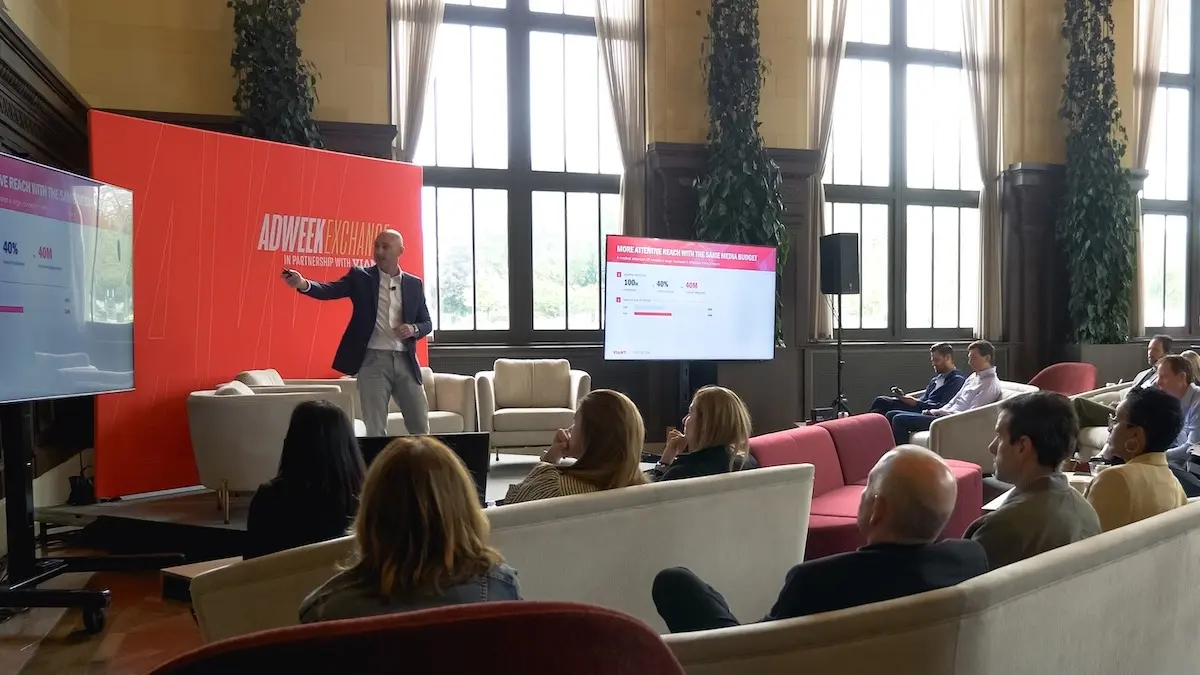
The urgent need to bridge this chasm took center stage at the ADWEEK Exchange in Detroit, the inaugural stop on a high-profile national roadshow produced in partnership with Viant. The event convened top-tier brand marketers, data scientists, and media executives to dissect a singular, pressing question: What happens in the critical space between an ad being served and a viewer actually paying attention?
Through a series of data-driven presentations and executive panel discussions, industry leaders confronted the uncomfortable reality of viewer fragmentation. They examined how attention metrics can unlock a deeper layer of accountability in Connected TV (CTV), why context and creative execution dictate whether an ad resonates or fades into background noise, and how real-time attention data is transforming from a post-campaign report card into an active, optimization engine. This report explores the key insights, data points, and strategic frameworks that emerged from Detroit, offering a roadmap for brands navigating the modern attention economy.
Detailed Chronology: From Detroit to the Future of Media Measurement
The Detroit gathering marked the opening salvo of Viant and ADWEEK’s multi-city tour across the nation’s premier advertising hubs. From the moment attendees gathered, the agenda was designed to strip away industry jargon and focus on practical solutions for media buyers grappling with signal loss, audience fragmentation, and shifting consumer habits.
Opening Insights: The Exposure-Attention Gap
The event commenced with a data-heavy keynote presentation by Yan Liu, CEO of TVision, who laid bare the statistical disconnect between TV exposure and genuine consumer attention. Liu framed the discussion around a compelling macro-statistic: the average U.S. consumer dedicates approximately 213.5 minutes—nearly four hours every single day—to television and streaming video.
However, a closer audit of that daily media diet reveals a sobering reality for advertisers. Of those 213.5 minutes, only about 24.5 minutes are allocated to advertising content. More critically, just nine minutes of that ad-supported time represent actual, measured viewer attention.
Liu walked the audience through the mechanics of passive viewing, noting that viewers are frequently present in the room without actively watching the screen, and in many instances, ads play out to an entirely empty room. In these scenarios, traditional measurement tools log a "completed view," falsely reassuring the advertiser that their message landed, when in fact, the creative played out in a vacuum.
The Creative and Contextual Catalyst
Moving beyond raw viewing figures, Liu demonstrated how attention directly impacts commercial outcomes. Drawing from a comprehensive TVision study spanning hundreds of campaigns across 20 distinct industries, Liu revealed a powerful correlation: each percentage-point increase in consumer attention corresponds to nearly a 1% increase in overall ad awareness.
Crucially, Liu emphasized that attention is not distributed randomly; it is heavily dictated by content context and viewing environments. In one striking case study, TVision tracked the performance of an identical creative asset placed across different programming genres. The data proved that the exact same ad commanded significantly higher attention when paired with sci-fi and sports content compared to news broadcasts or reality television programming.
"It’s the same creative. It’s just different context," Liu explained to the rapt Detroit audience.
To illustrate the volatile nature of real-time attention, Liu spotlighted viewership data from a high-stakes Thursday Night Football matchup between the Detroit Lions and the Buffalo Bills. The analysis uncovered unexpected behavioral shifts:
Score-Driven Engagement: Attention dipped as the point differential widened, but spiked upward as the game grew more competitive in the third quarter.
The Second-Half Surge: Counter to historical trends where viewer fatigue sets in early, the second half of the game drew noticeably higher attention than the first.
Co-Viewing Declines: The data also tracked a distinct drop in group or co-viewing after halftime, underscoring how minute-by-minute broadcast dynamics alter the living room environment.
These findings set the stage for the morning’s centerpiece panel, prompting marketers to ask: If attention fluctuates wildly based on context, creative variation, and live events, how can brands systematically operationalize these insights?
The Executive Roundtable: Translating Attention into Action
Following Liu’s presentation, ADWEEK CEO Will Lee moderated an executive panel featuring Deena Bahri, CMO of Nutrafol, Sarah Tarraf, SVP of Knowledge and Insights at Rocket, and Chris Vanderhook, Chief Operating Officer and Co-Founder of Viant.
The discussion immediately tackled the friction point between theoretical data and practical execution. Bahri admitted that she entered the session as an outright skeptic regarding whether short-term attention metrics could reliably predict long-term consumer action. However, she noted that the granularity of TVision’s findings offered a compelling framework for rethinking traditional media planning. Tarraf echoed this sentiment, raising a sophisticated question for the room: Does an ad that abruptly interrupts a streaming program cause viewers to mentally check out, or does their engagement carry over seamlessly into the commercial break?
For technology and platform providers like Viant, answering these questions has required structural evolution. Chris Vanderhook explained that Viant’s strategic focus has centered on providing buyers with superior signals for CTV procurement. By acquiring IRIS.TV—a move designed to ingest transparent, granular data about the specific content running inside streaming apps rather than relying solely on high-level app category buys—Viant gained unprecedented content visibility. Subsequent testing of TVision’s attention datasets allowed Viant to integrate these signals directly into predictive models, helping brands forecast campaign outcomes with surgical precision.
Supporting Context & Metrics: Navigating the New Media Landscape
To fully grasp the significance of the Detroit exchange, one must examine the macro-economic and technical forces reshaping the media ecosystem. The transition from linear cable to streaming-dominated households has liberated viewers from fixed programming schedules, but it has simultaneously complicated the marketer’s task.
The Anatomy of the Attention Deficit
Modern living rooms are defined by multitasking. According to various media consumption studies, over 70% of streaming viewers regularly use a smartphone or tablet while watching TV. This dual-screen reality means that capturing an impression on a connected TV screen no longer guarantees cognitive reception.
Active Attention Seconds, Gaze-Time, Contextal Relevance
Evaluation Timing
Post-campaign post-mortems
Real-time optimization and mid-flight reallocation
Data Granularity
App-level or Network-level delivery
Scene-level, genre-level, and creative-specific impact
Optimization Lever
Cost-Per-Mille (CPM) minimization
High-attention publisher shift and creative refinement
As outlined in the table above, the shift from exposure-based planning to attention-based optimization requires a complete overhaul of how marketing teams evaluate media value. Advertisers are no longer content simply buying cheap inventory; they are demanding proof that the audience is mentally present.
Case Studies in Brand Strategy: Nutrafol and Rocket
During the panel, the conversation pivoted from macro-metrics to brand-level execution, highlighting how two distinct companies—Nutrafol and Rocket—approach the challenge of earning and holding consumer attention.
Nutrafol’s Multi-Channel Harmony: Addressing the delicate balance between brand storytelling and customer acquisition, Nutrafol’s Deena Bahri discussed the brand’s recent campaigns centered on the emotional journey of improving hair health. Because the path to purchase is deeply personal and involves a long-term commitment, Nutrafol tailored its creative execution across channels without breaking narrative continuity. On CTV, the brand leveraged long-form storytelling to build emotional resonance. On social channels, they collaborated with authentic creators, while in-person touchpoints allowed consumers to experience the product tangibly. "Finding that balance between variety and consistency, I think, is the magic in great creative," Bahri noted.
Rocket’s Long-Term Awareness Strategy: Sarah Tarraf of Rocket addressed a different hurdle: marketing a high-consideration, low-frequency service like a mortgage. Because consumers rarely think about mortgages until they are ready to buy a home, Rocket’s advertising must achieve long-term memorability. Tarraf recounted an instance where internal testing revealed that viewers vividly remembered a high-profile Super Bowl spot but failed to connect it to Rocket. This insight prompted an immediate creative pivot, leading to more prominent visual branding and voiceover integration in subsequent ads. Furthermore, Rocket deployed rigorous test-and-control methodologies to prove whether exposure to specific brand campaigns drove tangible lifts in digital traffic, app interactions, and loan applications.
Official Statements and Industry Perspectives
The urgency of operationalizing attention data was further underscored during the closing remarks delivered by Tim Vanderhook, CEO and Co-founder of Viant. Shifting the narrative from theoretical measurement to active campaign management, Vanderhook issued a clear call to action for the brand marketers and media planners in attendance.
"You cut low attention providers, and you reallocate your budget to the higher attention placements that are there," Vanderhook stated, outlining a straightforward operational playbook for programmatic buyers.
Vanderhook challenged media buyers to stop treating attention data as a passive report card to be reviewed weeks after a campaign wraps up. Instead, he advocated for an active, agile workflow:
Establish Baselines: Run an initial campaign to benchmark its baseline attention score across existing publisher partners and creative assets.
Dynamic Reallocation: Actively monitor mid-flight performance, ruthlessly trimming budgets away from low-attention placements and channeling capital toward high-performing environments.
Creative Weighting: Give greater budget prioritization to creative variations that demonstrably earn sustained consumer gaze.
This methodology encapsulates the core promise of the modern programmatic supply chain: empowering brands with actionable intelligence that optimizes both media spend and creative impact in real-time.
Future Outlook: The Road Ahead for Attention-Based Media
As the ADWEEK Exchange roadshow rolls forward into other major advertising markets, the conversations sparked in Detroit are signaling a permanent shift in how the industry values media. The era of buying blind impressions based strictly on historical demo ratings is rapidly drawing to a close.
Several key trends will dictate the evolution of the attention economy over the coming years:
Standardization of Attention Metrics: As independent measurement providers like TVision refine their methodologies and platforms like Viant integrate these signals into automated buying platforms, the industry will move toward standardized benchmarks for CTV attention, mirroring the early days of viewability standards in digital display advertising.
Algorithmic Integration: Programmatic bidding algorithms will increasingly factor in attention scores alongside traditional cost metrics, allowing automated systems to optimize media delivery dynamically based on real-time viewer engagement.
The Synergy of Art and Science: Marketers will continue to realize that data alone cannot save weak creative. The true winners in the attention economy will be brands that combine rigorous, context-aware media placement strategies with emotionally resonant, highly crafted storytelling that actively commands the consumer’s gaze.
Ultimately, the insights emerging from the ADWEEK Exchange prove that while media consumption habits will continue to fragment across an ever-multiplying array of screens and services, the ultimate currency for advertisers remains unchanged: human attention. By embracing transparent data, refining creative execution, and optimizing media investments in real-time, forward-thinking brands are well-positioned to cut through the digital noise and turn passive viewers into active, engaged customers.