An authoritative guide on the European Union’s sweeping AI transparency mandates, moving past the panic to examine what actually requires a label, why UI "sparkles" fall short, and how product designers must adapt by August 2026.
Executive Overview
Over the past few weeks, a wave of apprehension has swept through tech boardrooms, legal departments, and product design studios worldwide. Sensationalized headlines have warned of “drastic measures,” “astronomical fines,” and “sweeping new AI mandates” taking effect under European Union jurisdiction.
In reality, the situation is far more nuanced—and considerably more pragmatic. The regulatory framework is not an outright ban or a blanket immobilization of artificial intelligence. Instead, it is a targeted, sensible approach to digital trust. At its core, the mandate boils down to a single principle: making AI explicitly recognizable when there is a risk that users might mistake synthetic material for human creation.
Beginning on August 2, 2026, strict AI labelling requirements become a formal legal obligation for any enterprise serving European Union citizens. Much like the European Accessibility Act (EAA) or the General Data Protection Regulation (GDPR) before it, the geographic scope of these rules is not confined to organizations headquartered within the EU. Any company, anywhere in the world, that operates within or targets the European market must comply if its AI outputs are consumed by people residing in the EU.
For product designers, UX architects, and engineering leads, this shift demands a move away from ambiguous visual shorthand—such as the ubiquitous AI "sparkle" icon—and toward clear, unambiguous, and accessible disclosures. This article breaks down what the regulations mandate, where the boundaries lie between human editing and machine generation, and how global teams can build compliance into their workflows.
Detailed Chronology and Regulatory Timeline
To understand the weight of the August 2026 deadline, it helps to contextualize the timeline of the EU AI Act’s rollout. The European Commission has steadily advanced transparency obligations as part of a phased implementation strategy designed to give organizations time to adapt.
The Legislative Foundation: The broader EU AI Act was formally adopted following extensive negotiations between the European Parliament and member states, establishing a risk-based taxonomy for artificial intelligence systems ranging from minimal risk to unacceptable risk.
Article 50 Activation: Article 50 of the AI Act specifically addresses transparency obligations for providers and deployers of certain AI systems. It dictates that users must be informed when they are interacting with AI, and that machine-generated text, audio, video, or images must be clearly marked.
The Code of Practice (Mid-2026): Ahead of the enforcement milestones, the European Commission released its final guidance and Code of Practice on the marking and labelling of AI-generated content. This included an official set of EU AI icons and strict guidelines regarding persistence and metadata.
The August 2, 2026 Enforcement Date: This is the critical juncture. From this date forward, transparency and labelling requirements transition from conceptual guidelines to enforceable mandates backed by regulatory oversight and substantial penalties for non-compliance.
What Actually Needs Labelling? Decoding Article 50
A common point of confusion is whether every single line of code, draft email, or automated image generated with the help of AI must carry a disclaimer. Fortunately, the regulations are much more targeted.
According to Article 50(4) of the AI Act, labelling obligations apply primarily in scenarios where deception or misattribution carries societal, economic, or democratic risk. Both providers (the entities that build or supply the underlying AI models) and deployers (the companies or individuals integrating and using those models in consumer-facing products) share legal responsibility. If a business licenses a third-party AI tool to generate marketing materials, it cannot bypass disclosure obligations by pointing the finger at the AI vendor.
However, the vast majority of day-to-day AI-assisted productivity work is not covered by these transparency rules. Most notably, disclosure obligations do not apply when AI-generated text has undergone substantive human review and editing, and where a named individual or entity assumes clear editorial responsibility.
Where the Disclosure Rule Applies:
Deepfakes and Synthetic Media: Any AI-generated or manipulated video, audio, or image that realistically portrays people, places, or events that do not actually exist must be transparently labelled.
Public Interest Content: If AI-generated text is published with the explicit intent to inform the public on matters of public interest—spanning health, safety, the environment, the economy, finances, politics, science, or culture—it requires clear disclosure.
Commercial and Conversational Interfaces: Systems interacting directly with natural persons must disclose that the user is communicating with an AI, unless it is entirely obvious from the context. Furthermore, marketing, advertising, and PR teams utilizing realistic AI-generated illustrations or product mockups must provide visible notices.
The Fine Line Between "Edited" and "AI-Generated"
One of the greyest areas for product teams is determining the threshold where human intervention strips away the requirement for an AI label. When an interface pre-fills a form using predictive AI, but a user subsequently modifies the text, is the final output still considered AI-generated?
The European Commission’s guidance offers clear boundaries, though some nuance remains:
Minor Assistive Edits: Basic tooling—such as automated spellcheck, grammar correction, formatting adjustments, cropping, basic color correction, and machine translation—does not constitute AI generation. These features operate as utility enhancements rather than creative content synthesis.
Substantive Generation: AI-generated summaries, composite imagery, substantial rewrites, or the programmatic addition and removal of elements from a photograph firmly cross the line into AI generation. Generating a paragraph from scratch using a large language model requires a disclosure label, whereas fine-tuning or tweaking a sentence originally authored by a human does not.
Crucially, the regulatory stance dismisses superficial workflows. A passing glance or a token "a human skimmed it before publishing" does not fulfill the requirement for editorial review. The review must be substantive, and a specific person or organization must take legal ownership of the final output.
Why AI "Sparkles" Are No Longer Enough
For years, the technology industry has relied on a shorthand visual language to denote artificial intelligence: the sparkle icon ($textsparkles$). Whether tucked into a corner of a text editor, floating above a generation button, or animating inside a mobile app icon, sparkles have universally signaled "AI-powered feature."
Under the new EU guidelines, sparkles are likely insufficient.
The European Commission has published an official set of EU AI label icons as part of its Code of Practice. These include distinct marks designed to differentiate between basic AI integration, fully generated content, and partially modified material.
The primary issue with the traditional sparkle icon is its ambiguity. In modern user interfaces, a sparkle frequently communicates that a feature uses AI (such as an AI-powered brainstorming assistant), rather than indicating that a specific piece of content was generated by a machine. This lack of precision runs counter to the EU’s demand for a "clear and distinguishable" signal.
Furthermore, the Commission has explicitly stated that simply slapping an icon onto an interface does not establish legal compliance by itself. Disclosures buried in deep footers, hidden behind multi-layered hover states, or displayed for only a fraction of a second violate the spirit and letter of the law.
Best Practices for Compliant UI Design:
Pair Icons with Plain Text: Always accompany visual markers with explicit, human-readable text such as "AI-generated" or "Synthetically produced."
Ensure Persistence: Labels cannot disappear when content is downloaded, screenshotted, or reshared. Metadata and persistent watermarking must travel with the asset.
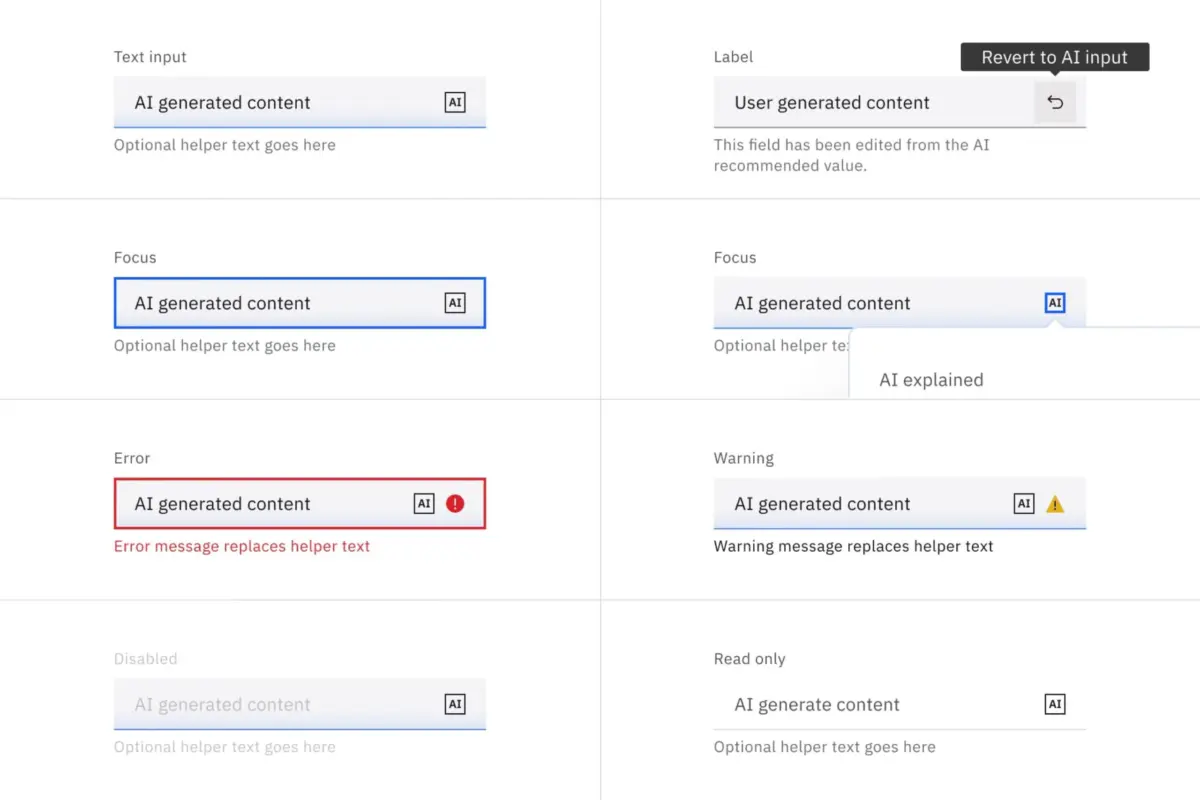
Accessibility First: Disclosures must be fully readable and navigable by screen readers and other assistive technologies. Design systems—such as IBM’s Carbon Design System, which features dedicated AI component variants—offer robust frameworks for building compliant explainability panels and inline tags.
A Global Regulatory Pattern
While European legislation often triggers groans from international product teams accustomed to a fast-moving regulatory landscape, the EU AI Act is not an isolated phenomenon. It represents a broader global convergence toward synthetic media transparency:
United States: State-level legislation has proliferated rapidly, targeting specific use cases such as synthetic human performers in entertainment, AI-driven political advertising, and automated hiring decisions. Federal agencies are similarly stepping up enforcement against deceptive AI practices.
Asia-Pacific: Jurisdictions across Asia have introduced stringent content-marking requirements for generative AI service providers, emphasizing watermark embedding and traceable provenance data.
Product and engineering leads must recognize that AI labelling is becoming a baseline global design pattern rather than a regional exception. Shipping AI features without a cross-functional strategy for transparency is an unnecessary business risk.
Future Outlook: Embracing Clarity
Panic and confusion are natural reactions to the arrival of major new regulatory frameworks. However, the underlying intent of the EU’s transparency obligations is straightforward and beneficial for the digital ecosystem as a whole:
When artificial intelligence generates content that could easily be mistaken for human work, creators and platforms must say so clearly, obviously, and unambiguously.
By removing ambiguity, these regulations help users navigate the digital landscape, separating genuine human creativity from automated noise. For product designers, developers, and UX professionals, viewing these requirements not as a bureaucratic hurdle, but as an opportunity to build deeper trust with users, will define the next era of AI interface design.