

By Investigative Staff
Published: October 26, 2026
Executive Overview
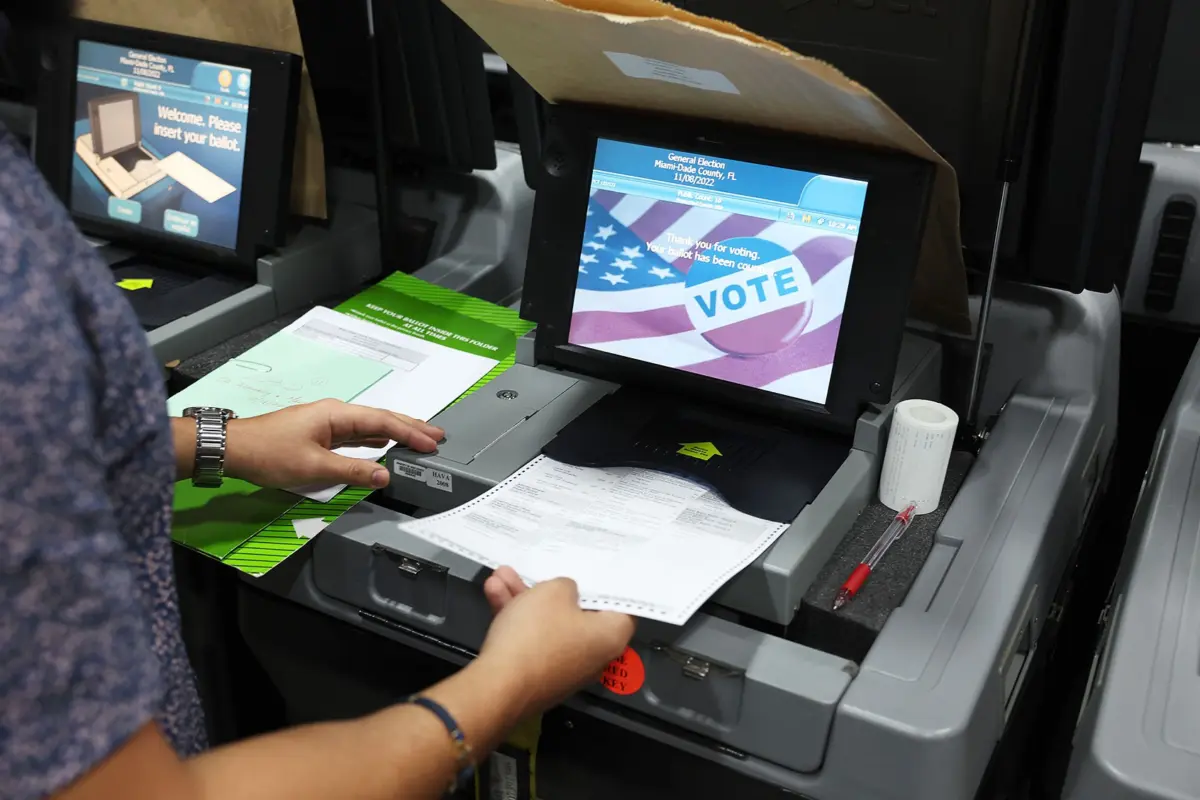
Months into Donald Trump’s second presidential term, political appointees within the Department of Homeland Security (DHS) issued a controversial directive to the nation’s premier civilian cybersecurity defense agency: covertly procure a voting machine and breach its software.
The objective, according to multiple former administration officials with direct knowledge of the directive, was to examine the hardware and compile findings directly for the White House. Career staffers at the Cybersecurity and Infrastructure Security Agency (CISA) reacted with alarm. CISA’s founding mandate is to fortify critical infrastructure and assist in thwarting malicious actors—not reverse-engineer voting devices for internal executive oversight. Furthermore, appointees instructed staffers to withhold any notification to the machine manufacturer if vulnerabilities were discovered, a direct violation of standard vulnerability-disclosure protocols.
Fearing they were being co-opted into a political interference campaign, CISA personnel repeatedly pushed back, noting that the agency lacked the operational capacity to fulfill the request. Crucially, the elite teams capable of executing such an assessment had recently been terminated under sweeping personnel cuts spearheaded by Elon Musk’s Department of Government Efficiency (DOGE) initiative. The appointees ultimately dropped the matter, but the episode highlights a profound institutional shift: an administration that publicly warns of widespread election vulnerabilities has simultaneously hollowed out the very federal agency tasked with protecting the nation’s voting systems.
Throughout Trump’s second term, CISA has been subjected to dramatic staff reductions, budget slashing, and a near-total withdrawal of logistical and intelligence support to state election authorities. For state officials tasked with orchestrating the 2026 midterm elections, the federal government’s sudden absence during critical planning cycles has severed decades of fragile, hard-won trust.
Detailed Chronology: From Critical Infrastructure to Internal Crisis
The Evolution of CISA and the 2016 Turning Point
Defending American democratic infrastructure from cyber threats was not always part of the DHS portfolio. Throughout the mid-1990s and 2000s, a series of sophisticated cyberattacks exposed vulnerable federal systems, culminating in a 2007 breach of the Pentagon that resulted in terabytes of sensitive data being siphoned by an unknown foreign adversary—an incident intelligence leaders privately labeled an "espionage Pearl Harbor."
In response, the George W. Bush administration reorganized DHS, creating the National Protection and Programs Directorate to safeguard critical infrastructure, from chemical plants to the Super Bowl. In 2018, President Trump signed legislation formally transforming this directorate into CISA, designed to function as an elite technological support desk for national infrastructure.
However, tensions quickly emerged regarding foreign interference. Following widespread Russian disinformation campaigns and cyber operations targeting political party committees during the 2016 election, DHS leadership recognized an urgent national security threat. In January 2017—just before Trump took office—DHS designated American election systems as "critical infrastructure," placing polls and voting technology under the watch of what would become CISA.
Building Trust and the 2020 Safeguards
Initially, state election authorities and voting machine vendors were deeply skeptical of federal involvement, fearing data leaks or federal overreach. Over the years, however, CISA forged a fragile trust under the leadership of Director Chris Krebs.
CISA implemented penetration testing, tabletop simulation exercises, and classified intelligence briefings for secretaries of state. The agency also funded sensor technology designed to detect malicious digital activity across state election networks.
When Trump refused to concede the 2020 presidential election, claiming widespread fraud, CISA served as a critical institutional guardrail. In November 2020, a coalition of state officials, industry vendors, and federal cyber experts—operating under CISA—issued a public statement declaring the election "the most secure in American history." When Krebs publicly debunked the administration’s claims, Trump terminated him via social media. Shortly thereafter, CISA and FBI leadership played an instrumental role in convincing then-Attorney General Bill Barr that post-election anomalies were attributable to human error rather than systemic fraud.
The Second Term and the DOGE Reductions
When Donald Trump returned to the White House in
January 2025, his administration immediately targeted CISA. Administrative restructuring and sweeping layoffs—accelerated by DOGE—shrank the agency by roughly one-third, eliminating more than 1,000 employees. Teams responsible for threat intelligence, state coordination, and disinformation mitigation were effectively dismantled.
By the time state and local election administrators began preparations for the 2026 midterm elections, CISA’s operational presence had largely vanished. State leaders reported receiving no assistance, guidance, or communication during the vital initial phases of election preparation.

Supporting Context & Metrics
The systematic downscaling of federal cyber support has left measurable gaps in state-level defenses. Key metrics and policy shifts underscore the current landscape of election administration:
- Staff Reductions: CISA has shed over 1,000 personnel during Trump’s second term, reducing its workforce by approximately 33%.
- Budget Proposals: The administration’s 2027 federal budget proposal outlines an additional $700 million funding reduction for the agency, which analysts project could necessitate another 900 layoffs.
- Information Sharing Breakdown: The unauthorized declassification and publication of raw, sensitive 2020 election data—information originally submitted to CISA under confidentiality agreements—has severely damaged intergovernmental data-sharing partnerships.
- Security Lapses: Independent security reporting revealed multiple administrative missteps, including acting leadership utilizing unsecure AI tools for sensitive government logs and accidental public exposure of internal cloud infrastructure keys.
The Erosion of Intergovernmental Trust
The breakdown in relations was further exacerbated by the Trump administration’s decision to declassify and release sensitive data logs provided by state authorities to CISA following the 2020 election. State election officials viewed the public release of these proprietary monitoring logs as a betrayal of long-standing confidentiality agreements.
"They’ve violated the entire premise of that information-sharing relationship," noted a former high-ranking federal cybersecurity official who now advises state governments. "There’s no way state governments are ever going to give any information to CISA, and it’s unclear if they ever will in the future."
In addition, high-profile security oversights—such as reports that acting CISA leadership uploaded records to unsecure AI platforms, and independent disclosures of leaked internal cloud keys on public GitHub repositories—have deepened concerns regarding the agency’s operational integrity and data handling protocols.
Official Statements and Responses
The White House has consistently defended the administration’s record on election integrity while deflecting specific inquiries regarding CISA’s operational status.
"President Trump has done more than any other President to ensure we have free and fair elections," stated White House spokesperson Lauren Bis in an email response. Regarding the release of confidential election monitoring logs, Bis added, "The release of such information is exactly the sort of transparency news organizations should applaud."
DHS and CISA leadership declined multiple interview requests and did not respond to detailed lists of written questions. However, acting CISA Director Nick Andersen convened a late-summer video conference with state election officials in August 2026 to introduce a newly formulated, late-stage election security plan.
The presentation was met with intense skepticism. State leaders, who had spent over a year preparing for the midterms without federal partnership, openly challenged the timing and motives of the agency’s sudden re-engagement.
"I told him I didn’t trust him," said Arizona Secretary of State Adrian Fontes, reflecting on the call. "I did raise my voice a little bit, because I’m frustrated—very frustrated—that they would have the temerity to come in, clear the entire deck of competent professionals, stop supporting the states, eviscerate the coordination efforts that they had and then suddenly come in and say: ‘Oh, we’re from the federal government. We’re here to help.’"
Future Outlook
As the nation navigates the 2026 midterm elections, state and local authorities have increasingly turned to private vendors and independent nonpartisan organizations—such as VoteShield and the Center for Election Innovation and Research—to bridge the security gaps left by the federal withdrawal.
While CISA published a 13-page election security plan in late September 2026 emphasizing its statutory commitment to safeguarding voting infrastructure, state election officials view the document as largely symbolic.
"For CISA to promise election officials now, at this point in time, that they are going to be a resource for the 2026 election is too little, too late," said Maine Secretary of State Shenna Bellows.
With federal intelligence channels compromised and institutional trust severely fractured, election administrators nationwide are left to rely exclusively on local infrastructure safeguards, bracing for potential political fallout and contested outcomes as the democratic process unfolds.