

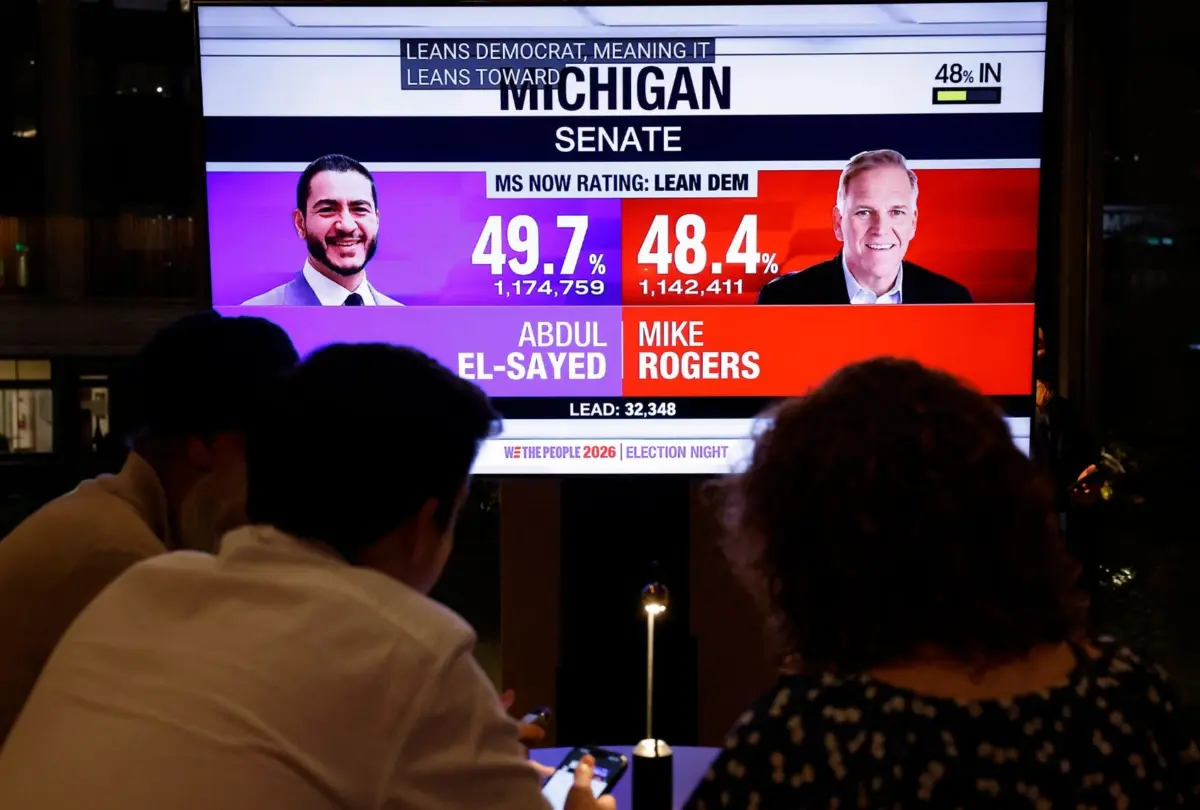
The 2026 midterm elections delivered a seismic political shift across the United States, culminating in a sweeping Democratic "blue wave" that dramatically altered the balance of power in Washington and state capitals alike. Beyond the raw numbers—which saw Democrats capture majorities in both the House and the Senate—the night marked a profound psychological turning point for major cable news networks.
For years, outlets such as CNN and MS NOW (formerly MSNBC) navigated an era defined by institutional hostility, corporate consolidation, and the pervasive shadow of the Trump administration. On election night 2026, however, these beleaguered networks traded their trademark funerary tone for unbridled optimism. From Van Jones’s scathing "Jonestown" critique of the Republican Party to Symone Sanders-Townsend’s tearful reflections on historic representation, the evening’s coverage served as both a chronicle of a political realignment and a therapeutic release for an audience and press corps exhausted by a decade of democratic strain.
Detailed Chronology: An Election Night of Historic Upsets
As the first precincts closed on November 3, 2026, the atmosphere within major newsrooms was heavily freighted with anticipation. Following years of polling anomalies and aggressive legal and political challenges directed at mainstream media outlets, anchors and analysts approached the data streams with cautious professionalism.
Early returns, however, quickly dispelled any notions of a routine midterms cycle. By mid-evening, veterans of the big boards—including MS NOW’s Ali Velshi and CNN’s John King—were tracking anomalies that pointed not merely to a conventional legislative rebuke, but to a systemic collapse of the incumbent administration’s party lines.
[Timeline of Key Election Night Milestones]
  ├── Early Evening: Precincts close; early data reveals unexpected Democratic momentum.
  ├── Prime Time: John King breaks down map shifts, dubbing the trend a "shellacking" and "repudiation."
  ├── Late Night: Democrats secure decisive victories in key congressional and gubernatorial races.
  └── Post-Midnight: Network analysts deliver defining monologues, pivoting from analysis to collective catharsis.
The Map Shifts and the Big Board Breakdown
John King’s deployment of CNN’s Magic Wall illustrated the stark contrast between the electoral map of 2024 and the deep-blue surge of 2026. Grappling with the velocity of the data, King questioned live on air: "What’s happening right now? What’s the right word? Is it a rebuke? Is it repudiation? Is it a shellacking? Is it a spanking? I mean, at the moment, this is the collapse of the president’s party on live television as you watch it play out."
Meanwhile, over at MS NOW, Ali Velshi energized viewers with rapid-fire data analysis. Stepping into the space left by former colleagues, Velshi traversed the network’s Big Board to unpack unexpected Democratic triumphs, such as a fiercely contested race in South Carolina. Pausing mid-breakdown, Velshi captured the surreal mood of the newsroom, remarking to the camera, "This is a totally weird conversation that we are having. Right?"
Rachel Maddow similarly seized the evening’s narrative arc from the opening broadcast. Observing that Americans were utilizing democratic mechanisms in record numbers, Maddow’s commentary grew increasingly ebullient as races were called. Her projection of Pennsylvania’s 8th congressional district for Democratic Scranton Mayor Paige Cognetti—while playfully jabbing the Republican opponent—signaled a broader, celebratory pivot across center-left media landscapes.
Supporting Context & Metrics: A Changing Media and Political Landscape
The 2026 midterms did not occur in a vacuum; they unfolded against a backdrop of deep structural transformation within both American politics and the media industry itself.
The Corporate Pressures on Cable News
Both CNN and MS NOW entered the 2026 cycle operating under intense corporate scrutiny and institutional uncertainty:
- MS NOW: Recently spun off from NBCUniversal under parent group Versant, the network has embraced a scrappier, more agile editorial stance.
- CNN: Part of Warner Bros. Discovery during the election, the network faced an impending transition under Skydance and its Trump-allied investor David Ellison.
This corporate precarity had previously imparted an undertaker’s gravity to anchors like Anderson Cooper, who viewed the future of mainstream journalism through a lens of existential vulnerability. The stark juxtaposition between this underlying corporate anxiety and the joyful reality of the election results made the anchors’ on-air celebrations all the more striking.
Voter Motivation and Historic Milestones
While exit polls pointed to widespread economic anxieties—principally the high cost of basic goods—analysts like Chris Hayes emphasized that economic hardship alone could not account for the sheer depth of the Democratic upsets. "The rot that is coming from the top of the country is very, very, very clearly on voters’ minds," Hayes noted during MS NOW’s panel coverage.
The night was equally defined by historic barrier-breaking achievements across the map:
- New Hampshire: Voters elected Democrat Chris Pappas to the U.S. Senate, making him the first openly gay man to serve in the chamber.
-
Texas: Demonstrating unexpected demographic and political shifts, Texas trended blue in several key statewide
contests.
- Georgia: Former Atlanta Mayor Keisha Lance Bottoms won the gubernatorial race, making her the first woman and the first Black person to be elected governor of Georgia, as well as the nation’s first female Black governor.
Official Statements & On-Air Commentary
The human element of the 2026 midterms was best captured by the unfiltered reactions of prominent commentators who had spent the preceding decade analyzing the erosion of democratic norms.
Van Jones’s "Jonestown" Monologue
Perhaps the most viral rhetorical moment of the evening belonged to CNN commentator Van Jones. Sitting directly across from chastened Republican pundit Scott Jennings, Jones delivered a searing post-mortem on the state of the GOP:
"If you join a cult, at some point the cult leader takes you to Jonestown and tries to get you to drink the Kool-Aid. This is Jonestown for the Republican Party. They drank the Kool-Aid, and they have candidates that are dropping like flies across the country because they did not stand up to this guy when he was doing things that were wrong… That’s where you are tonight, Republicans."
Later, Jones encapsulated the progressive elation of the room by describing the election results as "like Christmas and a birthday and an Easter bunny and Halloween!"
Symone Sanders-Townsend on Representation and Resilience
In a moment of profound emotional resonance, MS NOW’s Symone Sanders-Townsend provided vital context regarding the historic victory of Keisha Lance Bottoms in Georgia. Reflecting on the emotional toll of the 2024 presidential cycle, Sanders-Townsend shared her vulnerability on live television:
"After the 2024 presidential election, for myself and Black women all over this country, it felt like a repudiation of us. There were Black women, myself included, that felt like, ‘Well, maybe America just does not want us.’"
Wiping away tears, she contrasted that pain with the empowering reality of Bottoms’s victory—a win that not only placed a historic figure in the governor’s mansion but ensured a staunch institutional defender of democratic processes would occupy a critical seat of power ahead of the 2028 presidential cycle.
Future Outlook
The events of November 3, 2026, signal a critical inflection point for American governance, journalism, and political strategy.
- Legislative Re-alignment: With control of both the House and Senate shifting to the Democrats, the federal legislative agenda will experience a sharp pivot, halting the momentum of Trump-aligned policies and opening avenues for progressive and moderate legislative packages.
- Media Adaptation: For networks like CNN and MS NOW, the return of network optimism—tempered by ongoing corporate restructuring—proves that audiences are eager for narrative validation during times of political change. However, the looming ownership transitions suggest that the operational tightrope walked by journalists will remain taut.
- The 2028 Horizon: The emergence of resilient state-level leadership, exemplified by figures like Governor-elect Keisha Lance Bottoms in Georgia, establishes a new power grid for the Democratic Party. As these leaders take office, they will serve as key institutional bulwarks in safeguarding electoral integrity leading into the next presidential cycle.
Ultimately, while peddling optimism may not formally be the job of a journalistic enterprise, the 2026 midterms demonstrated that when a nation steps back from the brink of institutional erosion, the press and the public alike can finally permit themselves to exhale, find relief, and rediscover hope.
