

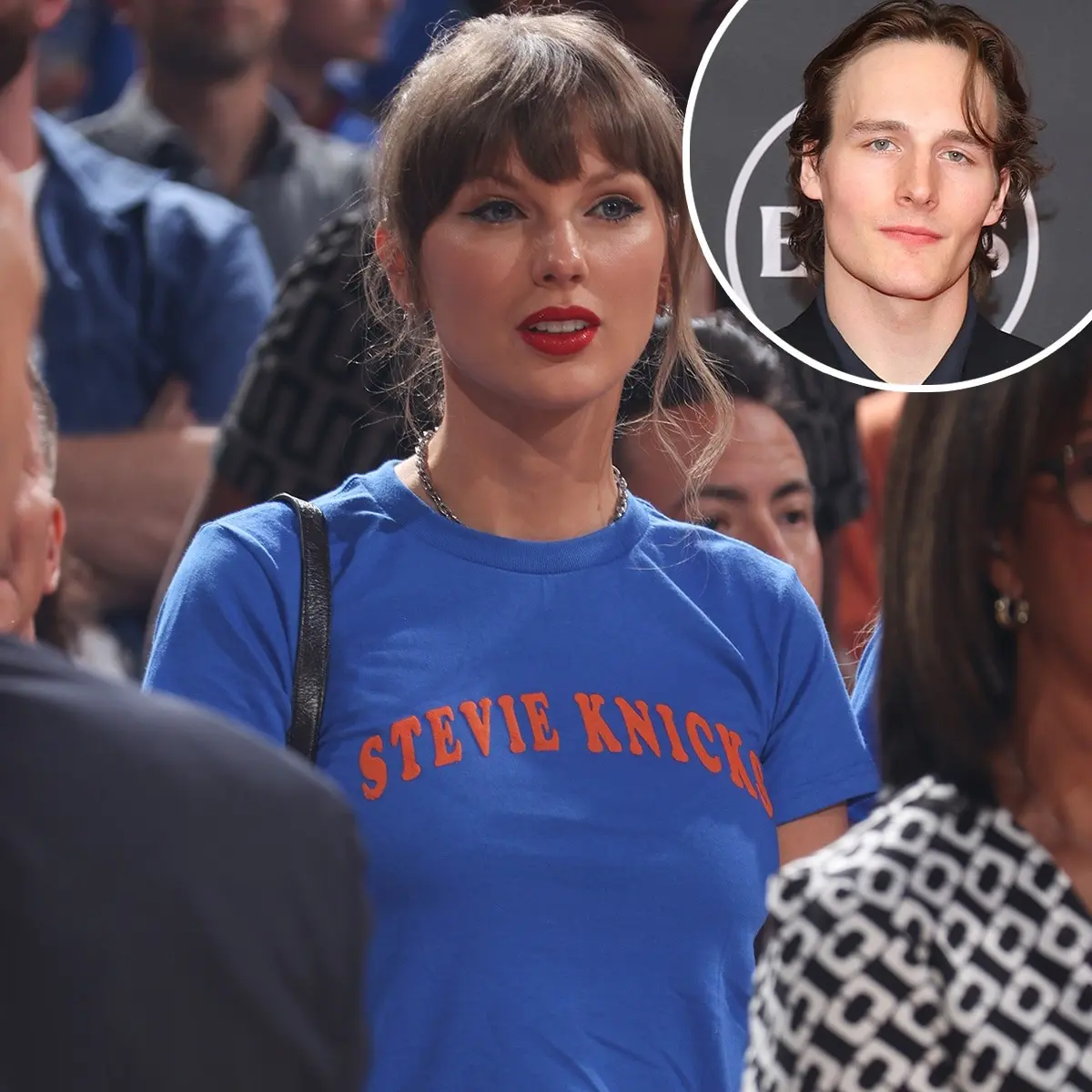
In the high-stakes intersection of professional sports, pop culture, and global celebrity branding, few names command the collective attention of the media quite like Taylor Swift and Travis Kelce. Recently, however, the cultural spotlight pivoted to an unexpected arena: the front office and hardwood of Madison Square Garden. What began as a casual, off-the-cuff remark by a professional athlete quickly snowballed into a multi-day sports media cycle, forcing the storied New York Knicks organization to formally defend one of its most high-profile supporters.
The drama unfolded when Knicks point guard Tyler Kolek, during an interview with the NBA 2K League alongside teammate Miles James "Deuce" McBride, was asked to identify the "fakest celebrity fan" seen sitting courtside at NBA games. Kolek pointed a direct finger at the Grammy-winning pop icon, characterizing her attendance as performative and suggesting she was merely a fair-weather spectator rather than a genuine devotee of the orange and blue. The comments immediately ignited the formidable digital defense force known worldwide as the Swifties, while sending shockwaves through sports talk radio and basketball blogs.
Recognizing the gravity of alienating a global cultural force—especially one with deep historical ties to Manhattan’s most famous arena and a proven track record of boosting franchise visibility—the Knicks organization took swift and decisive action. In an official statement released to E! News, the franchise strongly rebuffed Kolek’s claims, asserting that Swift’s fandom is long-standing and deeply rooted.
This incident highlights a broader tension in modern sports culture: the uneasy coexistence of traditional, hyper-local sports fandom and the ultra-modern phenomenon of celebrity-driven entertainment. As the lines between Hollywood, pop music, and professional sports continue to blur, this episode serves as a fascinating case study in brand management, public relations, and the sheer economic and cultural power wielded by Taylor Swift and her husband, NFL star Travis Kelce.
Detailed Chronology: From Casual Remark to Corporate Defense
The controversy materialized during a seemingly innocuous media engagement for the NBA 2K League. Tyler Kolek, a 25-year-old point guard entering his third season with the Knicks, sat down alongside teammate Miles James "Deuce" McBride for a video feature published on YouTube on November 5. The conversation drifted toward courtside culture, prompting the prompt: "Who’s the fakest celebrity fan you’ve seen sitting courtside in an NBA game?"
Kolek, attempting to keep his commentary candid, didn’t hold back. "At the Knicks games, I would say it’s very performative," Kolek remarked, adding that many celebrities "just want to be seen at the game, they’re not necessarily fans." He specifically singled out Swift, noting that while she had been spotted at a few playoff games, "I don’t know if I’ve seen her at any other games."
Recognizing the immediate danger of offending one of the most dedicated fandoms on earth, McBride—then 26—interjected with a dose of self-awareness. "Swifties not gonna like that answer," he warned, a prediction that proved prophetic within minutes of the video’s release.
While Kolek did offer a minor concession, noting that the "Fortnight" singer likely had a packed schedule that prevented regular attendance, the damage was done. The comments were clipped, shared across X (formerly Twitter), TikTok, and Instagram, and amplified by entertainment outlets worldwide.
Realizing the potential public relations misstep, the Knicks front office intervened less than 24 hours later. On November 6, a team spokesperson issued a definitive statement to E! News: "Taylor Swift has been a Knicks fan for many years, has a long history with Madison Square Garden, and we are incredibly appreciative of her support of the organization."
This rapid corporate pivot reflects the delicate ecosystem of modern sports franchises, where celebrity endorsements and high-profile courtside sightings are leveraged heavily for mainstream cultural relevance. By stepping in to protect Swift, the Knicks effectively neutralized the controversy, reaffirming their commitment to their celebrity benefactors.
Supporting Context & Metrics: Swift’s True Footprint in the NBA
To understand why the Knicks moved so quickly to defend Taylor Swift, one must examine the tangible impact of her presence during the team’s historic 2025–2026 championship run. Fandom in the modern era is measured not just by historical knowledge of a franchise’s box scores, but by visibility, merchandise sales, and media amplification—metrics in which Swift holds unmatched currency.
During the Knicks’ triumphant run through the 2026 NBA playoffs, Swift was far from a passive observer. Her most notable appearance came during Game 4 of the postseason, where she sat courtside alongside close friends Alana Haim, Este Haim, and Mariska Hargitay. True to form, Swift leveraged her fashion choices to make a statement, sporting custom, pun-laden New York Knicks merchandise—including a now-iconic t-shirt reading "Stevie Knicks."
Her support extended beyond Manhattan. Later in the spring, Swift and her husband, Travis Kelce—whom she married in a high-profile ceremony at Madison Square Garden on July 3—traveled to Ohio to serve as vocal cheerleaders for the team during the Eastern Conference Finals against the Cleveland Cavaliers at Rocket Mortgage FieldHouse. The cultural weight of their attendance was underscored by a bizarre yet telling artifact auction: the exact arena chair Swift occupied during the game was later put up for auction by The Realest and fetched a staggering $7,000.
This is not the first time Swift’s basketball allegiances have been publicly questioned. During a June 10 broadcast of the NBA Finals, prominent sports analyst Monica McNutt playfully exclaimed on-air: "Is that Taylor Swift down there? She’s not a Knicks fan. Get out of here girl." Much like Kolek, McNutt quickly realized the cultural force she was poking fun at. By June, McNutt had publicly walked back the comment, telling TMZ, "Shoutout T-Swift. We can be united."
Furthermore, Swift operates within a vast constellation of genuine, card-carrying celebrity Knicks fans who populate Madison Square Garden’s coveted courtside seats. The franchise’s celebrity ecosystem includes legendary names whose loyalty is unquestioned:
- Spike Lee: The quintessential New York filmmaker who views the franchise as a "team of destiny."
- Ben Stiller: The acclaimed director who famously stated he would trade an Academy Award for a Knicks championship title.
- Timothée Chalamet and Kylie Jenner: Regular fixtures at MSG, anchored by Chalamet’s lifelong fandom passed down by his grandmother.
- Cardi B and Stefon Diggs: Who officially debuted their romance courtside at a Knicks-Celtics showdown.
- Anne Hathaway, Jon Stewart, Tracy Morgan, and Larry David: A robust roster of New York natives whose dedication to the orange and blue spans decades.
When placed in this context, Swift’s active participation in the Knicks’ recent championship glory positions her not as an interloper, but as part of a rich tradition of New York cultural royalty supporting the team.
Official Statements and Industry Reactions
The collision between Tyler Kolek’s candid player perspective and the corporate realities of NBA public relations provides a fascinating look at how sports organizations navigate modern celebrity culture.
Kolek’s critique was rooted in a player’s mindset—one that values grinding through an 82-game regular season and often views casual or occasional observers with a degree of skepticism. In professional sports, authenticity is currency, and players who sweat on the court can occasionally harbor skepticism toward those who simply occupy expensive floor seats for the cameras.
However, the modern NBA is inextricably linked to the entertainment industry. Madison Square Garden is as much a stage for global pop culture as it is a basketball arena. The Knicks’ official statement was a masterclass in corporate diplomacy, carefully balancing respect for their young player’s competitive drive while firmly protecting a multi-million-dollar brand asset:
"Taylor Swift has been a Knicks fan for many years, has a long history with Madison Square Garden, and we are incredibly appreciative of her support of the organization."
Media analysts pointed out that alienating Swift—whose global reach encompasses hundreds of millions of engaged consumers—would be a catastrophic public relations error for any sports franchise looking to capture younger, cross-demographic audiences. By quickly establishing that Swift is considered an institutional ally, the Knicks effectively closed the book on the debate, ensuring that player candor did not morph into corporate friction.
Future Outlook: The Intersection of Pop Culture and Professional Sports
As the NBA looks toward the future, the integration of high-profile celebrities into nightly broadcasts is only accelerating. The "Kelce-Swift effect," which famously revolutionized viewership metrics and merchandise sales across the National Football League (NFL) during the 2023–2024 season, has permanently altered how sports leagues view entertainment partnerships.
For the New York Knicks, having Taylor Swift and Travis Kelce—now newlywed fixtures of the celebrity landscape following their July Madison Square Garden wedding—associated with the franchise is a massive win. As Kelce recently teased preparations for celebrating their first holiday season as a married couple, the couple continues to dominate headlines across both sports and entertainment sectors.
Tyler Kolek’s remarks, while momentarily disruptive, ultimately served to underscore the immense cultural gravity that Swift commands. In the modern sports landscape, criticism from a player only serves to amplify a celebrity’s presence, prompting institutions to rally around their high-profile supporters with unprecedented speed.
Ultimately, the brief "Knicks fan controversy" proved that while athletes may debate the authenticity of courtside spectators, front offices understand the bottom-line reality: in the arena of modern sports entertainment, having Taylor Swift in your corner is a championship-level advantage.
