

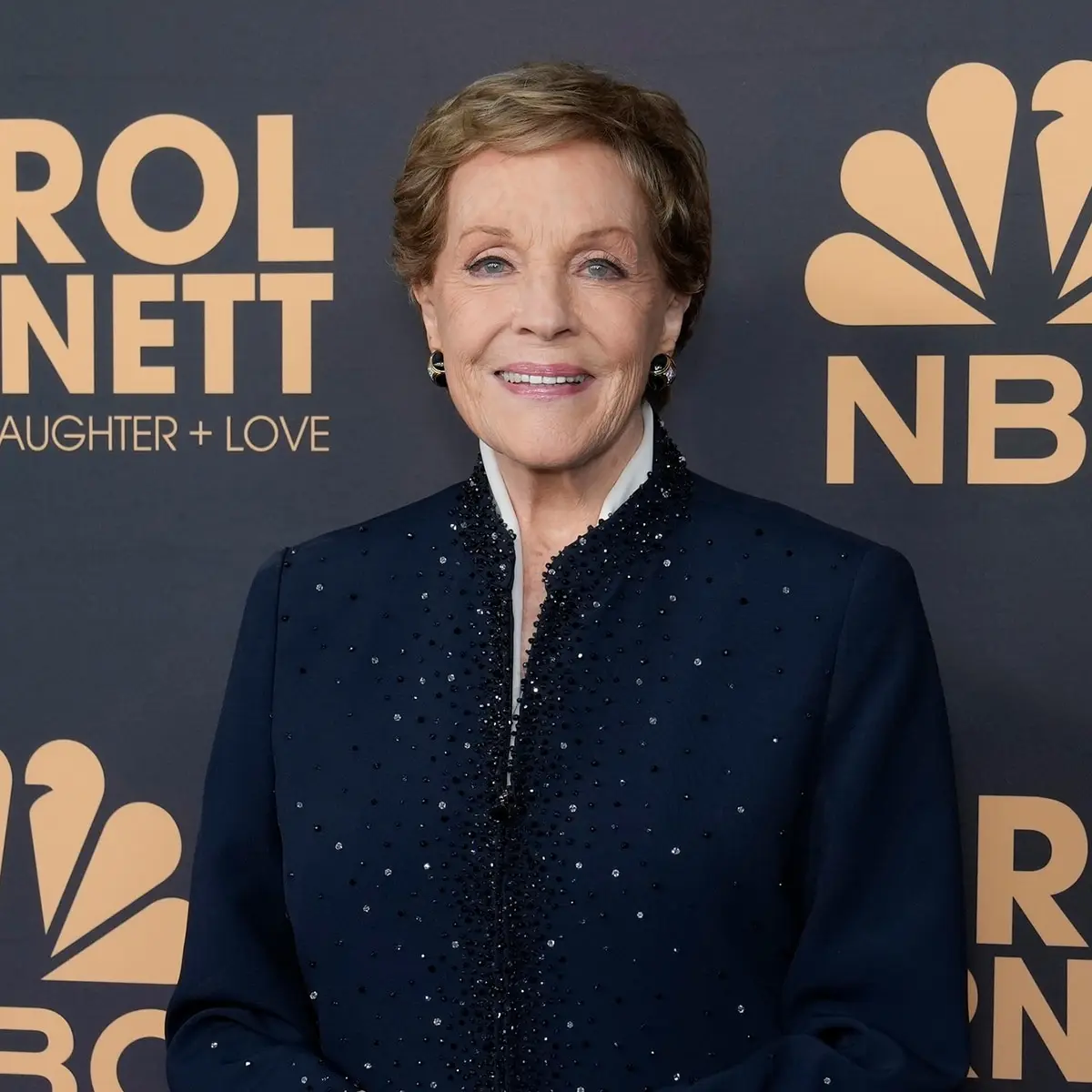
THE HAMPTONS, NEW YORK — In a rare public sighting that instantly captured the attention of entertainment journalists and devoted fans alike, legendary screen and stage icon Dame Julie Andrews was spotted stepping out in The Hamptons on October 16. Marking one of her few public appearances since celebrating her milestone 91st birthday just three weeks prior, the Sound of Music actress appeared relaxed, vibrant, and effortlessly chic. Photographed exiting a vehicle, Andrews sported a practical yet stylish purple rain jacket layered over a pristine white coat, completed by a white baseball cap and rose-tinted sunglasses.
While the casual sighting was a delightful surprise for onlookers, it arrives against the backdrop of a profound professional transition. Nearly three months prior to her autumn outing, Andrews officially confirmed what many in the industry had long suspected: her illustrious, decades-spanning career in front of the camera has officially drawn to a close.
For generations of filmgoers, the name Julie Andrews is synonymous with cinematic royalty. From her iconic, career-launching film debut in Disney’s Mary Poppins (1964)—which netted her an Academy Award for Best Actress—to her immortal portrayal of Maria von Trapp in The Sound of Music (1965), Andrews helped define the golden age of the movie musical. Her crystalline soprano voice, impeccable comedic timing, and innate elegance made her one of the most beloved figures in global entertainment.
Yet, as the entertainment industry looks toward the future, it must formally bid adieu to the prospect of seeing Andrews grace live-action cinematic frames. In a candid series of interviews, the Oscar-winning actress clarified that while her creative spirit burns as brightly as ever, her energy has shifted toward off-screen literary and auditory endeavors. Consequently, her absence from upcoming high-profile projects—most notably Disney’s highly anticipated Princess Diaries 3—marks the definitive turning of a monumental page in Hollywood history.
Detailed Chronology: From Golden Age Stardom to Literary & Auditory Realms
To truly appreciate Julie Andrews’ current lifestyle and her deliberate step away from the cinematic spotlight, one must examine the sweeping arc of a career that spans more than eight decades.
[1935–1950s] Early Beginnings & Broadway Stardom
       │
       ▼
[1964–1965] Cinematic Breakthrough (Mary Poppins & The Sound of Music)
       │
       ▼
[1982] Critical Acclaim (Victor/Victoria)
       │
       ▼
[2001–2004] Modern Renaissance (The Princess Diaries Franchise)
       │
       ▼
[Present Day] Off-Screen Pursuits (Book Author, Bridgerton Narrator, Podcast & Voiceover Work)
The Formative Years and Stage Triumph (1935–1959)
Born Julia Elizabeth Wells in Walton-on-Thames, Surrey, England, Andrews displayed an extraordinary four-octave vocal range at a remarkably young age. Encouraged by her stepfather, Ted Andrews, she began performing on the British vaudeville circuit as a child prodigy. By her late teens, her luminous soprano voice and pristine diction propelled her across the Atlantic to Broadway.
Andrews captured American audiences in theatrical milestones such as The Boy Friend (1954) and originated the iconic role of Eliza Doolittle in the smash-hit stage musical My Fair Lady (1956). Despite her monumental success on stage, Hollywood infamously passed her over for the film adaptation of My Fair Lady in favor of Audrey Hepburn—a snub that ultimately cleared the way for Walt Disney to cast Andrews in a role that would alter cinema history forever.
The Hollywood Crown Jewels (1960–1989)
In 1964, Andrews made her feature film debut in Mary Poppins. The role of the magical, no-nonsense nanny catapulted her to international superstardom and earned her the Academy Award for Best Actress. The following year, she starred as Maria von Trapp in The Sound of Music, which shattered global box-office records and became one of the highest-grossing films of all time.
Throughout the late 1960s, Andrews starred in a diverse array of projects, including Thoroughly Modern Millie (1967), Star! (1968), and Darliling Lili (1970). When the traditional movie musical fell out of favor in Hollywood during the 1970s, Andrews successfully pivoted to television, hosting her own variety shows and later collaborating with her second husband, visionary director Blake Edwards. In 1982, she delivered a critically acclaimed, daring dual performance in Edwards’ gender-bending comedy Victor/Victoria, earning her third Oscar nomination.
The Modern Renaissance and Generational Reintroduction (2000–2010s)
For an entire generation of 2000s moviegoers, Andrews experienced a massive career renaissance when she was cast as Queen Clarisse Renaldi in Garry Marshall’s sleeper hit The Princess Diaries (2001) alongside Anne Hathaway. Reprising the role in The Princess Diaries 2: Royal Engagement (2004), Andrews introduced her regal charm, sharp wit, and comforting presence to a brand-new audience of young fans.
Concurrently, Andrews lent her unmistakable voice to major animated blockbusters. She voiced Queen Lillian in the Shrek franchise (starting in 2004) and voiced Queen Karathean in DC’s cinematic universe hit Aquaman (2018).
The Transition to Literary and Auditory Mastery (2020–Present)
In recent years, Andrews has embraced a different kind of artistic expression. Operating away from the physical strains of film sets, she has dedicated her time to writing, podcasting, and voiceover work. Alongside her daughter, author and producer Emma Walton Hamilton, Andrews has co-authored more than three dozen children’s books, fostering a passion for literacy and storytelling in young minds.
Furthermore, millions of modern television viewers know her voice intimately as the razor-sharp, gossipy narrator Lady Whistledown in Netflix’s global phenomenon Bridgerton. Through this vocal performance, Andrews maintains an active, influential presence in contemporary pop culture without ever needing to step in front of a live-action camera lens.
Supporting Context & Metrics: Analyzing Andrews’ Historic Legacy
To quantify the enduring cultural footprint of Julie Andrews, one must look at the staggering metrics, accolades, and milestones that define her extraordinary career:
- Academy Award Recognition: Andrews was nominated for three Academy Awards for Best Actress, securing the win in 1965 for Mary Poppins and receiving subsequent nods for The Sound of Music (1965) and Victor/Victoria (1982).
- Literary Output: In collaboration with her daughter, Emma Walton Hamilton, Andrews has co-authored 36 children’s books, many of which have achieved New York Times bestseller status.
- Box Office Dominance: The Sound of Music held the title of the highest-grossing film in history for five years, unseating Gone with the Wind, and remains one of the most widely viewed cinematic treasures globally.
- Vocal Range: Celebrated for her pristine, operatic soprano voice, Andrews commanded a four-octave vocal range during her prime performance years.
- Theatrical Royalty: She originated two of the most iconic roles in Broadway history: Eliza Doolittle in My Fair Lady and Queen Victoria in Camelot.
Official Statements: In Their Own Words
The decision to officially step away from on-camera acting was not made lightly, but Andrews has approached her retirement from physical film sets with characteristic grace, humility, and pragmatism.
Julie Andrews on Her On-Screen Retirement
In an expansive interview with The Hollywood Reporter in August, Andrews reflected honestly on her physical and professional limitations at age 91:
"I think the absolute truth is that I think I’m really past all that now. I’m not completely retired, but it’s a different kind of work that I do these days—[writing] books, and I do a lot of recording of podcasts and voiceovers."
Expounding upon her creative fulfillment in InStyle, Andrews emphasized that her choice to stop filming is rooted in a desire to preserve the legacy of her past work rather than any lack of enthusiasm:
"It isn’t that I’m not enthusiastic for it. It’s just that I really don’t feel I should be part of it now."
Addressing the Princess Diaries 3 Absence
When the creative team behind the long-awaited Princess Diaries threequel approached Andrews to reprise her role as Queen Clarisse Renaldi, the actress admitted it was a grueling proposition to decline:
"[The film’s creative team] asked me all last year if I would be keen to do it," Andrews shared with InStyle. It was very, very hard to say ‘no,’ but I did because I thought I had a wonderful ride, and this one I felt would flourish very well and wouldn’t need Granny going in there at my age."
Her former co-star, Anne Hathaway, has consistently expressed deep admiration and affection for Andrews, publicly supporting the legend’s right to curate her golden years precisely as she sees fit. Industry insiders note that while Hathaway and the production team would have welcomed Andrews back with open arms, they fully respect her boundaries.
Anticipating the Definitive Documentary
Though Andrews will not physically appear in upcoming narrative films, she has agreed to participate in what Disney has officially designated as the "definitive" feature-length documentary chronicling her life and career, slated for release next year. Speaking on her involvement with the project via Today.com, Andrews revealed a touch of characteristic vulnerability:
"I’m a little nervous. But I figure at this age of mine now, it’s probably the time to have agreed to do it."
Future Outlook: The Enduring Echo of a Living Legend
As Julie Andrews navigates her tenth decade of life, her October 16 appearance in The Hamptons serves as a reassuring reminder to millions of fans: the woman who taught the world to sing “Do-Re-Mi” and championed the magical philosophy of “Supercalifragilisticexpialidocious” is enjoying a peaceful, well-earned chapter of rest and reflection.
The entertainment landscape has evolved dramatically since Andrews first stepped onto a London stage in the 1930s. Yet, the foundations she laid across theater, cinema, children’s literature, and audio narration remain unshakeable. While the modern cinema-going public will undoubtedly feel a pang of nostalgia—and perhaps a touch of heartbreak—knowing that Princess Diaries 3 will proceed without the wise, warm presence of Queen Clarisse, Andrews’ decision underscores a masterclass in professional grace.
Rather than chasing diminishing returns on physical film sets, Andrews has chosen to curate her legacy on her own terms. Through her continued work as a best-selling children’s author, her pitch-perfect narrative stewardship of Bridgerton, and the forthcoming definitive documentary expected next year, Julie Andrews ensures that her voice—both literal and literary—will continue to resonate across generations to come.
For a woman who spent the majority of a century in the glaring, unyielding light of global stardom, an afternoon drive through the quiet, autumn-chilled roads of The Hamptons is not just a rare public sighting—it is the peaceful, triumphant victory lap of a true cultural icon.