

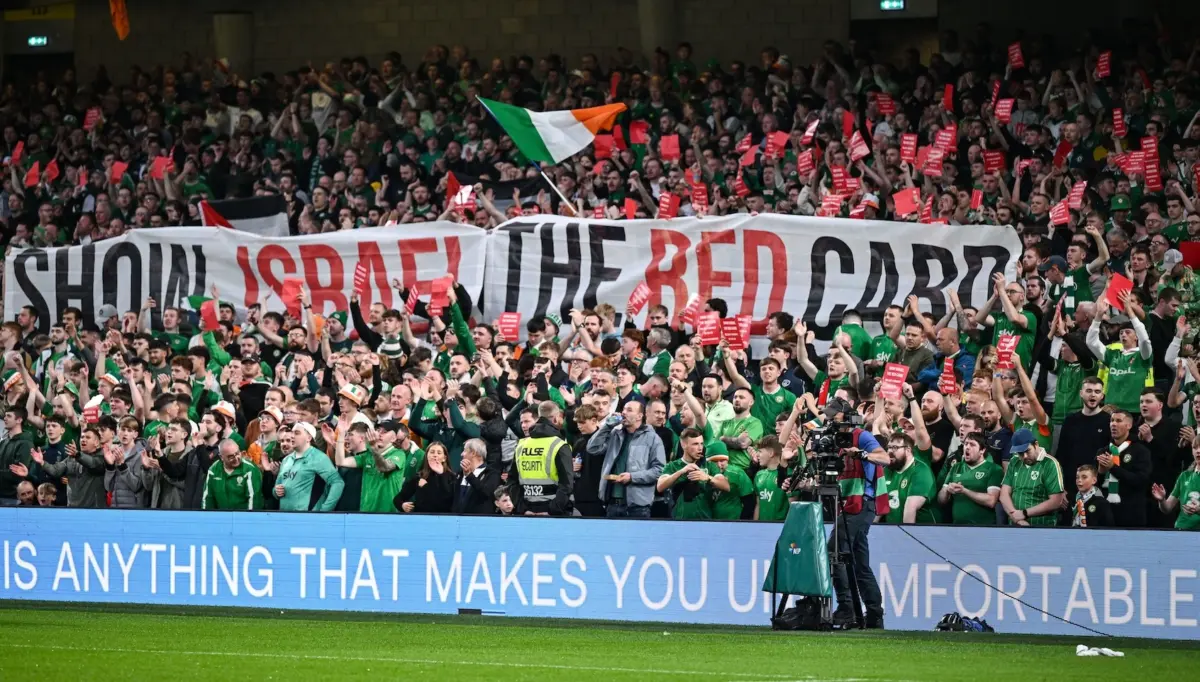
Executive Overview
What was originally scheduled as a routine European soccer fixture has metastasized into a bitter diplomatic crisis, laying bare the deep ideological fractures defining contemporary international relations. The Republic of Ireland and Israel are currently locked in an escalating war of words, transforming two upcoming UEFA Nations League matches into high-stakes symbols of a broader global schism over the ongoing conflict in Gaza.
The controversy has bypassed standard sports reporting to captivate global headlines, culminating in a direct rebuke delivered on the floor of the United Nations General Assembly. At the heart of the dispute is an unprecedented collision between modern geopolitics and international sports governance. With players openly expressing moral revulsion at the fixtures, national football associations scrambling to relocate games to empty stadiums, and political leaders trading sharp accusations of antisemitism and state-sponsored violence, the impending matches serve as a glaring reminder of how deeply the war in Gaza has permeated every corner of global society.
As the two teams prepare to face off under surreal, closed-door conditions, the saga illustrates a grim reality: in an era of heightened global polarization, even a minor sporting event can become a lightning rod for international hostility.
Detailed Chronology: The Escalation of a Diplomatic Crisis
The roots of the current sporting standoff do not lie within the confines of a stadium, but rather in a multi-year diplomatic deterioration between Dublin and Jerusalem. The timeline of this escalating feud reveals a steady progression from political friction to outright cultural and athletic estrangement.
- May 2024: Amid mounting international outcry over mounting civilian casualties in Gaza, the Irish government joins forces with Spain and Norway to formally recognize the State of Palestine. The move is hailed by pro-Palestinian advocates across Europe but draws immediate, furious condemnation from Israeli officialdom.
- December 2024: Diplomatic ties fracture further when Israel’s foreign ministry announces the permanent closure of its embassy in Dublin. Israeli officials publicly accuse then-Taoiseach Simon Harris of adopting and disseminating rhetoric that fosters antisemitism—a charge that stings deeply within a nation that views its historical record on minority rights with considerable pride.
- Throughout 2025: Cultural exchanges are abruptly shelved. Ireland emerges as a primary driver within a growing European movement to boycott the Eurovision Song Contest over Israel’s ongoing military campaign, setting a precedent for culture and sports as frontlines of political protest.
- Late 2025/Early 2026: The UEFA Nations League draw pairs Ireland and Israel in the same group. Given Israel’s status as a European competitor for athletic purposes—having been expelled from the Asian Football Confederation in the 1970s—the pairing guarantees two matches that neither nation’s sporting apparatus or populace actually desires.
- September 2026: Tensions boil over ahead of the fixtures. Heimir Hallgrímsson, the Icelandic manager of the Irish national team, breaks protocol by openly acknowledging the deep discomfort within his squad, famously characterizing the upcoming matches as "playing against genocide." The Israel Football Association fires back swiftly, branding the manager’s comments as the product of "stupidity, ignorance and hypocrisy."
- September 23, 2026: The feud reaches the global diplomatic stage at the UN General Assembly in New York. Irish Taoiseach Micheál Martin condemns Israeli settlement expansion in the West Bank—echoing warnings of "the specter of ethnic cleansing"—while formally demanding that Israeli authorities retract their "unacceptable remarks" regarding Hallgrímsson.
Supporting Context & Metrics: History, Irony, and the Logistics of Avoidance
To fully comprehend the depth of the Irish public’s reaction, one must look beyond standard European foreign policy to examine Ireland’s unique historical consciousness. Shaped by centuries of British colonial rule and the Great Famine, Irish public opinion has maintained a strongly anti-imperialist, pro-Palestinian stance for decades. This sentiment has only intensified as modern telecommunications beam the daily realities of the Gaza war directly into Irish living rooms.
Yet, this dynamic is layered with historical ironies. From an Irish perspective, allegations of widespread antisemitism ring hollow when measured against the nation’s historical relationship with its Jewish population. Unlike much of continental Europe during the mid-20th century, Ireland’s small Jewish community largely escaped persecution. In 1937, Ireland became the first European nation to explicitly guarantee religious freedom to Jewish citizens in its constitution.
Furthermore, historical figures of Jewish heritage achieved profound prominence in Irish civic life:
- Robert Briscoe: An Orthodox Jew and celebrated Irish revolutionary who fought against British rule, Briscoe later served as the Lord Mayor of Dublin during the 1950s.
- Chaim Herzog: Born in Belfast and raised in Dublin, Herzog went on to become the sixth President of Israel.
- Leopold Bloom: The immortal, ambiguous Jewish-Irish protagonist of James Joyce’s Ulysses, a work that forever intertwined Jewish identity with the literary landscape of Dublin.
Despite this heritage, the modern political reality has rendered the logistics of the upcoming soccer matches entirely untenable. Recognizing the immense potential for civil unrest, pitch invasions, and widespread boycotts, the Football Association of Ireland (FAI) faced immense pressure to forfeit the matches entirely.
While the FAI ultimately voted to proceed under threat of severe international sporting sanctions, the hosting arrangements were entirely upended:
- The "Home" Fixture (Sept. 27, 2026): Israel’s nominal home match will be played on neutral turf in Hungary, open only to a few hundred pre-vetted Israeli spectators.
- The Return Fixture (Oct. 4, 2026): Ireland’s home game has been stripped from Dublin’s cavernous Aviva Stadium. Instead, it will take place strictly behind closed doors at a modest sports complex in a small Serbian town, completely devoid of fans.
- The Broadcast Boycott: Ireland’s national broadcaster, RTÉ, found a unique middle ground to satisfy contractual obligations while reflecting public sentiment: the matches will be broadcast in bare-bones fashion, stripped of all standard commentary, pre-match punditry, and commercial advertising.
Official Statements and Institutional Reactions
The verbal sparring between Dublin and Jerusalem has generated no shortage of inflammatory rhetoric, drawing sharp lines between sporting governance, national sovereignty, and moral accountability.
The Irish Camp:
Manager Heimir Hallgrímsson’s candid admission—that his players view the fixture not as a game, but as an uncomfortable moral burden—captured the mood of a reluctant team. Speaking at a press briefing, the Icelandic coach noted the profound psychological weight resting on his squad:
"None of the players want to participate in these matches. It feels less like preparing for a sporting contest and more like playing against genocide."
At the diplomatic level, Taoiseach Micheál Martin used his platform at the United Nations General Assembly to elevate the sporting dispute into a broader indictment of Israeli policy. Martin stated:
"The expansion of Israeli settlements in the occupied West Bank raises the very specter of ethnic cleansing and endangers any viable two-state solution. Furthermore, the unacceptable remarks directed at our national team coach by Israeli authorities must be unconditionally withdrawn. Sports should bridge divides, not serve as an extension of diplomatic bellicosity."
The Israeli Camp:
The Israel Football Association (IFA) pushed back forcefully against the characterizations leveled by the Irish manager and political establishment. In a fiery statement released across social media channels, the IFA wrote:
"It is deeply regrettable that sports continue to be hijacked by political demagogues. To frame a standard international football fixture in such malicious terms is a display of sheer stupidity, ignorance, and breathtaking hypocrisy. Israeli athletes compete with pride, and attempts to delegitimize our participation on the pitch will not succeed."
Future Outlook: The Permanent Shadow Over International Sport
As the empty stadiums in Hungary and Serbia prepare to host two ghost matches that neither nation wants to witness, the long-term ramifications for international sports governance are profound.
The Ireland-Israel soccer controversy has established a dangerous precedent. It demonstrates that international sports bodies like UEFA can no longer isolate athletic competition from the volatile currents of global geopolitics. When national sentiment hardens to the point where managers openly lament their own fixtures, and when matches must be relocated to secret venues behind locked doors to prevent mass civil disobedience, the illusion of sports as an apolitical sanctuary is shattered.
Moving forward, regulatory bodies face an existential reckoning. As athletes increasingly demand moral alignment with their national federations—and as governments utilize international tournaments as proxies for diplomatic warfare—the model of global sporting integration is cracking.
Ultimately, the consensus among observers and fans alike is simple: when matches are played in empty arenas without fans, commentary, or joy, everybody has already lost. Whether this stark reality forces sports administrators to rethink how geopolitical conflicts intersect with global athletics remains to be seen, but the fault lines have been permanently etched into the turf.