

Executive Overview
On a humid late-August afternoon in 2026, the heart of the American capital transformed into a high-speed, deafeningly loud temporary speedway. The inaugural Freedom 250 Grand Prix tore through the streets surrounding the National Mall, offering a visceral, high-octane conclusion to months of federally coordinated pageantry celebrating the United States’ 250th birthday.
Conceived and executed under the direct cultural and political gravity of President Donald Trump’s administration, the summer-long celebration—dubbed "Freedom 250"—merged traditional civic pride with populist entertainment on a scale rarely witnessed in the District of Columbia. From a ceremonial lap in the armored presidential limousine, known universally as "The Beast," to flyovers by elite military aircraft, an aerial appearance by the newly configured Boeing 747 Air Force One, and a soaring live-flight display by a trained bald eagle, the event bore the unmistakable hallmark of Trump’s penchant for theatrical nationalism.
Yet, beyond the political symbolism and sensory overload lay a remarkably complex logistical undertaking. For weeks, downtown Washington had been subjected to lane closures, heavy construction, and infrastructural overhauls to safely route high-performance IndyCars past historical landmarks. When the dust settled and the chaotic 147-lap race concluded, driver Kyle Kirkwood emerged victorious, carving his name into motorsport history as the first winner of the D.C. Grand Prix.
This comprehensive report examines the culmination of the Freedom 250 initiative, detailing the sequence of events, logistical hurdles, public reception, and broader cultural implications of America’s hyper-visible semi-quincentennial anniversary.
Detailed Chronology of the Event
The timeline of the Freedom 250 Grand Prix finale was orchestrated with minute-by-minute precision, merging the worlds of high-stakes motorsport and executive pageantry.
Weeks Leading Up to the Race
The transformation of Washington, D.C.’s grid system into a temporary street circuit began in earnest in July 2026. City planners, civil engineers, and IndyCar safety officials collaborated under intense scrutiny to lay down specialized asphalt barriers, protective catch fences, and temporary pit lanes. The construction disrupted commuter traffic for weeks, drawing initial skepticism from local residents and business owners concerned about downtown accessibility. However, by race week, the atmosphere shifted from commuter frustration to carnival-like anticipation as grandstands and VIP hospitality suites materialized against the neoclassical backdrop of the nation’s monuments.
Pre-Race Ceremonies: Sunday, August 23, 2026
The afternoon of the race commenced with an arrival that immediately set the tone for the day’s events. First Lady Melania Trump made a rare and highly anticipated public appearance, stepping out in a striking white top paired with high-contrast black trousers—a daring sartorial choice amidst the grease, rubber, and exhaust of a motorsport paddock.
Accompanying President Trump, the First Lady joined him in the rear cabin of the presidential limousine, "The Beast," for a slow-speed ceremonial reconnaissance lap around the freshly paved circuit. Thousands of spectators lining the barricades roared as the heavily armored vehicle navigated the corners that drivers would soon tackle at speeds exceeding 180 miles per hour.
As the limousine returned to the starting grid, the official pre-race ceremonies unfurled in rapid succession:
- The National Anthem: Renowned tenor and presidential favorite Christopher Macchio delivered a soaring, operatic rendition of "The Star-Spangled Banner."
- The Wildlife Display: Adding a touch of wild Americana, a trained bald eagle made a low-altitude pass across the main straightaway, drawing rapturous applause from the grandstands.
- Aviation Spectacle: The skies above the National Mall erupted as military fighter jets thundered overhead in a precision flyover. Moments later, the newly minted presidential Boeing 747—the latest iteration of Air Force One gifted by international partners—swept low across the D.C. skyline, flanked by jet escorts.
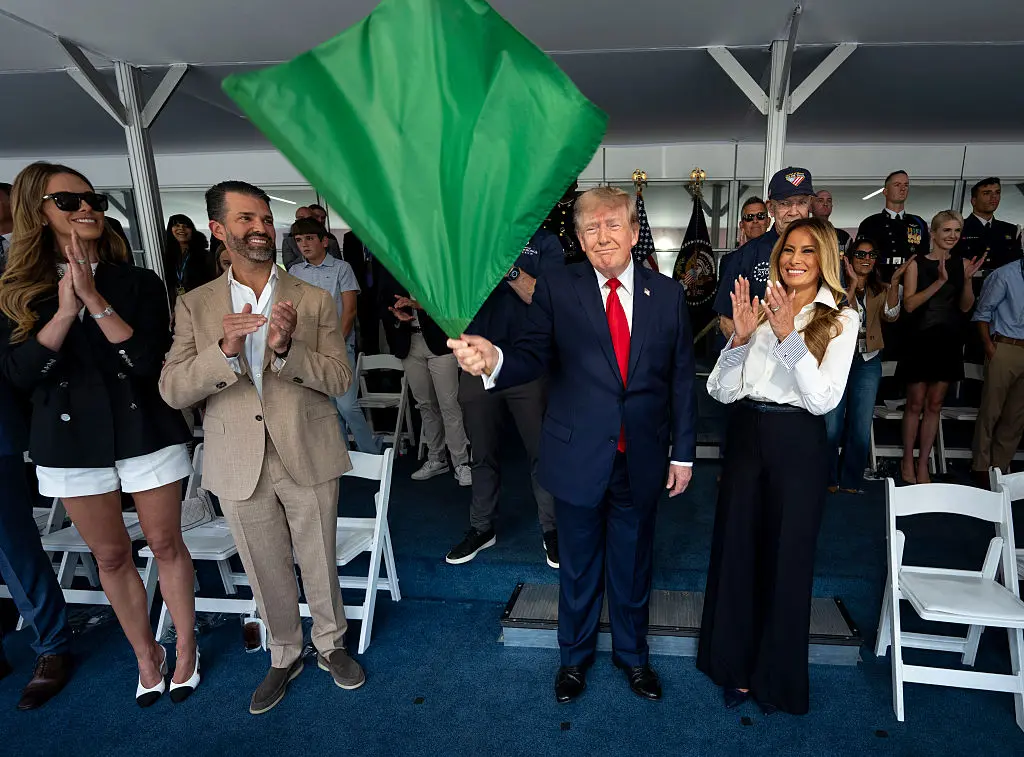
Following these displays, President Trump ascended to the glass-enclosed VIP viewing box alongside Donald Trump Jr. and Bettina Anderson, where he performed the symbolic duty of waving the green flag to officially start the inaugural grand prix.
The Race: 147 Laps of D.C. Asphalt
Once the green flag fell, the drivers faced an unforgiving, narrow street circuit. The unique layout—flanked by concrete barriers rather than wide gravel run-off areas—demanded absolute precision and invited immediate chaos.
The 147-lap race was defined by its attrition. A total of six caution periods slowed the field, and multiple high-profile crashes tested the mechanical resilience of the cars and the patience of the drivers. Despite the carnage, the event showcased elite racecraft.
As the race entered its final stages, Andretti Global’s Kyle Kirkwood navigated the debris and tactical restarts with masterclass composure. Kirkwood crossed the finish line first, securing a historic victory in the nation’s capital. Chip Ganassi Racing’s Christian Lundgaard claimed second place, while Team Penske veteran Will Power rounded out the podium in third.
Supporting Context & Metrics
To fully understand the magnitude of the Freedom 250 Grand Prix, one must examine the broader socio-political and economic framework of the summer of 2026.
The Evolution of "Freedom 250"
The semi-quincentennial of the United States—the 250th anniversary of the signing of the Declaration of Independence—was officially marked by widespread national commemorations. However, the Trump administration branded its own signature slate of events under the banner of "Freedom 250."
Unlike the more subdued, museum-centric exhibitions traditionally favored by federal heritage agencies, Freedom 250 favored populist entertainment, sporting spectacles, and overt displays of national strength. Earlier in the summer, this ethos was epitomized by a high-profile Ultimate Fighting Championship (UFC) event hosted directly on the grounds of the White House lawn. The D.C. IndyCar race served as the literal and figurative crescendo of this strategy, fusing Americana with commercial sports entertainment.
Logistical and Economic Metrics
Hosting a major motorsport event through the heart of a federal district requires staggering coordination and financial investment. Key metrics associated with the event include:
- Circuit Length & Layout: Approximately 2.2 miles of downtown D.C. asphalt converted into a temporary road course, incorporating major federal thoroughfares.
- Race Distance: 147 laps, testing the mechanical durability of IndyCar powertrains under intense urban summer heat.
- Duration of Disruption: Road closures and infrastructure modifications began in early July, with complete teardown projected to linger well into September 2026.
- Economic Impact: Preliminary municipal projections estimated tens of millions of dollars injected into the local hospitality, hotel, and dining sectors, drawing hundreds of thousands of unique visitors to the District over race weekend.
Official Statements and Public Reactions
The convergence of elite motorsport, partisan pageantry, and urban disruption naturally generated a diverse array of responses from political figures, motorsport icons, and the public.
Driver and Motorsport Community Perspectives
Despite the initial skepticism regarding the logistical nightmare of racing through a heavily protected federal city, the drivers themselves were universally complimentary of the venue once behind the wheel.
"It’s an incredible place to race," remarked race winner Kyle Kirkwood in his post-race victory lane interview. "You look around and you see the history, the monuments, and the sheer scale of the crowd. To win the inaugural race here in Washington is a career-defining moment."
IndyCar leadership echoed these sentiments, viewing the D.C. street race as a watershed moment for the sport’s American footprint, exposing open-wheel racing to a political and cultural audience that traditionally resides outside traditional racing demographics like Indianapolis or St. Petersburg.
Political and Public Discourse
The political reaction to the event largely mirrored existing national divides:
- Supporters praised the event as a masterclass in modern civic celebration, arguing that injecting high-energy entertainment into the nation’s birthday revitalized patriotism for younger generations and brought millions of tourism dollars into Washington, D.C.
- Critics and Local Officials, meanwhile, raised persistent concerns regarding the prolonged traffic gridlock, the allocation of federal security resources, and the blending of official governmental anniversaries with what many viewed as a personalized political rally for the Trump family. Environmental advocates also pointed to the heavy carbon footprint of the fighter jet flyovers, Air Force One’s demonstration, and the fleet of high-performance racing engines.
Future Outlook: A New D.C. Tradition or a One-Time Spectacle?
As the temporary concrete barriers are unbolted and the asphalt is cleared of rubber debris in the weeks following the race, a lingering question remains: Will the Freedom 250 Grand Prix become a permanent fixture on the IndyCar calendar, or was it strictly a singular celebration for America’s 250th birthday?
From a logistical standpoint, the street closures and infrastructural strains placed upon the District of Columbia make a annual recurrence a formidable challenge. Local commuter groups and city planners would demand substantial financial and operational concessions to accommodate the race year after year.
However, from a promotional and commercial perspective, the event was an undeniable heavyweight. The visual imagery of IndyCars accelerating past iconic American architecture, framed by a presidential endorsement and military pageantry, has cemented itself into the modern sports lexicon. Whether through the IndyCar series or alternative motorsport platforms, the administration’s blueprint has demonstrated that the nation’s capital can indeed serve as a high-speed playground.
Ultimately, whether the engines roar again down the streets of Washington or the event remains a unique historical artifact, the Freedom 250 Grand Prix ensured that America’s 250th summer celebration was anything but quiet.