

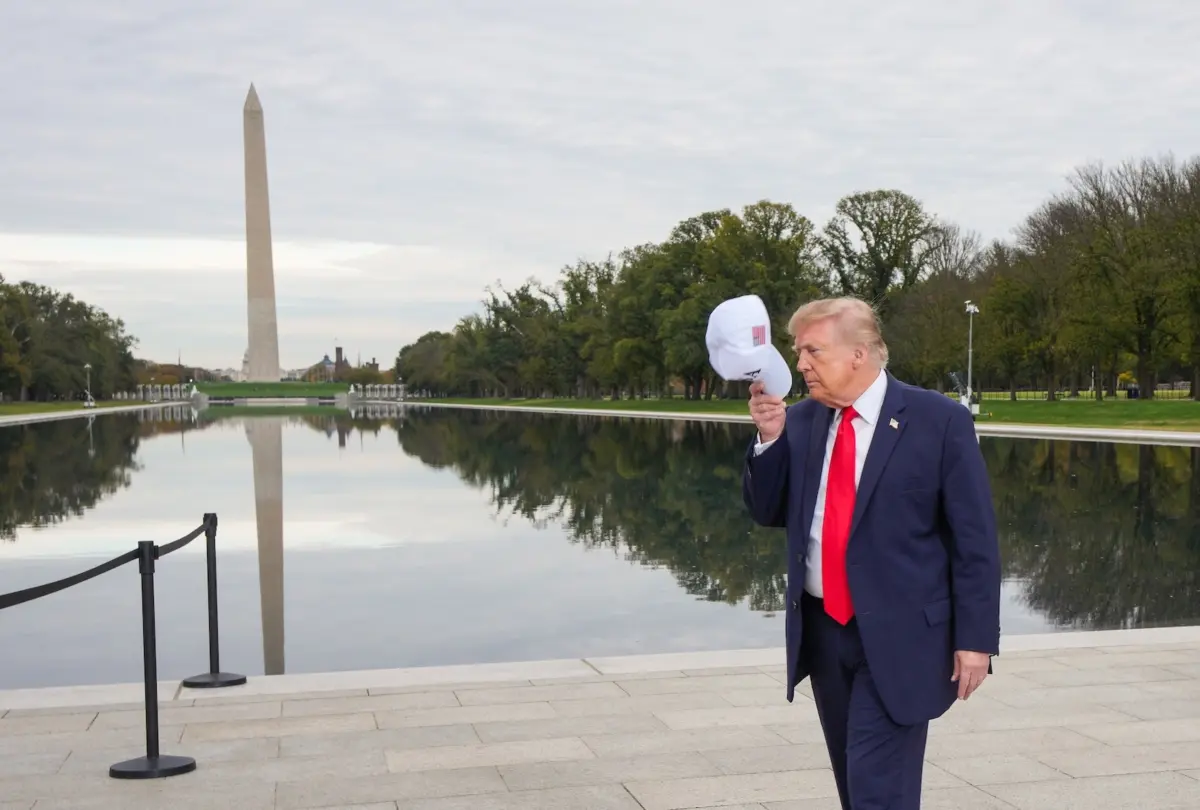
WASHINGTON — With the nation standing on the precipice of a high-stakes electoral reckoning, President Donald Trump delivered a rambling, fiery address before the Lincoln Memorial Reflecting Pool on Monday, just hours before polls open for the 2026 midterm elections.
Speaking to a crowd against the backdrop of a heavily scrutinized national landmark during his second term, Trump spent a significant portion of his hour-long address airing grievances about Washington, D.C., construction projects, revisiting past controversies regarding monument vandalism, and even joking that the iconic reflecting pool should be renamed in his honor.
However, when the president finally shifted his focus to the ballot box more than 23 minutes into his remarks, his tone grew stark. Painting a dystopian picture of the political opposition, Trump seemed to foreshadow potential major Republican losses in both the House and the Senate, framing the midterms as an existential struggle for the nation.
As Americans prepare to cast their final ballots on Tuesday, November 3, 2026, the political landscape is defined by unprecedented early voter turnout, shifting battlegrounds, and a desperate final push by the GOP to preserve its legislative majorities for the remainder of Trump’s second term.
Executive Overview
The 2026 midterm elections have arrived as a referendum on the latter half of Donald Trump’s second presidency. Facing traditional historical headwinds that typically penalize the sitting president’s party, the Republican administration is fighting tooth and nail to retain control of Capitol Hill.
Late-stage polling data paints a challenging picture for the GOP. Major polling aggregators and analytical firms, including The New York Times/Siena University and the Cook Political Report, indicate that Democrats hold distinct advantages heading into Election Day. Not only are Democrats favored in nearly all critical Senate battlegrounds, but they are also projected to secure a substantial majority in the House of Representatives—potentially their strongest legislative foothold since 2009.
Despite these ominous projections for the White House, the electorate itself has sent mixed signals through a historic wave of early voting. Smashed turnout records across states like Texas, Ohio, and South Carolina indicate a deeply engaged and mobilized populace. With roughly 50 million ballots already cast nationwide, Election Day 2026 is shaping up to be a chaotic, high-turnout finale where the final outcome remains stubbornly difficult to predict.
Detailed Chronology: Trump’s Final Push at the Lincoln Memorial
The president’s final campaign event of the 2026 cycle was vintage Trump: unpredictable, grievance-laden, and sharply divisive. Taking the podium at the Lincoln Memorial Reflecting Pool—a site that has faced its own share of administrative and political scandals throughout his second term—Trump opened with lighthearted remarks before diving into localized grievances.
For the first third of his speech, the president harped on the state of infrastructure in the nation’s capital, discussing ongoing Washington construction projects and reviving conspiracy theories surrounding previous instances of monument vandalism. At one point, he drew chuckles from supporters by suggesting the reflecting pool bearing Abraham Lincoln’s name should be rededicated to him.
However, the mood shifted dramatically when Trump finally addressed the imminent congressional elections.
"When you vote, remember a party that hates America cannot be allowed to rule over the people who built our country," Trump declared to the gathered crowd, launching into a severe condemnation of the Democratic Party.
He asserted that Democrats wanted to "blow all of this up by electing communist jihadists," utilizing extreme rhetoric designed to galvanize his base of core supporters.
Midway through his address, Trump appeared to acknowledge the heavy political gravity facing his party, openly discussing the historical curse that burdens sitting presidents during midterm cycles.
"If the people that voted for me and voted in the last election where we had such a great victory, if they go out and vote, just a good portion of them, we will win in a landslide," Trump said. "Now that doesn’t happen because usually whoever the sitting president is, Republican or Democrat, uh, good or bad, good president, great president, bad, for some reason the sitting president doesn’t win the midterms, but we gave this a very strong shot."
The speech encapsulated the duality of the closing days of the campaign: a president attempting to rally an enthusiastic base while privately and publicly acknowledging the fierce political headwinds blowing against his administration.
Supporting Context & Metrics: The Numbers Behind the Midterms
While the president rallies his base in the nation’s capital, the data coming out of final polling and early voting operations tells a story of profound national mobilization and potential institutional shift.
Polling Realities and Senate Battlegrounds
According to the final wave of polling data released by The New York Times and Siena University ahead of the election, the Democratic Party holds a commanding position in the fight for the upper chamber. The polls report that Democrats are currently leading in all seven of the states likeliest to decide control of the Senate:
- Michigan
- Kansas
- Texas
- Maine
- Ohio
- Alaska (more narrowly contested)
- Iowa (more narrowly contested)
These findings are further reinforced by the final projections from the Cook Political Report, which outline potential Democratic pickups in additional competitive states, including North Carolina, Florida, Tennessee, and Virginia. Furthermore, the Cook Political Report projects that Democrats are poised to pick up anywhere from 15 to 25 seats in the House of Representatives, potentially establishing a commanding 230- to 240-seat majority. Should these projections materialize into election night sweeps of toss-up districts, it would grant Democrats their largest majority in the House since 2009.
Smashed Early Voting Records
Despite the challenging polling data for Republicans, the ground game has been defined by shattered turnout records. Across the country, voters have utilized early and mail-in voting options in unprecedented numbers:
- Texas: More than 7.7 million voters cast early ballots, completely obliterating previous turnout records set during the 2018 midterm elections.
- South Carolina & Ohio: Both states reported record-breaking early voting numbers, signaling high civic engagement.
- National Total: Approximately 50 million Americans have already cast their ballots before Election Day.
Data analysts note that the share of registered Democrats has notably increased in several key battleground electorates during the early voting phase. However, political scientists caution that early metrics do not tell the whole story. According to The New York Times, roughly half of all expected votes are projected to be cast on Election Day itself, leaving a massive pool of uncounted ballots that could dramatically alter the final tallies once polls close.
Official Statements and Reactions
The fiery rhetoric deployed by President Trump at the Lincoln Memorial has drawn swift condemnation from political opponents and independent observers alike.
Democratic leadership pushed back aggressively against Trump’s characterization of the party, calling the "communist jihadists" remark a dangerous escalation of political demonization designed to divide the country on the eve of a democratic election.
"The American people are speaking clearly through record-breaking turnout, and they are demanding stability, competence, and a check on executive overreach," a senior Democratic campaign strategist noted in a statement responding to the president’s speech. "Name-calling and conspiracy theories will not obscure the clear choice voters face at the ballot box."
Meanwhile, Republican defenders have rallied around the president’s message, emphasizing that the accomplishments of Trump’s second term—particularly regarding economic adjustments and judicial appointments—hang in the balance. GOP congressional leaders have spent the final 48 hours urging their constituents to ignore mainstream polling aggregates, arguing that the massive early voter turnout includes a hidden reservoir of pro-Trump sentiment that traditional polling methodologies routinely fail to capture.
Future Outlook: What Happens Next?
As the sun rises on Election Day, the United States faces a pivotal inflection point that will dictate the trajectory of federal governance for the remainder of Donald Trump’s second term.
- Legislative Gridlock vs. Total Shift: If the final polls prove accurate and Democrats capture majorities in both the House and Senate, President Trump will face a radically hostile legislative branch. This outcome would effectively halt the administration’s domestic legislative agenda, setting the stage for intense oversight, gridlock, and potential legislative showdowns over federal spending and executive appointments.
- A Republican Upset: Conversely, should the massive early and Election Day turnout heavily favor Republican candidates—overturning the final polling aggregates—Trump will retain unified government control, cementing his policy legacy and empowering his administration to aggressively pursue its second-term objectives without congressional obstruction.
- The Aftermath of Rhetoric: Beyond the partisan math of the House and Senate, the tone set by the closing days of the campaign—marked by apocalyptic warnings, attacks on institutions, and deep ideological division—will undoubtedly leave a lasting imprint on the American political fabric.
As tens of millions of remaining voters head to the polls today, the nation waits with bated breath to see whether historical midterm trends will hold true, or if a new political reality will take shape in Washington.
