

Executive Overview
Fourteen years after Sacha Baron Cohen introduced the world to the bumbling, well-meaning, yet unapologetically bigoted Kazakh television journalist in Borat: Cultural Learnings of America for Make Benefit Glorious Nation of Kazakhstan, the infamous character returned for a timely and disruptive sequel. Officially titled Borat Subsequent Moviefilm: Delivery of Prodigious Bribe to American Regime for Make Benefit Once Glorious Nation of Kazakhstan (and streaming on Amazon Studios), the 2020 release arrived at a uniquely precarious cultural and political juncture. Released mere weeks before the contentious U.S. presidential election, the film dropped into a nation already reeling from a global pandemic, escalating political polarization, and a deeply entrenched media ecosystem characterized by rampant disinformation.
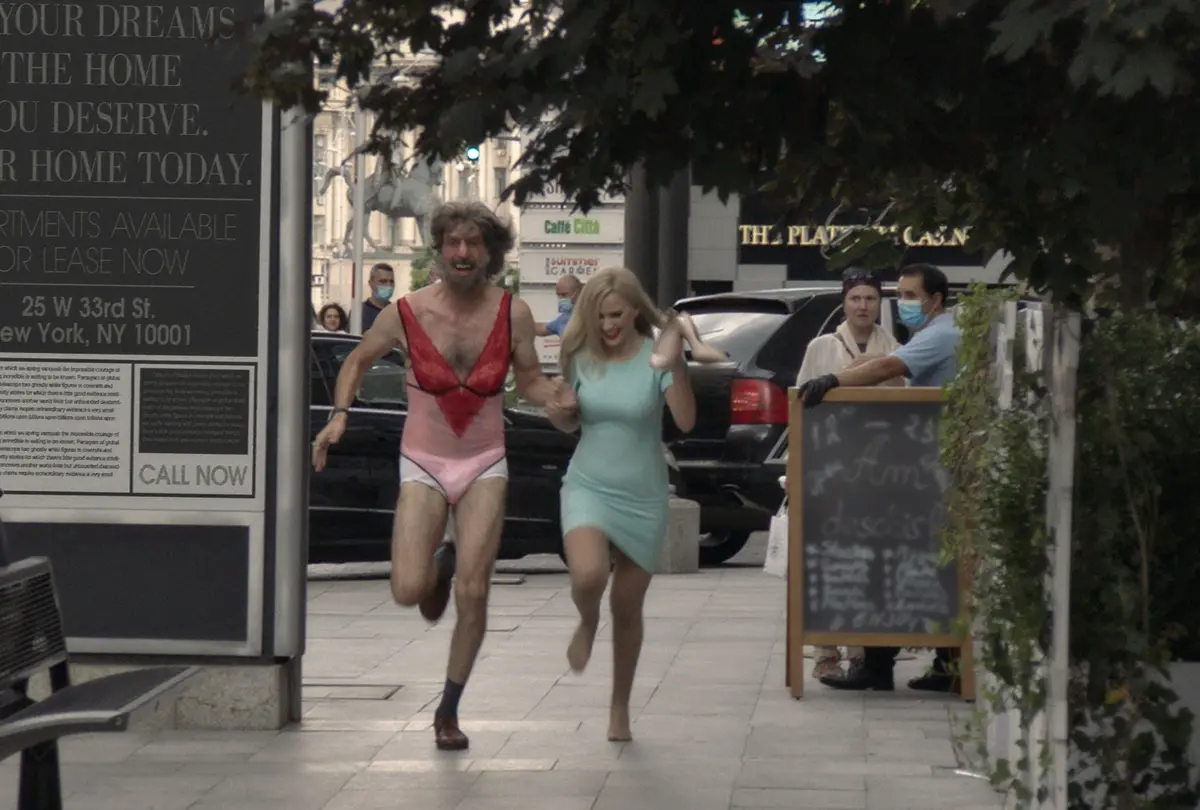
Rather than merely recycling the shock-value formula of the 2006 original, Baron Cohen recalibrated his satirical lens. This time, he was not the only focal point of the chaos. The sequel introduced breakout Bulgarian actor Maria Bakalova as Tutar, Borat’s imprisoned, coarse, and fiercely underestimated 15-year-old daughter. Together, father and daughter embark on a cross-country odyssey through a United States that has changed drastically—or perhaps simply unmasked itself—since Borat’s first visit.
While the film generated massive pre-release headlines for its infamous "sting" operation involving former New York City Mayor and presidential attorney Rudy Giuliani, the true triumph of Borat Subsequent Moviefilm lies beyond the sensationalist gotcha moments. The film functions as an intricate, uncomfortable mirror held up to American society. It exposes how casual misogyny, systemic prejudice, and an erosion of critical thinking have rendered the public acutely vulnerable to manipulation. By shifting the emotional core of the narrative toward Tutar’s journey of self-actualization, Baron Cohen and his team crafted a feminist-themed satire that is as biting as it is conceptually ambitious.
Detailed Chronology: From the Gulag to the Golden Cage
The narrative arc of Borat Subsequent Moviefilm begins with the immediate fallout of the 2006 documentary. While the original film achieved blockbuster success in the West, it brought profound shame to Borat’s home village of Kuzcek. Portrayed as a wretched backward wasteland, the community’s collective mortification resulted in Borat being sentenced to a grueling life of hard labor within a remote state gulag.
Fourteen years later, Kazakhstan’s ruling regime finds an unexpected use for its most disgraced citizen. Premier Nazarbayev (played by Dani Popescu) recognizes that the nation requires a fresh diplomatic play to secure its standing among the world’s authoritarian strongmen. Borat is pulled from his confinement, given a familiar makeover—complete with his ill-fitting grey suit, walrus mustache, and unruly hair—and dispatched to Washington, D.C. His mission is to deliver a lavish peace offering to "Vice Premier Mikhail Pence": Johnny the Monkey, who is simultaneously introduced as Kazakhstan’s Minister of Culture and its premier adult-film star.
However, complications arise immediately upon Borat’s arrival in Texas, where he discovers he is instantly recognized by ecstatic crowds. More importantly, he discovers that he is not traveling alone. Tutar, his estranged teenage daughter, has stowed away in the shipping crate carrying the monkey.
Raised in a pen and conditioned by a heavily censored book gifted to her by the Kazakh government, Tutar embodies the subjugated woman. The government-issued text instills in her the belief that women cannot drive, operate businesses, or touch their own bodies without triggering apocalyptic disasters on par with the sinking of the Titanic. Her ultimate aspiration in life is to reside in a golden cage, emulating Melania Trump, whom the handbook promotes as "the happiest wife in the world."
As the father-daughter duo traverses the United States, Tutar initially sleeps in a horse trailer dragged behind Borat’s jalopy while she is kept caged inside. Yet, as the narrative progresses into its second half, the film pivots dramatically. Tutar’s awakening and eventual empowerment become the emotional engine of the project. Guided momentarily by individuals like Jeanise Jones—a compassionate Black woman hired to look after Tutar, who ultimately wakes the girl up to her father’s web of lies—Tutar begins to deconstruct the misogynistic worldview forced upon her. She learns to read between the lines of her oppressive upbringing, transforming from a submissive captive into a razor-sharp operative who is just as capable of exposing fools as her father.
Supporting Context & Metrics: The Anatomy of a Sequel
Evaluating Borat Subsequent Moviefilm purely through the lens of traditional comedy metrics sets it up for an unfair comparison with its predecessor. The original 2006 film functioned as an effective social experiment. Back then, Borat operated as a cinematic truth serum—an amiable ignoramus whose transparently absurd bigotry invited subjects to either lower their guard or match his prejudice in an attempt to find common ground.
By 2020, the cultural landscape had fundamentally shifted. As Baron Cohen himself noted in previous retrospective interviews regarding his retirement of the character, the primary drawback of sustained success is that familiarity breeds self-defeat. Every individual who had already seen the original film represented one fewer person who could be authentically duped by the uninitiated persona.
To bypass this hurdle, the production relied heavily on elaborate prosthetics, shifting disguises, and the introduction of Bakalova’s Tutar. This structural pivot also mirrors the stylistic choices of director Jason Woliner, whose past television credits include critically acclaimed, boundary-pushing docu-comedy projects like Nathan for You. Woliner’s influence manifests in the film’s reliance on extended situational cringe rather than quick, isolated sight gags.
Furthermore, the statistical and logistical realities of filming a guerrilla-style comedy during an unfolding global health crisis cannot be understated. The COVID-19 pandemic forced production to pause and pivot toward the end of its principal photography, resulting in an ending that feels somewhat abrupt. Despite these structural seams, the film’s examination of modern American psychology remains its most vital contribution.
Unlike the 2006 iteration—where the biggest laughs derived from cultural misunderstandings and physical comedy, such as the infamous nude hotel-room wrestling match between Borat and his producer Azamat (Ken Davilian)—the 2020 sequel relies heavily on systemic complicity. The targets are no longer just fringe figures shouting slurs at a rodeo. Instead, Borat Subsequent Moviefilm exposes everyday citizens who casually accommodate and normalize bigotry as long as it does not disrupt their immediate comfort.
Official Statements and Controversies
No major satirical release in the modern political era arrives without a storm of pre-release leaks, legal threats, and defensive public relations management. Borat Subsequent Moviefilm dominated news cycles weeks before its streaming debut due to a sequence involving former New York City Mayor Rudy Giuliani.
In the film’s climax, Bakalova portrays a conservative "fake news" reporter who secures an exclusive, sit-down interview with Giuliani in a luxury hotel suite. Following the formal interview, the interaction transitions to a bedroom area where Giuliani is recorded tucking his shirt in while lying on a bed in the presence of the young actor—a sequence that instantly ignited a ferocious public debate across cable news networks and political circles.
Giuliani swiftly condemned the project, labeling the encounter a calculated "hit job" orchestrated in retaliation for his political attacks on then-candidate Joe Biden’s family. In various media appearances, the former mayor insisted he was merely tucking his shirt in after removing recording equipment and maintained that his behavior was entirely benign.
Yet, as critics and cultural analysts pointed out, the Giuliani sting functioned less as a shocking revelation and more as a predictable confirmation of existing perceptions. Just as Johnny the Monkey would naturally gravitate toward a room full of bananas, placing a figure known for compromised judgment into a carefully constructed honeytrap yielded entirely expected results.
Beyond the Giuliani controversy, the film captured other notable figures and fringe groups. These included an infiltration of the Conservative Political Action Conference (CPAC) where Baron Cohen dressed as Donald Trump, and an appearance at a right-wing rally in Washington state where Borat—disguised as "Country Steve"—led a crowd in a darkly satirical singalong featuring incendiary lyrics about political opponents.
While these high-profile "gotcha" moments generated immediate headlines, reviewers argued that they ultimately told the public little that it did not already know about the individuals involved. The true resonance of the project lay not in the shock value of catching politicians off-guard, but in the casual, unscripted indifference displayed by everyday citizens when confronted with overt prejudice.
Future Outlook: The Legacy of a Satirical Masterpiece
As Borat Subsequent Moviefilm continues to be analyzed as a cultural artifact of the turbulent year 2020, its long-term legacy extends far beyond its shock-value comedy. The film serves as a harsh diagnostic tool for a democratic society struggling to agree on basic, objective facts.
The decline of critical thinking, exacerbated by the deluge of digital disinformation and political radicalization, has left contemporary populations deeply susceptible to bad-faith actors—both domestic and foreign. Baron Cohen’s satire suggests that the danger facing Western democracies is no longer just the presence of overt bigots, but the widespread societal apathy that allows prejudice to flourish unchecked beneath a veneer of polite hospitality.
Moreover, the film leaves viewers with a devastating tonal inversion compared to its 2006 predecessor. When audiences first encountered Borat fourteen years prior, they could take comforting refuge in first-world exceptionalism—laughing at a foreign culture while quietly assuring themselves that their own society was vastly superior and enlightened.
Borat Subsequent Moviefilm strips away that comforting illusion. In its haunting final sequences, the film implies that the threat is no longer just the existence of "ugly Americans," but a once-glorious nation being actively steered backward into diminishment by political goons and unprincipled leadership. It is a sobering conclusion that transforms the project from a standard comedy sequel into a genuine cultural wake-up call—proving that while the methods may involve slapstick and prosthetics, the underlying diagnosis is entirely, terrifyingly real.
