

Executive Overview
In a stunning revelation that upends decades of textbook biology, a tiny prehistoric fossil discovered in Scotland has been unmasked as a completely different type of ancient animal than previously believed. For nearly thirty years, the specimen—formally known as Westlothiana lizziae and affectionately dubbed "Lizzie" by the scientific community—has been held up as the gold standard for the earliest known amniote, representing the pivotal evolutionary split that gave rise to reptiles, birds, and mammals.
However, groundbreaking new research published in the prestigious journal Nature has shattered this long-established paradigm. Spearheaded by an international coalition of paleontologists from the American Museum of Natural History (AMNH) and the University of Oxford, in close collaboration with the European Synchrotron Radiation Facility (ESRF), the study deployed cutting-edge non-destructive imaging technology to peer deep within the rock matrix housing the specimen.
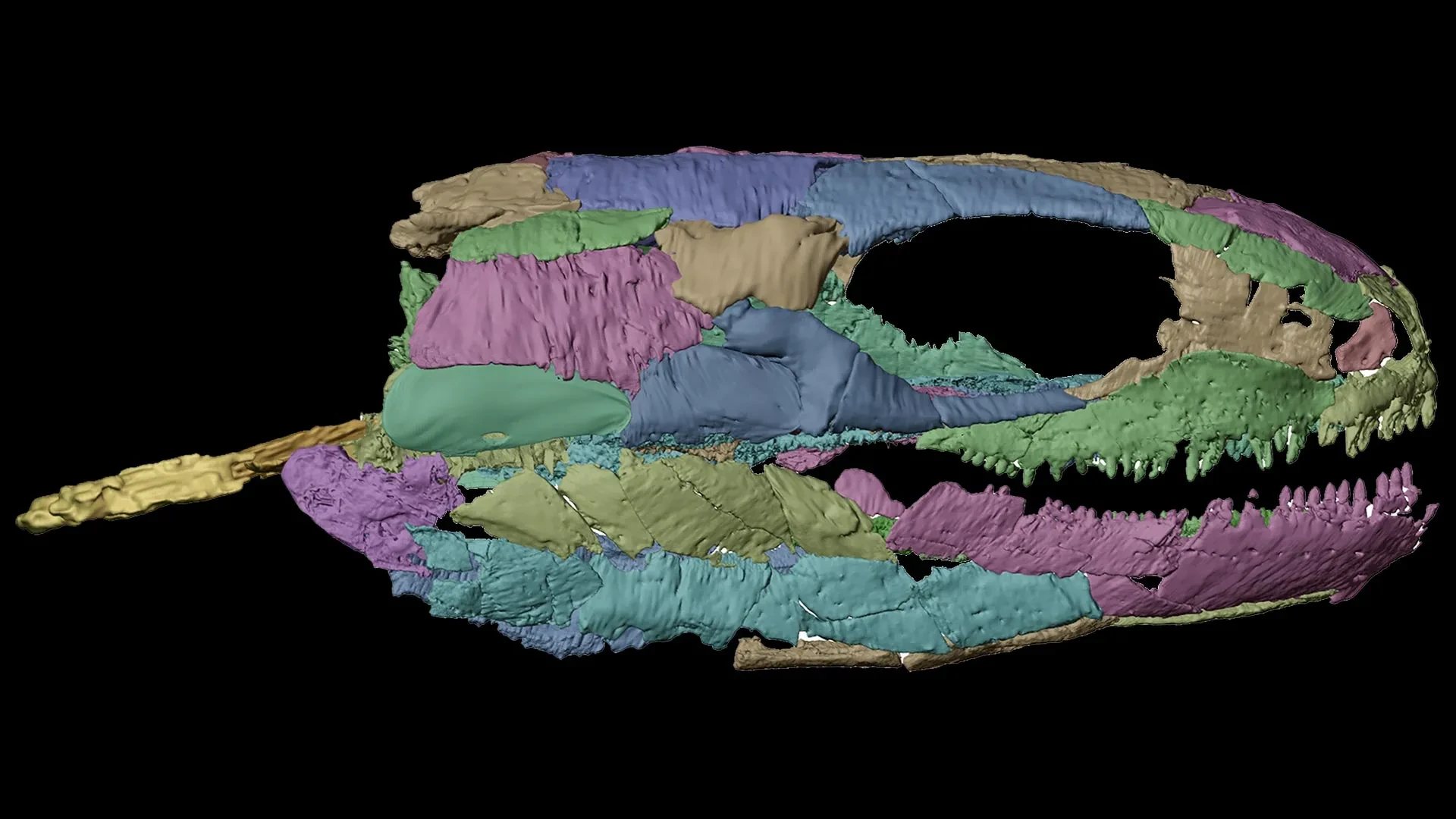
The results of these high-resolution X-ray scans revealed an internal anatomy radically incongruous with the traditional profile of an early terrestrial reptile. Instead of a land-dwelling pioneer, Westlothiana was actually a heavily aquatic or amphibious creature, complete with a primitive skull, internal gill structures supported by bone, and a specialized fish-like jaw lined with thousands of microscopic teeth.
This dramatic misidentification forces the scientific community to re-evaluate not only the evolutionary timeline of early land vertebrates, but also the very criteria used to interpret prehistoric footprints and fossil trackways. By demonstrating that key anatomical features traditionally thought to be exclusive to terrestrial amniotes—such as five-toed feet and claw-like digits—actually evolved in water-dwelling ancestors, the study provides a profound lesson in evolutionary biology: appearances can be profoundly deceiving, and the pathway to terrestrial life was far more complex, piecemeal, and fluid than previously imagined.
Detailed Chronology
Discovery and Initial Classification (1984–1990)
The story of Westlothiana lizziae began in 1984 during routine fossil-hunting expeditions in the fossil-rich strata of Scotland. Paleontologists unearthed a remarkably complete, albeit heavily distorted and crushed, miniature skeleton preserved across two matching slabs of sedimentary rock. Dating back approximately 345 million years to the Carboniferous period, the specimen immediately captured the attention of the global paleontological community due to its sheer completeness and age.
Because the fossil was physically trapped within dense rock, early descriptions had to rely strictly on external anatomical features visible under microscopes. Researchers focused heavily on the creature’s limbs, noting that it possessed four well-developed legs terminating in fingers and toes with what appeared to be claw-like tips. In an era when most contemporaneous aquatic and semi-aquatic vertebrates possessed fin-like limbs or primitive paddles, the presence of distinct, weight-bearing digits immediately singled Westlothiana out.
By 1990, following its formal scientific description, the creature was christened Westlothiana lizziae and quickly earned the affectionate nickname "Lizzie" due to its uncanny superficial resemblance to a modern lizard. Given the limits of 20th-century preparation techniques—which risked destroying delicate internal structures if researchers attempted to mechanically carve the fossil out of the stone—pioneering paleontologists classified Lizzie as the earliest known amniote. This monumental status positioned it squarely at the base of the evolutionary tree that birthed all modern reptiles, dinosaurs, birds, and mammals, cementing its place in academic textbooks worldwide.
The Technological Revolution: Non-Destructive Synchrotron Imaging (Modern Era)
For nearly three decades, Lizzie remained an untouchable icon of early terrestrial evolution. However, the rapid advancement of non-destructive imaging technologies in the 21st century set the stage for a dramatic scientific reckoning.
To resolve the deep anatomical mysteries hidden within the crushed rock slabs, a multidisciplinary research team turned to the European Synchrotron Radiation Facility (ESRF) in Grenoble, France. The ESRF houses one of the most powerful particle accelerators in the world, capable of generating high-energy X-rays that can penetrate dense geological matrices with microscopic precision.
Unlike traditional CT scans, synchrotron microtomography provides exceptional contrast and resolution, allowing scientists to digitally dissect fossils virtually, layer by layer, without causing a single scratch to the invaluable historical specimens. Researchers scanned the Westlothiana fossil from multiple angles, compiling terabytes of high-resolution digital data that could be reconstructed into three-dimensional models. This technological breakthrough allowed the team to "see inside" the fossil for the very first time, peering past the superficial rock surface to reveal bones, skull fragments, and soft-tissue impressions that had remained hidden and unstudied for 345 million years.
Unmasking the True "Lizzie"
The digital reconstructions yielded shocking revelations that completely dismantled the prevailing consensus. Rather than displaying the robust, well-ossified skull typical of a land-dwelling amniote, Lizzie possessed a remarkably primitive skull structure.
Most damning to its former status as a reptile was the undeniable presence of internal gills reinforced by bone, alongside a jaw morphology closely mirroring that of a primitive fish, packed with thousands of tiny, specialized teeth. These diagnostic features are completely incompatible with the terrestrial, air-breathing lineage leading to reptiles and mammals. Instead, the data painted a vivid portrait of a creature that spent the vast majority of its life swimming in water, utilizing its aquatic adaptations to hunt small prey, while retaining certain anatomical novelties in its limbs that had previously fooled generations of researchers.
Supporting Context & Metrics
The Stakes of Amniote Evolution
To understand why the Westlothiana correction is sending shockwaves through the scientific community, one must grasp the biological significance of amniotes. The evolution of the amniotic egg—an egg furnished with a protective amnion, chorion, and allantois—was the evolutionary "key" that unlocked dry land for vertebrate life. It liberated vertebrates from the absolute necessity of returning to open water to lay their eggs, paving the way for the explosive radiation of reptiles, dinosaurs, birds, and mammals across terrestrial ecosystems.
For thirty years, Lizzie served as the anchor point for this transition. Textbooks, phylogenetic trees, and macroevolutionary models were calibrated around the assumption that an amniote-grade body plan had already been fully established by 345 million years ago. Stripping Lizzie of this title forces a profound recalibration of when, where, and how these critical adaptive traits emerged.
Anatomical Mosaicism and Convergent Evolution
The new study underscores a fundamental concept in evolutionary biology: mosaic evolution. Organisms do not evolve as uniform blocks; rather, individual anatomical systems adapt piecemeal in response to immediate ecological pressures.
In the case of Westlothiana, features previously deemed exclusive hallmarks of terrestrial life—such as pentadactyly (the five-digit pattern seen in hands and feet) and claw-like phalanges—were actually present in lineages that remained fundamentally aquatic or amphibious. These traits did not evolve after animals conquered the land; rather, they evolved while those animals were still navigating the muddy margins of lakes, swamps, and rivers. The ancestral stock of tetrapods (the broader clade encompassing both amphibians and amniotes) was far more morphologically innovative than previously suspected, experimenting with digits and weight-bearing structures long before taking up permanent residence on terra firma.
Rethinking Prehistoric Footprint and Trackway Analysis
The ripple effects of this discovery extend far beyond skeletal morphology, plunging the interpretation of Paleozoic trace fossils into a state of flux.
In recent years, paleontologists have uncovered enigmatic fossil trackways dating back to the Devonian Period—more than 359 million years ago. These ancient impressions, featuring clear outlines of four-limbed animals with apparent clawed digits, have frequently been cited as smoking-gun evidence that true amniotes had already evolved millions of years before their oldest known body fossils appeared.
However, the revelation that an amphibious, fish-toothed creature like Westlothiana could also possess claw-like digits shatters this interpretive framework. Scientists can no longer assume that a fossilized footprint featuring claw impressions automatically equates to a terrestrial amniote. Many of these ancient trackways, previously attributed to pioneering land reptiles, may instead have been left by more ancient, amphibious cousins belonging to the broader tetrapod lineage—creatures that lived active lives in and out of the water, leaving terrestrial-looking prints without ever committing to a fully land-based lifestyle.
Official Statements
The profound nature of the discovery has elicited strong reactions from the leading scientists behind the research, highlighting both the humility required in modern paleontology and the power of advanced technology to rewrite history.
"Lizzie has been an icon for the early evolution of amniotes for decades. But when we were finally able to see inside the fossil, we found an animal that looked very different from what we expected."
— Xavier Jenkins, Postdoctoral Fellow in the Division of Paleontology at the American Museum of Natural History and Co-Lead Author
Jenkins emphasized that the discovery serves as a cautionary tale for paleontologists relying solely on surface anatomy preserved in compressed rock slabs.
"The surprisingly primitive features of the skull show us that Lizzie was not only not a reptile, but belonged to a much more ancient lineage. It turns out looks can be deceiving, and Lizzie lived a completely different lifestyle than we previously thought."
— Ben Igielman, Co-Lead Author (research initiated during graduate studies at the University of Oxford)
Igielman pointed to the fish-like jaw and internal gills as definitive proof that the scientific community had fundamentally misread the creature’s ecological niche for nearly half a century.
"This is a big surprise. It shows that, although we think of amphibians as being more ‘primitive’ than reptiles today, some of the traits of reptiles were already there in the ancestor of both amphibians and reptiles."
— Roger Benson, Macaulay Curator of Paleontology at the American Museum of Natural History and Study Co-Author
Benson highlighted how the discovery blurs the rigid historical boundaries drawn between modern amphibian and reptile lineages, pointing toward a deeply shared ancestral heritage of complex physical traits.
"The broader lesson is that terrestrial-looking traits, such as a reptile-like foot, a weight-bearing forelimb, and claw-like phalanges were not unique features of tetrapods [amniotes], but rather accumulated piecemeal in their close relatives, in animals that were still living in and out of the water."
— Xavier Jenkins, summarizing the macroevolutionary implications of the study
Future Outlook
The publication of this landmark study in Nature marks not an endpoint, but a vigorous new beginning for early vertebrate paleontology. As research teams unpack the high-resolution digital models yielded by the ESRF scans, the scientific community is actively pivoting toward a comprehensive re-examination of the Carboniferous and Devonian fossil records.
A Systematic Re-Evaluation of Museum Collections
Armed with the knowledge that superficial morphology can completely mask an animal’s true phylogenetic affinity, researchers are planning non-destructive synchrotron scans of other compressed, hard-to-interpret Paleozoic fossils housed in museum vaults worldwide. Specimens that were pigeonholed decades ago based on external silhouette features are now prime candidates for digital dissection. This wave of reinvestigation is expected to unearth further instances of convergent evolution and misclassification, potentially reshaping our understanding of the vertebrate family tree across the board.
Re-Mapping the Trace Fossil Record
Paleontologists specializing in ichnology—the study of fossilized tracks, trails, and burrows—face the daunting task of re-evaluating Devonian and Carboniferous trackways. Without the automatic assumption that claws equal amniotes, researchers must develop more nuanced criteria for distinguishing terrestrial tracks from those left by amphibious tetrapod relatives. This will likely involve integrating geological context, sedimentology, and biomechanical computer modeling to simulate how creatures like Westlothiana interacted with wet shoreline substrates.
Funding and Collaborative Research Momentum
The success of this international endeavor was made possible through robust financial and institutional backing. The research received generous grants from the National Science Foundation (EAR-PF 2518154), the National Environment Research Council (NE/S000739/1, NE/W007576/1, and NE/L002507/1), and the Biotechnology and Biological Sciences Research Council (BB/X014819/1). This coalition of funding bodies underscores the growing recognition that answering fundamental questions in evolutionary biology requires expensive, cross-disciplinary, and technologically intensive methodologies.
As institutions such as the American Museum of Natural History, the University of Oxford, the ESRF, the University of Cambridge, and the Natural History Museum of London continue their collaborative partnerships, the story of how life conquered the land is undergoing a radical, data-driven rewrite. "Lizzie," once the poster child for the first reptile, now stands as a powerful symbol of scientific self-correction—proving that in the endless quest to reconstruct Earth’s deep history, nature always holds a few more surprises beneath the surface.
