

Executive Overview
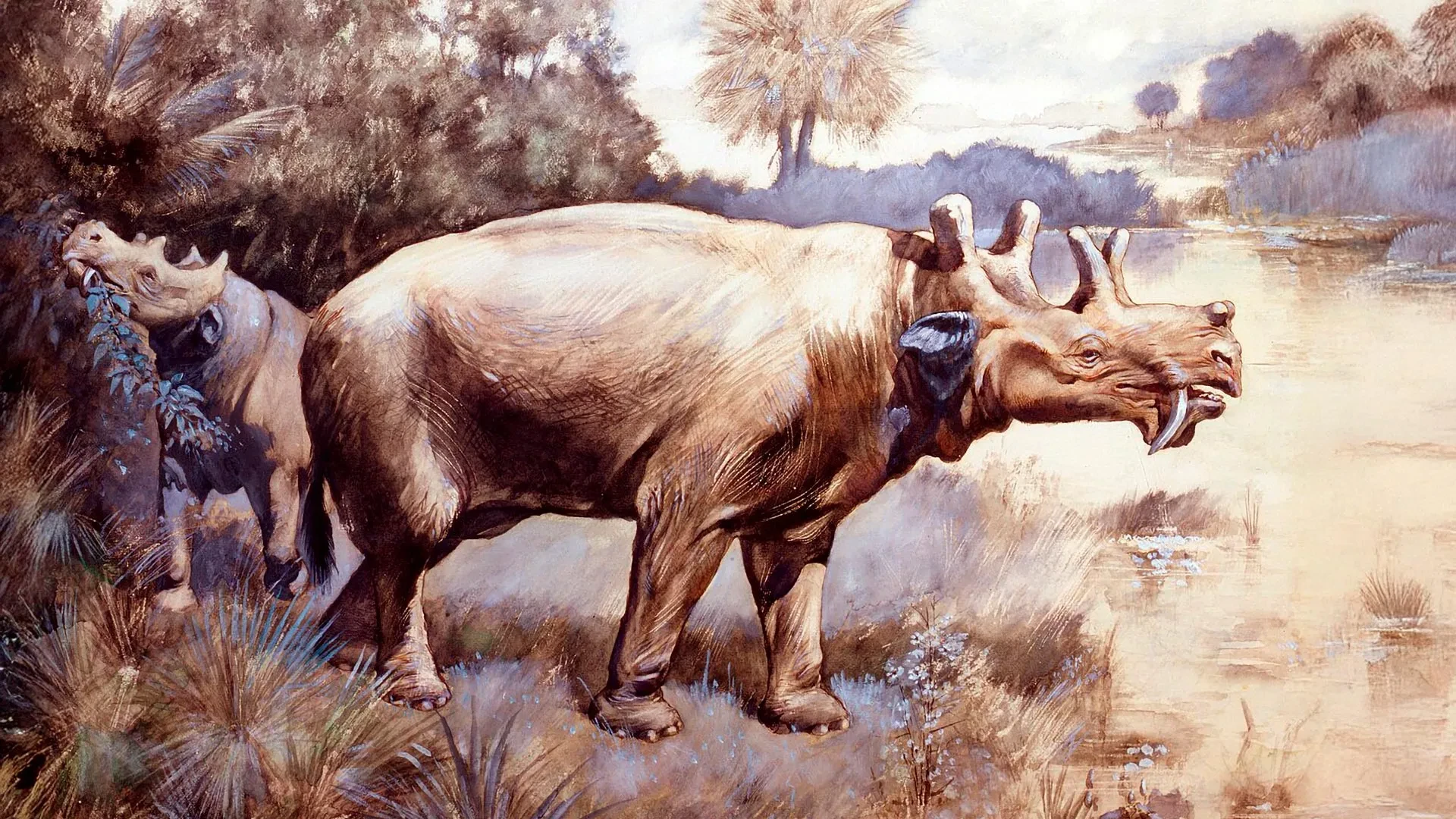
For generations, paleontologists have relied on a textbook narrative regarding uintatheres, an extinct order of massive, heavily armored herbivorous mammals that roamed North America and Asia roughly 58 to 38 million years ago. Recognizable by their rhinoceros-like bodies, formidable cranial horns, and exaggerated upper canine teeth, these creatures have long served as a classic evolutionary exhibit of pronounced sexual dimorphism. In the conventional telling, male uintatheres were colossal, aggressive combatants bearing massive bone-core horns and terrifying sabers used to vie for dominance, while females were presumed to be significantly smaller, more demure, and largely unadorned.
However, a meticulous new study published in PLOS One by researchers at the University of Kansas suggests this long-held dogma is built on fragile foundations—and potentially tainted by historical bias. Spearheaded by KU Biodiversity Institute & Natural History Museum doctoral student Kevin Mulcahy and senior curator K. Christopher Beard, the investigation began not with a grand theoretical quest, but with the humble discovery of a broken fossil tooth. By applying modern statistical rigor to museum-grade cranial archives and cross-referencing their findings with living analogues like the American bison, the KU team discovered that the physical divide between male and female uintatheres was far less pronounced than previously assumed.
This revisionist finding reaches far beyond a single prehistoric lineage. By exposing how late-19th-century Victorian cultural norms influenced early evolutionary interpretations, the research challenges foundational assumptions about sexual dimorphism across the mammalian fossil record. As modern biology continues to dismantle the notion that male-biased size dimorphism is the universal baseline for mammals, this study serves as an urgent reminder to re-evaluate how historical cultural bias has historically dictated the lens through which we view deep evolutionary history.
Detailed Chronology: From a Broken Tooth to a Paradigm Shift
The Fieldwork Discovery in Montana
The scientific pivot began quietly in the field. Kevin Mulcahy and K. Christopher Beard were conducting routine paleontological fieldwork in Montana, recovering various fragments of ancient fauna from Eocene-aged strata. Among their finds was a broken upper molar—a fragmentary specimen that immediately piqued their interest. Suspecting the tooth belonged to a uintathere, the researchers realized they lacked the comparative material necessary to pin down the species and confirm its anatomical identity with absolute certainty.
To resolve the identity of the isolated tooth, Mulcahy and Beard traveled to the American Museum of Natural History (AMNH) in New York City. The institution houses one of the world’s premier collections of fossil mammals, including entire rows of towering, meter-long uintathere skulls collected during the heroic age of American paleontology in the late 19th and early 20th centuries. Their initial objective was straightforward: match the dental morphology of the broken Montana molar against established type specimens.
The Museum Awakening
While studying the expansive AMNH fossil collections, however, Mulcahy noticed an anomaly that shifted the trajectory of his research. Walking down aisles lined with massive fossil skulls, he observed an immense degree of physical variation among specimens assigned to the same taxonomic groups. Crucially, this variation did not sort itself into the neat, bimodal binary that historical literature claimed existed.
"They have this big collection—entire shelves occupied with these skulls, and each one of them is almost a meter long," Mulcahy recalled. "These are famous specimens that are in the literature, and I was originally just looking at them to compare their teeth, and I noticed a ton of variation in a way that didn’t appear binary."
Driven by scientific curiosity, Mulcahy abandoned his exclusive focus on dental morphology. Armed with a simple handheld ruler, he began taking rapid-fire morphological measurements of the skulls lined up on the museum shelves, logging cranial lengths, horn core dimensions, and canine alveoli sizes.
Statistical Reality Checks
Back at the University of Kansas, Mulcahy began running statistical analyses on his hastily gathered dataset. Under classic models of sexual dimorphism—where males and females exhibit radically different physical builds due to sexual selection—statistical distribution curves of skull measurements should display a bimodal distribution. In plain terms, a frequency graph should reveal two distinct peaks or clusters: one representing the smaller females and another representing the larger males.
Instead, Mulcahy’s initial runs produced a frustratingly continuous spread. The metrics failed to cluster into two clean camps of "scary giants" and "smaller counterparts." This led to a critical methodological question: Were these animals genuinely classic examples of sexual dimorphism, or had generations of scientists simply forced a binary narrative onto a spectrum of natural variation?
To rigorously test this, Mulcahy expanded his dataset far beyond the New York collections. He gathered measurements from fossil repositories across North America, eventually compiling a comprehensive matrix encompassing approximately 30 remarkably complete skulls belonging to a single, well-represented species: Uintatherium anceps.
Despite boosting his sample size and applying advanced multivariate statistical analyses, the signal for distinct sexual dimorphism remained stubbornly faint. Mulcahy confronted a fundamental limitation intrinsic to paleontology: researchers cannot draw blood samples, examine chromosomes, or inspect soft tissues to determine the sex of an extinct organism.
"You can guess and then test whether or not the ones you guess are males differ from the ones you guess are females, but that’s super circular," Mulcahy explained. "Because you could just be picking the most extreme ones to be one sex and the least extreme to be the other. Of course they’re going to differ."
Supporting Context & Metrics: The Bison Control Group and Historical Bias
The Modern Bison Benchmark
To ensure his statistical methods were robust enough to detect sexual dimorphism if it genuinely existed, Mulcahy needed a control group—a living mammal with known sexes, massive body size, herbivorous habits, and prominent cranial weaponry. He selected the American bison (Bison bison).
Bison offered an ideal ecological and morphological parallel. Like uintatheres, they are massive herd-dwelling herbivores featuring prominent horns that play a role in social interactions. By analyzing skeletal measurements of modern bison specimens of verified sex, Mulcahy tested whether his statistical models could accurately sort the animals.
The results served as a stark contrast. "When you’re dealing with living animals, you can just take the males, take the females and compare them," Mulcahy noted. "Bison are another really big herbivore, with a similar sort of ecology that’s been proposed for uintatheres, and they also have big horns. What I noticed is that the signals of dimorphism I was picking up in bison were a lot clearer. When I was looking at the bison, it was almost perfect that all of the females were most similar to the females, and all the males were most similar to the males."
This methodological validation confirmed that Mulcahy’s statistical tools were sharp enough to detect real sexual dimorphism. The fact that those same techniques failed to yield clear-cut dimorphism in Uintatherium anceps strongly indicated that the historical consensus on the beasts was largely illusory.
The Victorian-Era Ideological Framework
If the fossil data does not support extreme sexual dimorphism, how did the myth persist for over a century? Mulcahy traces the origin of the assumption back to the cultural milieu of late-19th-century science.
The golden age of North American vertebrate paleontology coincided with the height of the Victorian era. It was an era when Charles Darwin’s newly minted theories of natural and sexual selection were being enthusiastically applied—and often overextended—to explain the natural world. Early paleontological pioneers, working within a deeply patriarchal social framework, approached the fossil record with preconceived notions about gender roles, dominance hierarchies, and physical capability.
"I think it’s really important to remember that these things were first discovered in the late 1800s by a bunch of male paleontologists working in a very Victorian-era mindset," Mulcahy said. "The idea is basically assumed at that point that males are going to be bigger and scarier than females. It’s really interesting: When you step back and actually test that hypothesis, it doesn’t really hold up."
By projecting contemporary human social constructs and Victorian ideals of aggressive, dominant males onto deep-time ecosystems, pioneering researchers institutionalized an unverified hypothesis. Because uintatheres were subsequently cited in textbooks as the quintessential poster children for sexual dimorphism, the assumption calcified into accepted fact, insulating it from empirical challenge for generations.
Official Statements and Expert Perspectives
"Males have been interpreted as being much larger and possessing far more dramatic cranial features than females."
— Kevin Mulcahy, Doctoral Student, KU Biodiversity Institute & Natural History Museum
Mulcahy’s work has forced a re-examination of how evolutionary biologists interpret the fossil record. Rather than viewing anatomical variation through a binary filter of sexual competition, modern paleontology is increasingly recognizing the complex interplay of age, individual variation, intraspecific competition, and environmental stressors.
"Strong, big male-style sexual dimorphism was probably not ancestral at the root of the mammalian tree, and among the mammals where we do see this pattern today, it’s almost certainly shown up independently several times."
— Kevin Mulcahy, Study Lead Author
This perspective aligns with broader shifts in mammalian biology. For decades, evolutionary theory operated under the blanket assumption that male-biased size dimorphism was the ancestral mammalian condition. However, recent large-scale demographic surveys of extant mammals have upended this dogma. Comprehensive studies published within the last several years demonstrate that among living mammalian species, the majority either exhibit no significant size dimorphism or actually feature larger females.
"The idea that males are always bigger than females is really just a choice of what animals were people looking at, what are the things that biologists in the past were interested in," Mulcahy emphasized. By focusing disproportionately on charismatic megafauna like seals, deer, and primates—where male-biased dimorphism is common—early researchers constructed a skewed baseline that failed to capture the true breadth of mammalian evolutionary strategies.
Future Outlook: Re-Evaluating Deep-Time Ecosystems
The implications of Mulcahy and Beard’s research extend far beyond the taxonomy of Uintatherium anceps. If uintatheres—long considered the gold standard for sexual dimorphism in the Eocene fossil record—fail to demonstrate clear sexual bifurcation, paleontologists must now rigorously re-examine other extinct lineages.
Next Steps in Paleontological Research
- Auditing Historical Collections: Researchers are beginning to revisit classic fossil assemblages across major international museums, applying modern multivariate morphometrics and geometric morphometrics to taxa previously assumed to be heavily dimorphic.
- Refining Sex-Determination Protocols: Without soft tissue or genetic material, paleomammalogists are exploring alternative proxies—such as dental isotopic analysis, pathological stress markers, and bone density histology—to find non-circular methods for identifying biological sex in fossils.
- Broadening Ecological Modeling: Reassessing uintathere social structures will require rebuilding models of how these animals fed, migrated, and interacted. If males and females were closer in size and armament, social dynamics within uintathere herds may have been far more egalitarian or cooperative than previously imagined.
The Broader Legacy
The unravelling of the uintathere dimorphism myth highlights the self-correcting nature of the scientific method. It demonstrates how modern statistical rigor, combined with a willingness to interrogate historical assumptions, can breathe new life into museum archives that have sat undisturbed for over a century.
As science continues to shed its historical biases, the prehistoric world emerges not as a simplistic mirror of Victorian social expectations, but as a complex, dynamic biosphere governed by evolutionary pressures far more diverse than our intellectual ancestors ever imagined.
