

Executive Overview
Every year, millions of tons of durable synthetic polymers are discarded, compounding a global environmental crisis that has choked municipal landfills and contaminated marine ecosystems. Among these persistent pollutants, polyvinyl chloride (PVC)—widely used in weathered plumbing pipes, rigid window frames, and expired credit cards—stands out as one of the most chemically recalcitrant and notoriously difficult materials to recycle.
However, a team of pioneering chemists and chemical engineers at Virginia Tech has unlocked a transformative chemical pathway that could fundamentally alter humanity’s relationship with plastic waste. Led by Guoliang "Greg" Liu, the research team has successfully developed an innovative upcycling process that converts discarded PVC directly into polyalphaolefins (PAOs)—the high-value, synthetic base oils that serve as the lifeblood of advanced industrial lubricants and motor oils.
Published in the prestigious journal Nature, this breakthrough offers a dual-pronged solution to some of the modern era’s most pressing engineering and environmental challenges. By tackling the chlorine-laden chemistry that has historically stymied conventional recycling streams, the Virginia Tech methodology simultaneously diverts stubborn plastic waste from landfills and establishes a greener, more sustainable manufacturing pipeline for vital mechanical fluids.
As global demand for high-performance synthetic lubricants continues its steady upward trajectory, this discovery bridges the gap between waste management and petrochemical engineering. It proves that tomorrow’s industrial lubricants do not need to be synthesized exclusively from virgin fossil fuels, but can instead be mined from the very refuse we throw away.
Detailed Chronology: From Lab-Bench Frustration to a Breakthrough in Polymer Science
Building on Earlier Plastic Upcycling Successes
The journey toward converting PVC into engine oil did not happen in a vacuum. It represents the logical, albeit ambitious, next step in a broader research initiative spearheaded by Liu’s laboratory at Virginia Tech. In previous groundbreaking studies published in high-impact journals such as Science and Nature Sustainability, Liu and his team demonstrated that other challenging classes of plastic waste could be successfully broken down and transformed into surfactants—surface-active agents widely utilized in commercial soaps, detergents, and industrial emulsifiers to bridge the gap between water and grease.
Encouraged by these early victories in polymer upcycling, Liu challenged his research group to confront a far more formidable adversary: polyvinyl chloride. While standard plastic waste management often relies on mechanical recycling—melting and reshaping plastics into lower-grade products—upcycling aims higher, seeking to elevate discarded materials into high-value chemical commodities. To execute this vision, Liu assembled a tightly knit team of graduate students, affectionately dubbed the "three musketeers" of the lab.
Eric Munyaneza Nuwayo, a doctoral candidate in his final year, was tapped to lead the day-to-day experimental execution. He was joined by Connor S. Thompson, a chemistry graduate student who seamlessly pivoted from an entirely different research track, and Abby Civiello, a first-year graduate student whose rapid integration proved critical to maintaining the project’s momentum.
The Pivot: From Modification to Molecular Fragmentation
Initially, the team approached the problem through the lens of traditional polymer modification. Like all plastics, PVC is a polymer—a macromolecule constructed from immense, repeating chains of chemical units. In the case of PVC, the backbone is characterized by a carbon-carbon skeleton heavily decorated with chlorine atoms.
The initial working hypothesis was deceptively straightforward. Because PVC represents one of the most chemically activated forms of polyethylene, the research team assumed they could simply strip away or replace the chlorine atoms with alternative functional groups, thereby altering the polymer’s physical characteristics into a useful, stable material.
Yet, nature proved uncooperative. Repeated experiments yielded consistently disappointing results. Instead of producing a cleanly functionalized polymer with marketable traits, the chemical reactions continually bogged down, resulting in tacky, gooey, and thoroughly impractical sticky substances. For weeks, the project hovered on the brink of stagnation as the team grappled with unwanted byproducts.
The turning point arrived during a moment of profound scientific reflection. Observing the stubbornly soft and unmanageable nature of the gooey intermediate material, Liu experienced a conceptual epiphany. Rather than stubbornly attempting to preserve and modify the long molecular chains, why not lean into the breakdown? What if the polymer chains were aggressively fragmented into much smaller, highly controlled segments?
"The idea was simple. PVC, as one of the most activated forms of polyethylene, ought to be easily converted into some other molecules by replacing the chlorine atoms with other groups," Liu recalled. Reflecting on the turning point, he noted: "One day I realized—if this polymer is so gooey and so soft, why don’t I just keep breaking the polymer chains down to smaller segments?"
Refining the Chemical Process
Acting on this intuitive leap, the team modified their protocol. Instead of mere functional substitution, they subjected the PVC feedstock to a specialized cracking and synthetic rebuilding process.
The refined procedure is remarkably methodical. First, post-consumer or industrial PVC—sourced from items as mundane as old plumbing pipes, discarded window frames, and expired credit cards—is introduced into a specialized solvent bath. Next, the researchers add aluminum trichloride alongside alpha-olefins, a specific class of hydrocarbons heavily relied upon in the production of high-grade synthetic lubricants.
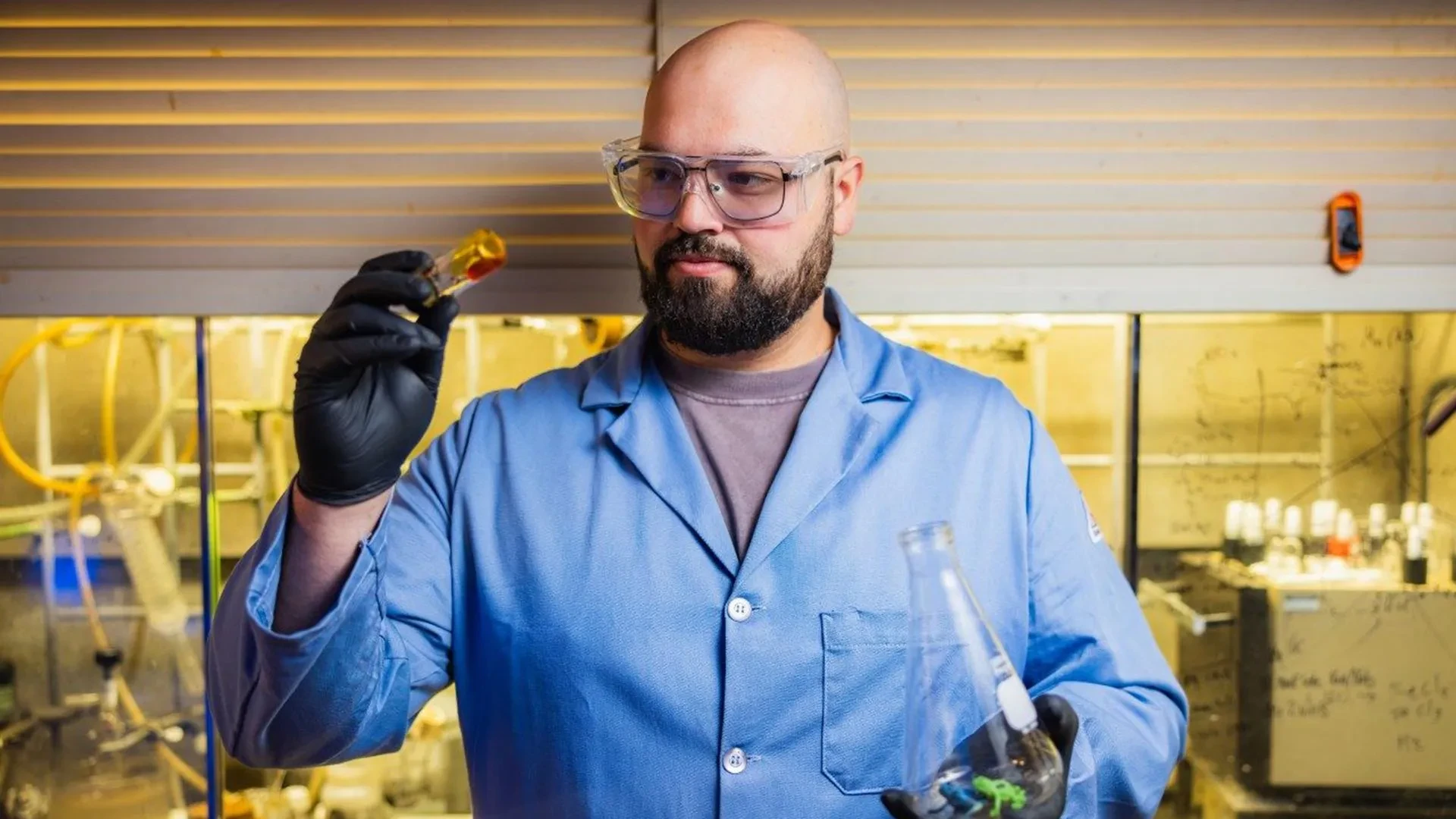
The entire mixture is then heated to a controlled temperature of 158 degrees Fahrenheit (approximately 70 degrees Celsius) and allowed to react for three hours. Throughout this thermal and catalytic window, the massive, rigid PVC chains are systematically dismantled and re-engineered. Upon completion, the researchers extract a relatively thick, amber-hued lubricating oil that possesses the exact chemical architecture required for demanding mechanical applications.
Supporting Context & Metrics: The Chemistry and Economics of PVC Upcycling
Why PVC Recycling Has Historically Failed
To appreciate the magnitude of the Virginia Tech discovery, one must understand why polyvinyl chloride has long been considered the pariah of the recycling industry. PVC is the world’s third-most widely produced synthetic plastic polymer, finding ubiquitous application in construction, healthcare, consumer goods, and automotive manufacturing.
However, its chemical composition presents unique nightmares for recycling facilities:
- The Chlorine Factor: Chlorine constitutes roughly 57% of PVC’s molecular weight. When conventional plastics are melted down or incinerated without sophisticated scrubbing, this high chlorine content can lead to the emission of corrosive hydrochloric acid gas and toxic dioxins.
- Complex Additives: To make PVC versatile—ranging from rigid pipes to flexible medical tubing—manufacturers blend in a vast array of chemical plasticizers (such as phthalates), thermal stabilizers, and fillers. These foreign additives contaminate standard recycling streams, rendering traditional mechanical reprocessing economically unviable and technically destructive to processing machinery.
Consequently, the vast majority of global PVC waste bypasses recycling loops entirely, destined instead for permanent interment in municipal landfills or environmental accumulation.
The Hidden Industrial Giant: Synthetic Lubricants
While plastic waste dominates environmental headlines, another silent industrial giant consumes vast resources: synthetic lubricants. Lubricants rarely capture public attention, yet they are the unsung heroes of modern mechanical civilization.
From backyard lawnmowers and commuter automobiles to massive industrial turbines and high-bypass jet engines, lubricants perform non-negotiable tasks:
- Friction Reduction: They interpose a microscopic fluid film between moving metal components, drastically lowering surface friction.
- Thermal Regulation and Wear Prevention: By minimizing metal-on-metal contact, they mitigate wear and tear, vastly extending the operational lifespan of expensive mechanical equipment and preventing catastrophic thermal seizures.
The Virginia Tech process yields polyalphaolefins (PAOs), which belong to an elite class of synthetic base oils prized across the globe for their exceptional thermal stability, shear resistance, and capacity to function flawlessly across extreme temperature differentials. By successfully synthesizing PAOs from degraded PVC, the researchers have established a direct bridge from a high-liability waste stream to a high-value industrial commodity.
Collaborative Validation and Scale-Up Modeling
Recognizing that laboratory success is only the first step toward commercial viability, Liu engaged a multidisciplinary coalition of academic institutions to rigorously evaluate the newly minted synthetic oil:
- Performance Testing: Samples were dispatched to Dr. Ali Erdemir’s laboratory at Texas A&M University, where tribology experts subjected the recycled-plastic oil to rigorous friction, wear, and load-bearing evaluations, confirming its parity with commercial-grade PAOs.
- Molecular Modeling: At the California Institute of Technology (Caltech), Nobel laureate-associated computational chemist William Goddard provided advanced chemical computations to model and verify the underlying reaction mechanisms at a molecular level.
- Economic Viability: Back at Virginia Tech, researcher Xi Chen spearheaded the techno-economic and manufacturing analysis, constructing predictive models to determine how this chemical transformation can be scaled up from benchtop glassware to industrial reactor fleets.
Official Statements and Expert Perspectives
The breakthrough has generated substantial excitement within the academic and chemical engineering communities, validating years of persistence by Liu and his graduate students.
Reflecting on the dual impact of the discovery, lead researcher Guoliang "Greg" Liu emphasized both the scientific milestone and its market alignment:
"Number one, we have proved that it is feasible to use plastic waste to make high-performance lubricants. Number two, these lubricants are green, and they can meet the emerging needs for sustainability by the market."
Addressing the societal invisibility of their finished product, Liu poetically underscored the vital role lubricants play in global infrastructure:
"Lubricants are the silent hero out there. We often don’t exist in people’s minds, but they are out there working quietly. We want to be able to produce the oil on a larger scale to reach more people in the world."
Commenting on the grueling yet rewarding trajectory of the research, Liu fondly recalled the dynamic among his student researchers, praising their collective adaptability:
"I often called them the three musketeers."
Future Outlook: Scaling Sustainability for a Circular Economy
As the Virginia Tech team transitions from foundational discovery to applied development, the roadmap ahead is focused squarely on scalability, environmental optimization, and commercialization.
While the laboratory-scale conversion proves that old plumbing pipes, discarded window frames, and expired credit cards can be successfully transmuted into premium motor oil, several critical milestones remain:
- Feedstock Diversification: Future studies will test the chemical process against heavily contaminated, post-consumer municipal PVC waste streams containing mixed plasticizers and environmental debris to ensure the catalyst systems remain robust.
- Process Optimization: Engineering teams are working to refine solvent recovery rates, lower energy inputs during the 158-degree Fahrenheit heating phase, and maximize the overall conversion yield to ensure commercial cost-competitiveness against virgin petrochemical routes.
- Industrial Partnerships: Translating academic innovation into industrial reality will require strategic partnerships with lubricant manufacturers and petrochemical conglomerates capable of designing continuous-flow pilot plants.
If successful, this technology heralds a profound shift in materials science. By converting one of the planet’s most stubborn and environmentally hazardous polymers into a high-performance industrial asset, Virginia Tech’s research team has sketched the blueprint for a true circular economy. In the near future, the PVC pipe discarded during a home renovation may very well return to guard the engine of your automobile—proving that in the realm of advanced chemistry, waste is merely a resource waiting for the right catalyst.
