

Executive Overview
The convergence of election night reality and right-wing media fantasy reached a dramatic breaking point as the final polls closed across the United States. For months, conservative media empires—anchored by Fox News, Newsmax, and a sprawling network of digital influencers—painted a picture of an angry, ascendant electorate poised to enact a sweeping, permanent political realignment. Figures like Greg Gutfeld and Clay Travis routinely dismissed the possibility of a Democratic resurgence, leaning heavily into culture-war tropes and assuring their audiences that the conservative wave was unstoppable.
Instead, the electorate delivered an unmistakable political earthquake. Dubbed a "blue tsunami" even by Murdoch-owned tabloids like the New York Post, the midterms dismantled years of manufactured MAGA hype. Voters decisively rejected the economic and social messaging of the contemporary right, repudiating policies symbolized by the administration’s contentious financial packages and turning out in historic numbers to reshape the American political landscape.
As the full scope of the defeat became clear, the conservative apparatus fractured immediately. Rather than engaging in constructive introspection or acknowledging economic realities, the movement’s most prominent architects and commentators retreated into a circular firing squad. Blame was cast in every conceivable direction: immigration policies, voting access laws, internal ideological betrayals, and even Donald Trump himself. This analysis examines the anatomy of that collapse, charting how an insular political media ecosystem, blinded by its own rhetoric, reacted when confronted with an undeniable democratic verdict.
Detailed Chronology: From Election Eve Hubris to Morning-After Panic
The Final Hours of Denial
As late as forty-five minutes before the first precincts closed on Tuesday evening, the baseline narrative across conservative media remained entirely detached from the unfolding reality on the ground. On Fox News’ The Five, Greg Gutfeld leaned into trademark satirical deflection, quipping on air, "Gas prices are so high, I’m going to vote for the party that wanted to trans my kids," while assuring viewers that no Democratic momentum existed. Concurrently, Outkick founder and Fox contributor Clay Travis took to social media to proclaim a major Republican surge in Florida, assuring followers that polling aggregates were entirely wrong.
This confidence was echoed across the digital sphere, where millions of dollars in venture-backed and independent influencer capital had been deployed to secure conservative strongholds. Elon Musk, who had relocated to Texas and reportedly invested $150 million to cement conservative dominance in the Lone Star State, broadcasted optimistic rallying cries urging voters to turn the state deep red.
The Returns and the Reality Check
The illusion evaporated the moment results began trickling in. The electoral map revealed an avalanche of progressive and moderate Democratic victories that caught both parties flat-footed. Georgia made history by electing Keisha Lance Bottoms as its first Black woman governor, while Michigan dispatched Dr. Abdul El-Sayed to Washington as the nation’s first Muslim senator. In New Hampshire, voters elected Chris Pappas as the first openly gay man to represent the state in the Senate, and New Mexico elevated Deb Haaland to the governorship as the state’s first Native American woman.
Further compounding the conservative shockwaves:
- Minnesota: Peggy Flanagan secured a historic Senate seat as a Native American woman.
- Texas: Gina Hinojosa defeated three-term incumbent Greg Abbott, becoming the state’s first Latina governor and breaking a decades-long Democratic drought in the executive mansion.
- Ohio: Dr. Amy Acton claimed the governorship, marking a first for women in the state.
- South Carolina: Dr. Annie Andrews captured a historic Senate victory.
- Kansas: Democrats secured a Senate seat for the first time in nearly a century.
With majorities in both the House and Senate effectively locked in, projections solidified that Hakeem Jeffries would ascend to become the nation’s first Black Speaker of the House. Even Rupert Murdoch’s New York Post abandoned its usual defensive posture, running a blistering front-page headline: "Trump suffers historic rebuke as Dems romp in midterms," underscored by the bold declaration, "BLUE TSUNAMI."
Supporting Context & Metrics: The Anatomy of an Economic Rejection
The seismic shift in the 2026 midterms was not merely a cultural protest; it was a profound economic referendum. For years, right-wing media apparatuses treated Donald Trump’s political brand as an unassailable cultural force, assuming that domestic grievance and identity politics could indefinitely mask structural economic pain.
However, voters experiencing severe cost-of-living pressures viewed the administration’s signature economic initiatives—including the much-touted "$5,000 Trump Dividend" proposals—with deep skepticism. On election night, former New York Mayor Bill de Blasio, seated awkwardly between former Trump press secretaries Kayleigh McEnany and Karoline Leavitt on Fox News, bluntly diagnosed the disconnect: "The American people are looking at a war they do not believe in, and they did not authorize. They’re looking at prices that are making it impossible for middle-class people, let alone working-class people, to live."
This sentiment was mirrored in voter participation metrics, which defied conservative efforts to restrict access to the ballot. Despite high-profile attempts by legislative leaders to shrink the active electorate, working-class families and suburban voters utilized early and mail-in voting channels to voice their discontent. The narrative that conservative policies were bringing about mass exoduses from blue states like California collided with the reality that local economic distress was hitting traditional red strongholds just as hard, leaving voters to penalize incumbents across the board.
Official Statements and Internecine Warfare
As the morning sun rose on Wednesday, November 4, 2026, the conservative ecosystem dissolved into open warfare. The reaction from leadership figures and media surrogates exposed deep ideological fractures within the post-establishment Republican coalition.
The White House and the Network Connection
Watching the coverage unfold from the White House, Donald Trump took to Truth Social to air his grievances with his preferred network, expressing fury at the inclusion of political opponents and attacking commentators: "Why does FoxNews have deBlasio… I can’t stand Jessica Tarlov’s voice — DUMB AS A ROCK, but it’s the voice that gets me."
When Gutfeld read the president’s real-time text messages live on air—underscoring Fox News’s modern role as a direct feedback loop for the executive branch—liberal panelist Jessica Tarlov responded via social media: "Reality is a tricky thing," adding that the president "should get better at dealing with it."
The Influencer Ecosystem’s Circular Firing Squad
In the broader conservative media and influencer sphere, the response was chaotic and mutually destructive:
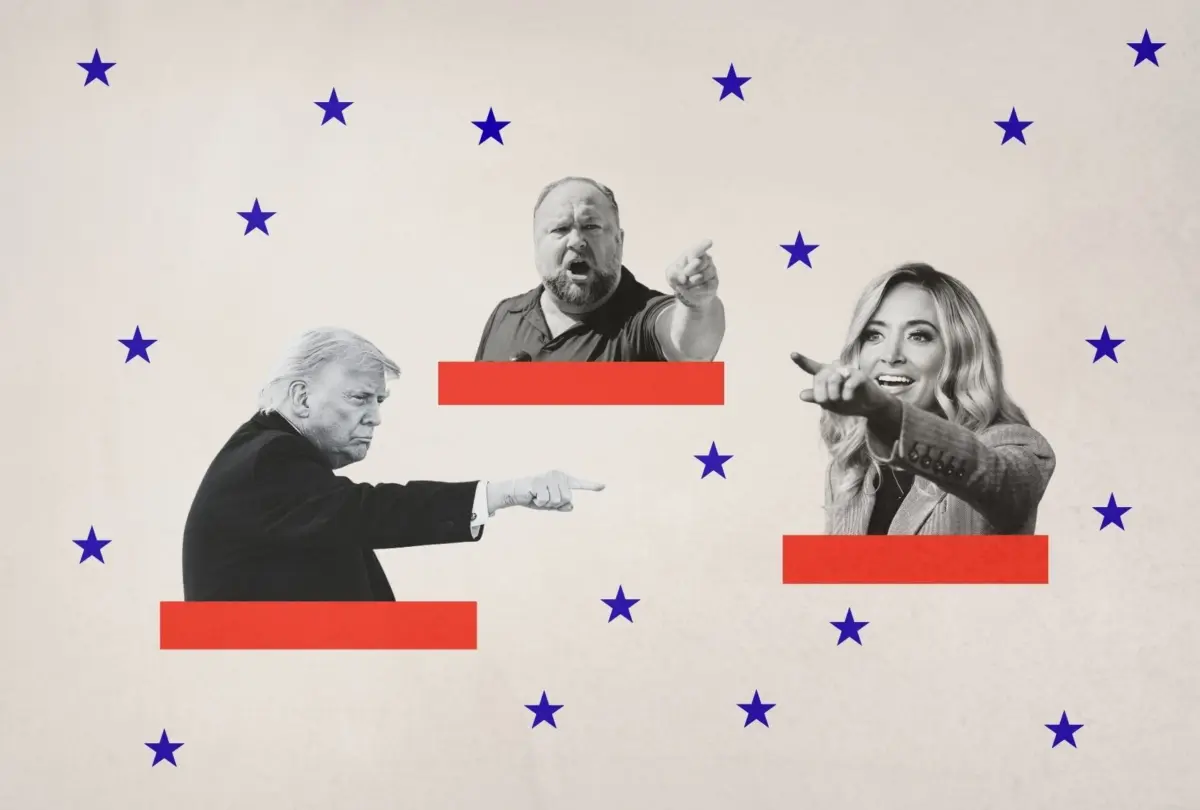
- Alex Jones: In a stunning livestream, conspiracy theorist Alex Jones turned his ire toward the movement’s titular head, suggesting that Trump was a deep-state plant: "I think he’s a Democrat. I’m 100% at war with Trump. He’s not that rtarded. He did this on purpose. I think he’s the ultimate Democrat sleeper cell and he works for them."*
- The Great Replacement Rhetoric: Figures like Benny Johnson, Libs of TikTok, and Fox’s Lawrence Jones reverted to familiar nativist tropes. Reporting from Texas, Lawrence Jones warned, "There is a lesson here. Don’t be so welcoming."
- Doomerism and Meme Culture: Influencer Laura Loomer declared that "America is over and so is the American Dream." Meanwhile, Daily Wire commentator Ben Shapiro posted the classic "everything is fine" fire GIF, and The Federalist’s Sean Davis answered with the hot-dog-suit meme, symbolizing a refusal to accept internal accountability.
Legislative Collisions
The hostility quickly turned personal among elected officials and media commentators. Representative Nancy Mace took to Fox News to excoriate conservative radio host Mark Levin, telling him to "STFU" and blaming his "beloved" foreign wars for alienating working-class voters who could no longer afford basic necessities.
Levin fired back viciously on his platform, labeling Mace a "washed up political loser" and "one of the most mentally unhinged POS to ever be in Congress." He claimed she was lashing out because she would "actually have to now work for a living."
Adding a final layer of irony to the evening, Katie Miller—podcaster, administration insider, and prominent MAGA voice—revealed to CBS News that she had chosen not to participate in the election at all. Explaining her abstention in Virginia, she noted, "I did not vote in Virginia because in Virginia when you vote, you dox your own address, and so I prefer my own safety and security over giving that up."
Future Outlook: The Post-MAGA Political Landscape
The events of November 4, 2026, mark a definitive turning point in American political history. The election results demonstrate unequivocally that the MAGA phenomenon was fundamentally tethered to Donald Trump’s unique personal magnetism and historical circumstances, failing to function as a durable, institutionalized governing philosophy that could be easily transferred to imitators or sustained during acute economic strain.
For the conservative media apparatus, the midterms exposed the dangerous peril of living inside an informational echo chamber. By substituting culture-war hallucinations for macroeconomic reality, networks like Fox News and Newsmax left their audiences and political champions completely unprepared for the popular backlash.
As the new congressional majorities prepare to take office—ushering in historic diverse leadership under figures like incoming House Speaker Hakeem Jeffries—the conservative movement faces an existential reckoning. Stripped of its institutional guardrails, fractured by internal recriminations, and abandoned by voters who prioritized economic stability and democratic norms over grievance politics, the right now confronts a fractured future. Whether the movement can rebuild from the ashes of the 2026 debacle, or whether it will continue to tear itself apart in public view, remains the central question of the post-Trump era.
