

For years, the WordPress ecosystem has relied on a standardized, boxed-in methodology for site creation. Traditional page builders made web design accessible to the masses, but they frequently came with heavy structural compromises: rigid layouts, dependency on a fragmented web of third-party plugins, bloated Document Object Models (DOMs), and significant performance trade-offs that damaged search engine optimization (SEO) and user experience.
Enter Kirki, a pioneering no-code visual website builder for WordPress that challenges decades of platform conventions. Featuring a freeform infinite canvas, a robust integrated Content Management System (CMS), and zero plugin dependencies, Kirki redefines how websites are architected. Rather than modifying legacy paradigms, it bridges the design freedom of modern tools like Figma and Webflow with the content management power of WordPress.

This comprehensive analysis examines Kirki’s core architecture, compares its performance metrics against traditional competitors like Elementor, details its feature set—ranging from native dynamic content to real-time collaboration—and evaluates its potential to reshape the future of WordPress development.

Detailed Chronology & Industry Evolution
To understand the disruption Kirki brings to the WordPress market, one must trace the evolution of site-building tools over the past two decades:

- The Era of Static Themes (Early 2010s): Developers relied heavily on PHP-based theme files, child themes, and CSS frameworks. Customization required deep technical knowledge, creating a high barrier to entry for non-developers.
- The Rise of Structured Page Builders (Mid-to-Late 2010s): Tools like Elementor, WPBakery, and Divi democratized web design by introducing drag-and-drop interfaces. However, these systems forced elements into rigid rows, columns, and heavily nested
<div>wrappers, setting the stage for modern site bloat. - The Block Editor Revolution (2018–Present): WordPress introduced Gutenberg to modernize the core publishing experience, pushing toward native component blocks. Yet, advanced design professionals often found core blocks too restrictive for pixel-perfect agency work.
- The Modern Design Tool Shift (2020s): Standalone SaaS design tools like Webflow and Framer shifted user expectations toward freeform canvases, CSS variables, and fluid responsive layouts. WordPress users, however, remained bound to traditional plugin ecosystems.
- The Arrival of Kirki: Breaking away from traditional box models, Kirki launched as the first freeform visual website builder on WordPress with an infinite canvas, unifying design freedom, performance optimization, and zero third-party dependencies into a single platform.
Supporting Context & Performance Metrics
Performance directly impacts user retention, conversion rates, and search rankings. To evaluate how Kirki stacks up against established industry standards, independent benchmarks were conducted comparing Kirki and Elementor under identical, controlled conditions.

Benchmark Test Parameters
- Environment: Clean WordPress installation utilizing the default Twenty Twenty-Five theme.
- Layout Structure: Identical visual multi-section layouts featuring text, imagery, structural wrappers, and call-to-action buttons.
- Testing Tool: Google Lighthouse performance audits measuring load times, script execution, and Core Web Vitals.
Performance Results & Code Output Analysis
The performance audits revealed a stark contrast in technical efficiency:

- Kirki Performance Output: Kirki generated a streamlined, clean Document Object Model (DOM). By eliminating unnecessary wrapper tags and deeply nested HTML structures, Kirki produced fast execution times, minimal script overhead, and high scores across all Core Web Vitals.
- Elementor Performance Output: Elementor introduced heavier markup and additional runtime scripts even on basic layouts. The resulting heavily nested HTML structure negatively impacted DOM size and delayed First Contentful Paint (FCP) metrics.
| Performance Metric | Kirki Builder | Traditional Competitor (Elementor) |
|---|---|---|
| DOM Complexity | Minimal, semantic HTML | Heavily nested wrappers (<div> bloat) |
| Script Execution Overhead | Low | High (requires additional runtime assets) |
| Core Web Vitals Impact | Negligible / Optimized | Moderate to High (requires caching plugins to mitigate) |
| Third-Party Add-on Need | Zero (All-in-one architecture) | Frequently requires multiple extensions |
Feature Deep Dive: Architectural Innovations
Kirki distinguishes itself through a suite of advanced, natively integrated tools designed to streamline workflows for designers, developers, and enterprise agencies alike.

1. Freeform Infinite Canvas & True Responsive Editing
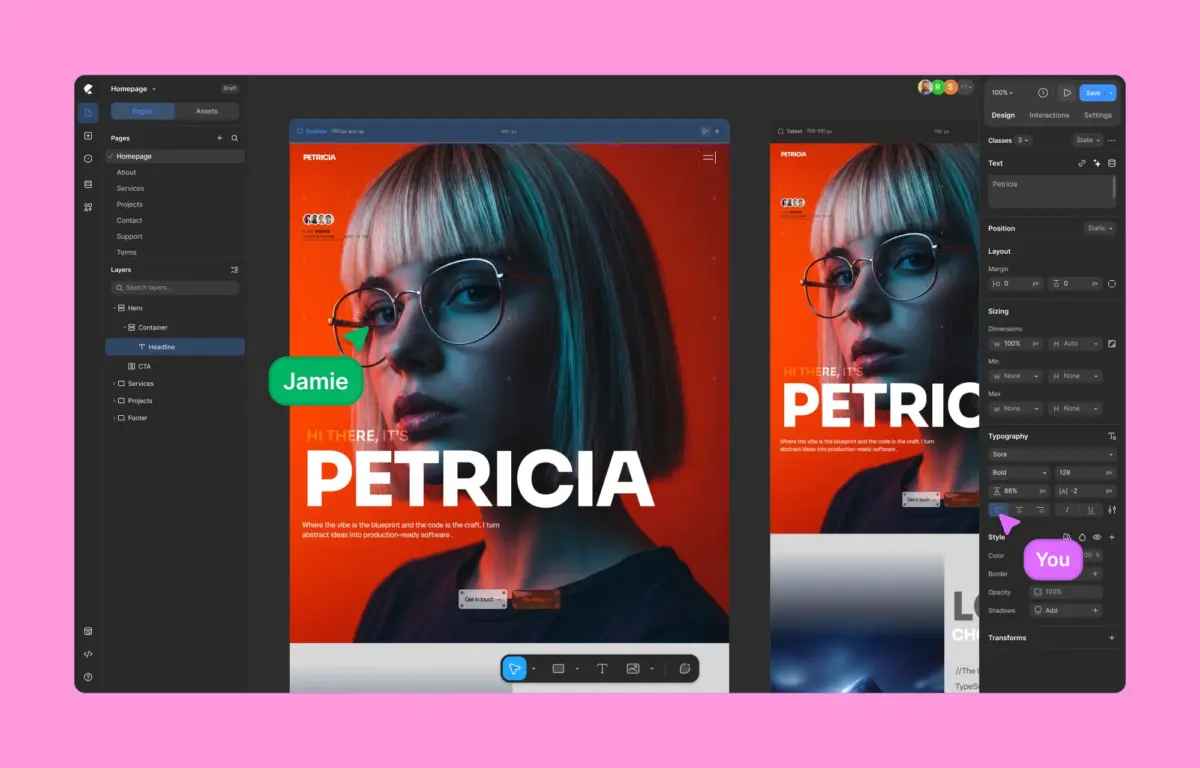
Moving beyond strict grid constraints, Kirki provides an infinite canvas where creators can pan, zoom, layer backgrounds, and position elements with absolute precision. Furthermore, Kirki solves one of responsive design’s greatest headaches through concurrent multi-view editing. Desktop, tablet, landscape, and mobile views are displayed simultaneously on the same canvas in real time. Changes cascade intelligently from larger breakpoints down to smaller screens, eliminating redundant adjustments.

2. Instant Figma-to-Kirki Handoff
For design-forward agencies, Kirki bridges the gap between UI/UX design tools and production code. Designers can import complex layouts created in Figma directly into Kirki. The system automatically structures the import into responsive, clean layouts without requiring developers to rebuild pages from scratch.

3. Native Dynamic Content & Class-Based Styling
- Dynamic Content Manager: Unlike traditional WordPress setups that require external plugins like Advanced Custom Fields (ACF) to handle custom fields and dynamic data bindings, Kirki integrates a robust dynamic content manager natively.
- Class-Based & Global CSS Variables: Elements styled in Kirki automatically map to reusable CSS classes and global design tokens (colors, typography, spacing). Updating a global variable instantly transforms styling across the entire site, ensuring design consistency at scale.
4. Visual Interactions, Animations & Kirki Apps
Kirki includes a timeline-based animation editor that supports scroll-triggered motions, hover interactions, and character-level text animations without writing custom JavaScript. Additionally, the Kirki Apps dashboard centralizes third-party integrations—such as CRMs, analytics platforms, and marketing tools—allowing administrators to connect services directly from the builder interface.

5. Collaborative Co-Editing & Built-in Quality Control
Addressing the needs of distributed teams, Kirki introduces real-time multi-user co-editing. Team members can view color-coded cursors and leave contextual comments directly pinned to elements on the canvas. Before publishing, the built-in Page Audit tool scans layouts for accessibility flaws, missing image alt text, broken links, and SEO readiness.

Pricing Models and Value Proposition
Kirki offers a transparent pricing structure designed to remove hidden upgrade walls common in the page builder market:

- Free Version: Available directly on WordPress.org, the free tier provides full access to the infinite canvas and modern styling tools without acting as a restricted teaser.
- Starter Plan ($59/year): Covers a single site and unlocks all premium features, dynamic tools, and template libraries.
- Lifetime Plan ($499 one-time): Provides unlimited usage forever with no recurring subscription fees or surprise upcharges.
Comparatively, traditional platforms often gate critical features behind higher pricing tiers or necessitate purchases of separate form builders, popup plugins, and animation add-ons. Kirki bundles these capabilities into a unified subscription.

Future Outlook
As the web development landscape increasingly demands higher performance standards, lightweight codebases, and seamless design workflows, legacy WordPress builders face mounting pressure to modernize.

Kirki represents a fundamental shift in how WordPress sites are conceptualized. By combining the visual fluidity of modern design software with the robust backend capabilities of the world’s most popular CMS, Kirki proves that performance and creative freedom do not need to be mutually exclusive. For designers, developers, and digital agencies seeking to future-proof their web development stack, Kirki emerges not merely as an alternative tool, but as a compelling blueprint for the next generation of WordPress site building.
