

Executive Overview
In the high-stakes realm of planetary science, monumental discoveries are occasionally born not from grand, coordinated observing campaigns, but from the quiet, methodical vigilance of a single researcher poring over data. This was precisely the case when Robert Wagner, an image-processing specialist from Intuitive Machines collaborating with NASA’s Lunar Reconnaissance Orbiter (LRO) mission, noticed an unmistakable anomaly on his computer screen.
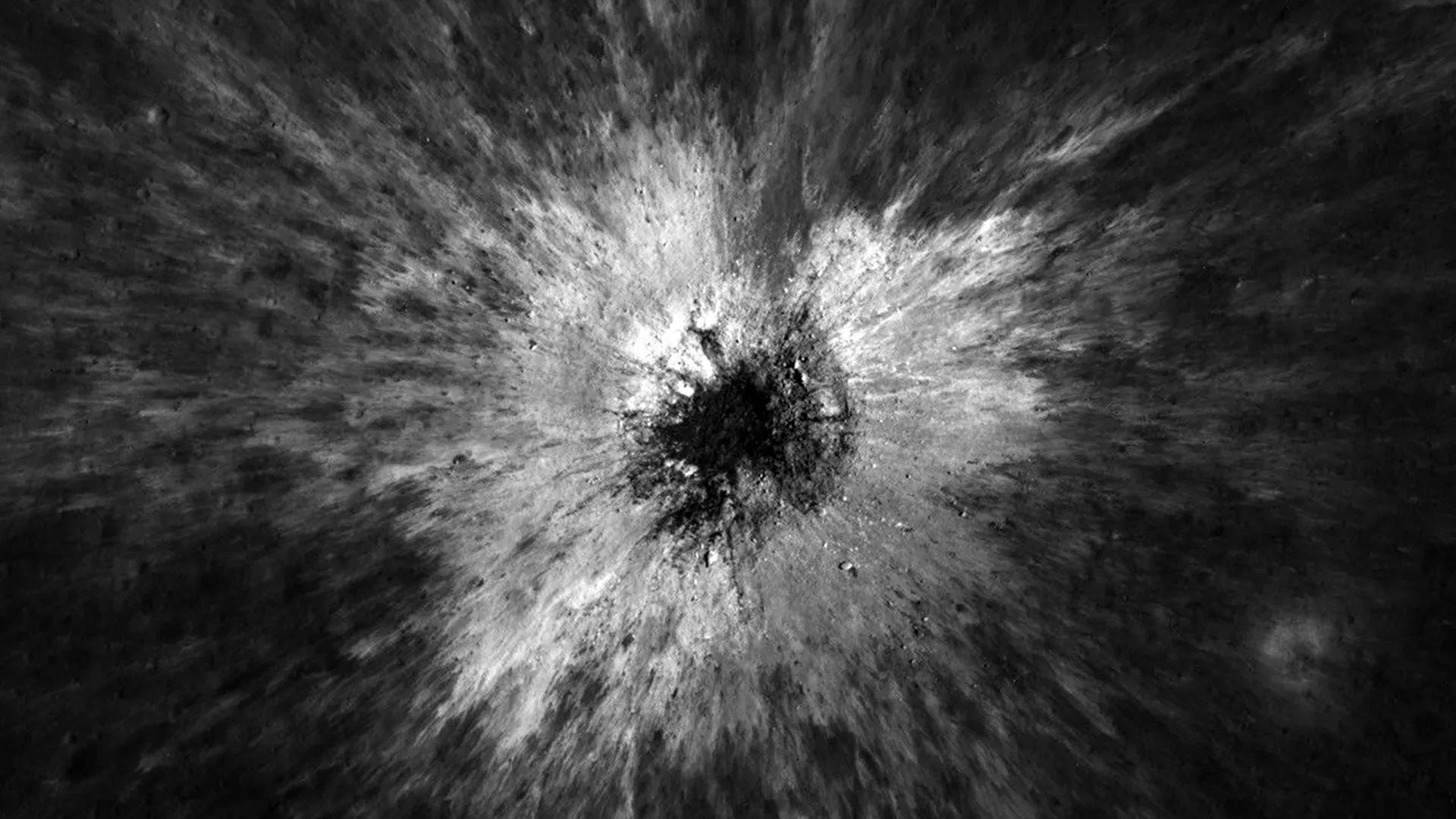
A routine scan of lunar cartography data revealed an unusually bright patch framed by a stark, dark halo—a classic signature of freshly disturbed regolith. What Wagner had stumbled upon was not a glitch in the software or a shadow trick cast by the low-slung lunar sun, but a newly formed impact crater of unprecedented proportions.
Officially named McGetchin in honor of the pioneering lunar scientist Tom McGetchin, this colossal scar on the lunar landscape is the largest newly formed impact crater ever documented in our solar system. Measuring an astonishing 728 feet wide—roughly the length of two football fields—and plunging 141 feet deep, the crater was carved out by an asteroid or comet roughly the size of a three-to-six-story building. The impact occurred near the Moon’s eastern edge between April 11 and May 22, 2024.
Published in a pair of landmark studies in the journal Science Advances, the discovery underscores the relentless, dynamic nature of our nearest celestial neighbor. Furthermore, it highlights the invaluable utility of NASA’s long-standing lunar observation infrastructure as humanity stands on the precipice of a new era of sustained human exploration and commercial development on the Moon.
Detailed Chronology: From Routine Scan to Historic Discovery
The sequence of events leading to the identification of the McGetchin crater reads like a masterclass in observational astronomy and archival data analysis. While the LROC (Lunar Reconnaissance Orbiter Camera) system routinely photographs the lunar surface to track minor micro-impacts and geological shifts, major global surveys require a different operational cadence.
Every few years, the LROC team executes a macro-level investigation. Researchers generate global maps of the Moon by stitching together thousands of individual frames and comparing them against historical baselines, actively hunting for large-scale disruptions wider than 150 feet.
On October 24, 2025, Robert Wagner was tasked with conducting one of these periodic comparative analyses. Operating from an altitude of approximately 60 miles as the LRO spacecraft executed its pole-to-pole orbits, the LROC Wide-Angle Camera captured broad expanses of the lunar terrain. Wagner utilized specialized image-processing software designed to isolate differences between "before" and "after" global mosaics. In these difference-maps, unchanging geological features rendered as neutral gray, while altered terrain flared into high-contrast bright or dark anomalies.
[LRO Polar Orbit (~60 miles up)]
       │
       ▼
[Wide-Angle Camera Global Scans] ──► [Software Differential Analysis]
                                              │
       ┌──────────────────────────────────────┘
       ▼
[High-Contrast Anomaly Detected] ──► [Manual Human Review (Robert Wagner)]
       │
       ▼
[Narrow-Angle Camera Target Lock] ──► [Dimensions & Thermal Analysis Confirmed]
Navigating the Noise
The automated differential software, while powerful, is inherently noisy. Minor fluctuations in solar illumination angles, shifting shadows, and topographical relief can trigger hundreds of false positives. To separate the genuine signals from the spectral background noise, Wagner typically looks for faint, fuzzy halos surrounding bright points just a single pixel wide—subtle calling cards of low-mass, high-velocity impacts that kick up localized sprays of fresh regolith.
McGetchin defied this standard signature entirely.
Instead of a localized point of interest, the debris pattern spanned hundreds of individual pixels, dominating the visual field of the composite map.
"I just stopped, dropped everything, and started looking into what that spot was," Wagner recalled. "It was by far the most obvious impact debris pattern I’ve ever seen in one of these images."
Precision Targeting and Measurement
Recognizing the gravity of the anomaly, the research team immediately pivoted their observational strategy. They commanded the LRO’s high-resolution Narrow-Angle Camera—capable of resolving surface details down to roughly 3 feet per pixel—to target the coordinates of the anomalous zone during subsequent orbital passes.
By comparing these ultra-high-resolution close-ups with archival imagery predating April 2024, scientists accurately bounded the temporal window of the strike to between April 11 and May 22, 2024. Subsequent stereoscopic analysis allowed researchers to calculate the crater’s precise dimensions, model the trajectory of the impactor, and map the extensive ejecta blanket thrown out across the surrounding highlands.
Supporting Context & Metrics: The Violent Reality of the Lunar Surface
To fully appreciate the magnitude of the McGetchin event, one must contextualize it within the broader framework of lunar bombardment statistics compiled over the 17-year operational lifetime of the Lunar Reconnaissance Orbiter.
Unlike Earth, whose robust atmosphere acts as a planetary shield, vaporizing or decelerating the vast majority of incoming space debris, the Moon possesses virtually no atmosphere. Meteors, asteroids, and comets strike the lunar terrain unhindered, transferring their kinetic energy directly into the bedrock and regolith.
+-----------------------------------------------------------------+
|              LRO 17-Year Observation Metrics                    |
+-----------------------------------------------------------------+
|  Total New Impact Craters Identified          │ At least 1,000  |
|  Total Surface Changes Recorded               │ ~100,000        |
|  Annual Rate of 30+ Foot Craters              │ ~140 / year     |
|  Estimated Frequency of McGetchin-class Hits  │ Once per century|
+-----------------------------------------------------------------+
The Statistical Rarity of McGetchin
While LRO has cataloged over 1,000 new impact craters and roughly 100,000 distinct surface alterations—including secondary boulder movements, seismic shifts, and ejecta blankets—the overwhelming majority of these events are microscopic or small-scale phenomena.
- Small Impacts: The smallest craters reliably detected in LRO imagery measure approximately 30 feet across (comparable to the length of a three-story building lying on its side). These are typically generated by space rocks roughly 43 inches in diameter—the size of a heavy-duty monster-truck tire. Scientists estimate that impacts of this scale occur roughly 140 times annually across the lunar surface.
- The McGetchin Class: An impact capable of carving a crater 728 feet wide and 141 feet deep is an entirely different statistical beast. Planetary scientists calculate that an impactor of this scale—equivalent to a three-to-six-story architectural structure slamming into the ground at hyper-velocity—strikes the Moon only once every century, and potentially even less frequently. To witness and document the aftermath of such a cataclysmic event in real-time is a monumental coup for planetary geology.
The Four-Mile Cold Thermal Anomaly
The discovery of McGetchin extended far beyond visual morphology. Following the initial optical identification, researchers deployed the Diviner Lunar Radiometer Experiment—LRO’s thermal infrared instrument—to analyze the thermodynamic properties of the impact zone.
The results stunned the scientific community. Thermal imaging revealed that an expansive region spanning roughly 4 miles (6.4 kilometers) in diameter centered on the crater was approximately 16 degrees Fahrenheit colder at night than the surrounding, undisturbed lunar terrain.
According to the secondary paper published in Science Advances on September 16, this thermal anomaly is directly linked to structural alterations in the lunar regolith. The violent kinetic energy of the impact pulverized, churned up, and loosened the upper layers of soil and rock. This process drastically reduced the bulk density of the regolith, destroying its capacity to retain solar heat absorbed during the two-week lunar day. Consequently, as the lunar night sets in, the hyper-disturbed regolith radiates its thermal energy into space much faster than the dense, compacted soil found elsewhere on the Moon.
Official Statements and Scientific Implications
The dual publication in Science Advances has elicited widespread acclaim from the international planetary science community, validating decades of investment in lunar orbital assets.
Dr. Emerson Vance, a senior planetary geologist unaffiliated with the direct discovery team, noted the profound implications of the thermal findings: "For years, we treated impacts primarily as localized excavation events. The realization that a single hyper-velocity strike can structurally alter the thermophysical properties of the lunar crust across a four-mile radius demonstrates that impact gardening is a far more pervasive and disruptive force than previously modeled."
Furthermore, the naming of the crater pays profound homage to its namesake. Tom McGetchin was a visionary geophysicist whose foundational research into volcanic processes, impact mechanics, and planetary evolution helped shape modern astrogeology. By attaching his name to the largest newly formed crater in the solar system, NASA has cemented his legacy within the very landscapes he spent his career deciphering.
Mission engineers have also emphasized the operational significance of the discovery. As global space agencies and commercial entities race toward establishing a permanent human presence on the Moon, understanding the physical state of the regolith is a paramount safety and engineering priority.
Future Outlook: Preparing for the Artemis Era
The identification of the McGetchin crater and its sprawling thermal halo arrives at a critical juncture in human spaceflight. With NASA’s Artemis campaign actively preparing for sustained crewed surface operations, the detailed mapping of recent lunar impacts provides essential intelligence for mission planners, habitat architects, and rover engineers.
[Orbital Discovery: McGetchin]
       │
       ▼
[Regolith Density & Thermal Mapping (Diviner)]
       │
       ▼
[Artemis Mission Planning & Risk Mitigation]
       ├── Mobility Risk Assessment (Rover Wheel Traction)
       ├── Structural Thermal Modeling (Habitat Site Selection)
       └── Long-Term Micrometeoroid Hazard Analysis
Engineering Challenges Posed by Disturbed Regolith
The physical characteristics of impact-altered regolith—characterized by low density, high porosity, and altered thermal inertia—present unique engineering hurdles:
- Surface Mobility: Rovers, heavy transport vehicles, and pressurized human rovers navigating areas with disturbed regolith like the McGetchin cold spot may experience unexpected wheel sinkage or traction loss. The loosened soil behaves mechanically distinct from the compacted, weathered regolith found in older mare and highland regions.
- Infrastructure Siting: The thermal variance associated with large impact halos could complicate long-term thermal management for surface habitats, power generation stations, and in-situ resource utilization (ISRU) plants. Understanding how local soil density influences subsurface temperatures is vital for anchoring equipment and managing thermal loads.
- Micrometeoroid Hazard Assessment: The statistical confirmation of high-frequency impacts reinforces the reality of the lunar hazard environment. While a McGetchin-scale event occurs only once a century, the steady baseline of 140 annual impacts in the 30-foot range necessitates robust shielding protocols for all long-duration lunar assets.
The Next Frontier in Lunar Reconnaissance
As LRO continues its extended mission profile, the techniques pioneered by Robert Wagner and the LROC team are being refined. Plans are already underway to integrate automated machine-learning algorithms capable of pre-screening global differential maps, allowing researchers to flag major impact anomalies within hours rather than years.
The discovery of the McGetchin crater serves as a poignant reminder of the dynamic, ever-changing nature of our solar system. Far from being a dead, unchanging world locked in geological stasis, the Moon remains an active archive of cosmic impacts—one that continues to surprise, challenge, and prepare us as we take our next tentative steps out into the wider cosmos.