

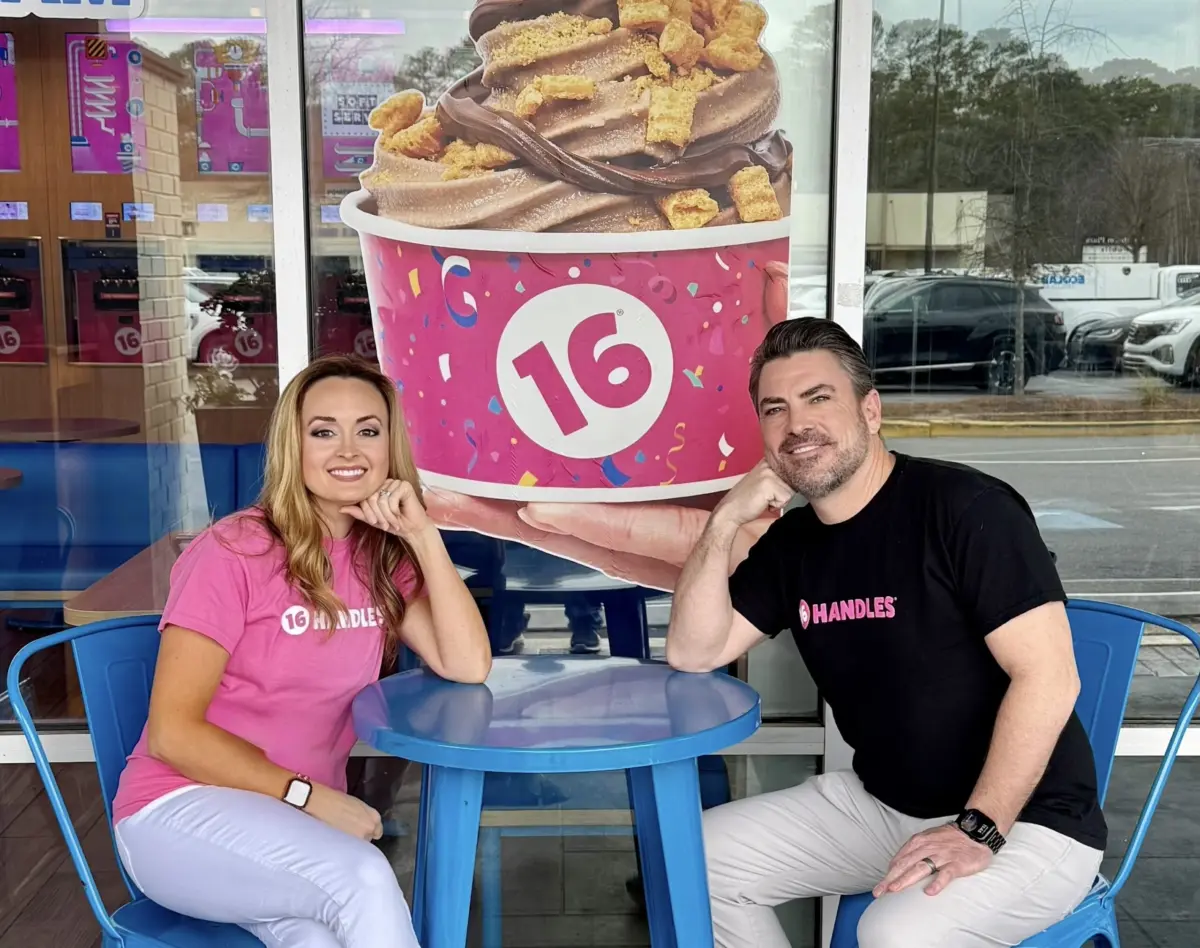
Executive Overview
In the world of retail franchising, hitting the seven-figure mark within a company’s first year of operation is a monumental achievement. Doing so in just half a year is nothing short of extraordinary. For Ken and Sarah Barlow, the husband-and-wife entrepreneurial duo behind the 16 Handles frozen yogurt franchise in Forest Acres, South Carolina, this milestone was not the result of a lucky stroke of fortune. Instead, it was the product of meticulous site selection, aggressive community integration, strict financial preparation, and an unwavering commitment to operational excellence.
What began as an innocent, spontaneous family conversation—sparked by their young daughter’s desire to design her own custom ice cream creation—morphed into a thriving, high-volume retail powerhouse. When the Barlows looked around their hometown of Forest Acres in early 2024, they realized a glaring gap in the local market: the community lacked a self-service frozen yogurt destination where families could gather, customize their desserts, and share joyful experiences.
By signing on with the 16 Handles brand, navigating the complex hurdles of construction and leasing, and officially opening their doors in June 2025, the Barlows rewrote the playbook on rapid retail scaling. Within six months of serving their first swirl, their storefront surpassed $1 million in sales. This comprehensive report examines the trajectory of the Barlows’ entrepreneurial journey, exploring the strategic decisions, operational realities, and community-first initiatives that fueled their meteoric rise.
Detailed Chronology: From Family Craving to Seven-Figure Reality
The journey to building a million-dollar frozen yogurt destination did not happen overnight. It required a methodical, step-by-step evolution that tested the Barlows’ resolve, business acumen, and patience.
Phase 1: The Incubation Period (Early 2024)
The genesis of the enterprise was remarkably organic. During a routine family outing, the Barlows’ young daughter asked a simple question: Where could they go to "make her own ice cream" and choose from an endless array of flavors and toppings? Recognizing that Forest Acres was entirely devoid of such an interactive, self-service concept, Sarah and Ken began to evaluate the commercial viability of filling that void.
As self-proclaimed foodies who deeply valued their local culinary ecosystem, the couple saw an opportunity to introduce a joyful, community-centric business model to their neighborhood. Rather than rushing into a franchise agreement, they entered a deliberate phase of research. They evaluated the 16 Handles brand, engaged in extensive discovery calls with the corporate team, scrutinized financial disclosures, and analyzed how the concept would resonate within the South Carolina market.
Phase 2: Financial Calibration and Corporate Alignment
Once the decision was cemented to move forward in early 2024, the Barlows transitioned from conceptual dreamers to disciplined executors. Ken spearheaded the financial preparation, working closely with lenders to map out a realistic budget. They looked past the initial franchise fee, accounting meticulously for the steep costs of physical build-outs, working capital, permitting, and inventory.
Concurrently, they discovered that corporate franchising is not an autonomous machine that runs on autopilot. They learned quickly that even with an established corporate framework behind them, active ownership requires intense adaptability, constant problem-solving, and a hands-on management style.
Phase 3: Site Selection and Construction (Mid 2024 – Spring 2025)
Securing the right piece of real estate proved to be the cornerstone of their subsequent financial success. The Barlows were uncompromising in their search, eventually securing a prime location within a heavily trafficked shopping center positioned inside a densely populated sector of Forest Acres.
However, this phase also brought the friction inherent in commercial real estate. As the Barlows later reflected, every stage of the pre-opening process—ranging from site selection and architectural drafting to city permitting and construction—exceeded its original timeline. Navigating these delays required immense patience and adherence to the foundational research they had conducted months prior.
Phase 4: Grand Opening and the Drive to $1 Million (June 2025 – December 2025)
When the store officially unlocked its doors in June 2025, the Barlows wasted no time integrating into the local social fabric. Eschewing passive marketing strategies, they immediately launched an aggressive grassroots campaign centered on community partnerships.
By prioritizing high-visibility foot traffic and embedding themselves within local schools, sports leagues, and nonprofit organizations, they created a powerful compounding loop of repeat customer visits. By December 2025—just six months post-launch—the store officially eclipsed the $1 million sales threshold, validating every calculated risk the couple had taken along the way.
Supporting Context & Metrics: The Anatomy of a Rapid Retail Scale
Achieving $1 million in revenue within half a year in the quick-service restaurant (QSR) and dessert franchising sector requires extraordinary metrics. To understand how the Barlows achieved this milestone, one must analyze the dual pillars of their strategy: prime real estate positioning and hyper-local community immersion.
[ Strategic Pillars of the Barlows' Success ]
 ├── 1. Prime Real Estate Acquisition
 │    ├── High-traffic shopping center placement
 │    ├── Densely populated demographic zone
 │    └── Maximum visual exposure for organic foot traffic
 │
 ├── 2. Hyper-Local Grassroots Integration
 │    ├── Over 70 non-profit fundraising events hosted in 6 months
 │    ├── Direct support for schools, sports teams, and dance troupes
 │    └── Transforming transactional buyers into loyal brand advocates
 │
 └── 3. Financial Preparedness & Risk Mitigation
      ├── Full-scope capital allocation (build-out, working capital, fees)
      ├── Realistic timeline expectations (accounting for permitting delays)
      └── Active, hands-on operational oversight
The Power of Location
Sarah Barlow noted that securing an optimal retail footprint was non-negotiable. By planting their flag in a densely populated shopping corridor characterized by robust organic foot traffic, the store benefited from constant, passive consumer acquisition. Passersby became curious visitors, and curious visitors quickly converted into returning patrons. The physical visibility of the storefront acted as a 24-hour billboard in a market hungry for family-friendly experiences.
Community Partnerships as a Revenue Engine
While foot traffic established the baseline, community engagement served as the exponential multiplier. Over their first six months of operation, the Barlows hosted more than 70 distinct fundraising events dedicated to local nonprofit organizations. They extended their support directly to youth sports teams, public and private schools, and local dance companies.
Ken Barlow emphasizes that these initiatives were never viewed as mere corporate philanthropy or "nice-to-have" marketing checkboxes. Instead, they functioned as core economic drivers. By giving back directly to the community that sustained their business, they fostered profound brand loyalty, turning casual consumers into passionate community advocates who prioritized 16 Handles over competing dessert concepts.
Official Insights: An Interview with Ken and Sarah Barlow
To provide a deeper look into the operational philosophy of these standout franchisees, the following sections synthesize their key perspectives on franchising, growth strategies, and advice for aspiring entrepreneurs.
Going Into Franchising: Expectations vs. Reality
When asked about the exact moment they committed to buying a franchise, Sarah explained that the decision did not stem from a single dramatic revelation.
"There wasn’t really one dramatic moment where we just woke up and decided to do it," Sarah shares. "It was more a series of conversations and research that gradually gave us confidence that this was the right opportunity. As we learned more about 16 Handles, talked with the franchise team, reviewed the numbers, and learned about their vision for the future of the company, we started to feel more comfortable with the decision."
Yet, entering the franchise ecosystem came with its own set of eye-opening lessons. Ken candidly addressed the misconceptions many first-time buyers hold regarding corporate support structures.
"One assumption we had going into franchising was that because there was an established corporate structure, everything would run very smoothly all the time," Ken notes. "We quickly learned that franchises are still operated by people, and like any business, there can be challenges and hiccups along the way. What surprised us is that being a franchise owner still requires a lot of flexibility and problem-solving. The franchise system gives you a great foundation and support, but you can’t just put things on autopilot."
Growth Strategies: Building a Million-Dollar Footprint in 180 Days
Reaching the seven-figure milestone in half a year demands structural intention. Sarah attributes their velocity to the dual execution of retail placement and localized outreach.
"A big part of our growth really came down to two things: location and being active in the community from day one," Sarah explains. "We were very intentional about securing what we felt was the best possible location for our store in a highly trafficked shopping center… The second major factor has been how deeply we’ve tried to plug into the community. For us, growth hasn’t been about one single tactic — it’s been about being in the right place and making sure we’re showing up for the community in a real, consistent way."
Ken reinforces this sentiment, underlining that community-driven marketing yields tangible economic returns.
"Community partnerships and local events have been a huge part of our business," Ken adds. "I wouldn’t say they’re just ‘nice to have’ — they’ve had a real impact on our revenue and, just as importantly, on building a loyal customer base."
Roadmap for Aspiring Franchisees
For individuals looking to enter the franchising space without a clear roadmap, Ken offers a pragmatic framework rooted in financial literacy and unyielding patience.
"Once we decided we were serious about exploring franchising, the first thing we did was get our financial situation in order," Ken advises. "We looked at what we could realistically invest, talked with lenders, and made sure we fully understood the total cost — not just the initial franchise fee, but build-out, working capital, and everything that comes with opening a location. From there, we spent a lot of time researching different franchise brands and really trying to understand the systems behind them."
Ken issues a stern warning against impatience:
"Between discovery calls, approvals, site selection, leases, construction, and training, it takes time. Probably longer than most people expect at the beginning. Don’t rush into it. Take the time to really understand the brand you’re considering, talk to as many people as you can, and be ready for a learning curve."
Reflections: Advice to Their Past Selves
Reflecting on the anxieties of the pre-signing era, Sarah shares what she would tell herself the week before signing the franchise agreement:
"First, trust your instincts, and second, be patient," Sarah says. "There are so many unknowns before you sign a franchise agreement, and it’s easy to second-guess yourself or wonder if you’re making the right decision. Looking back, all of the research, questions, and due diligence we did gave us a solid foundation, and we’d remind ourselves to trust the work we had already put in."
She adds a final note on endurance:
"We’d also tell ourselves that everything is going to take longer than expected… Most importantly, we’d tell ourselves that the long hours and challenges will be worth it. Seeing the store become a part of the community, supporting local organizations, and watching customers make 16 Handles part of their routines has been incredibly rewarding."
Future Outlook
The rapid success of Ken and Sarah Barlow’s Forest Acres 16 Handles location signals a broader trend within post-pandemic retail franchising: consumers are increasingly gravitating toward experiential, highly localized brick-and-mortar destinations. As experiential retail continues to outperform traditional, transactional storefronts, franchisees who deeply integrate themselves into their local municipal ecosystems are uniquely positioned to capture outsized market share.
For the Barlows, hitting $1 million in sales within six months is merely a launching pad. By maintaining their rigorous operational standards, continuing their prolific schedule of community fundraisers, and leaning into the hands-on problem-solving philosophy that carried them through their initial build-out delays, the couple has established a scalable blueprint for multi-unit potential.
As other aspiring entrepreneurs evaluate the feasibility of entering the QSR and dessert franchise landscape, the Barlows’ journey stands as a masterclass in modern franchising: pair a proven corporate framework with unyielding local dedication, respect the realities of commercial timelines, and never underestimate the commercial power of treating a hometown community like family.