

Executive Overview
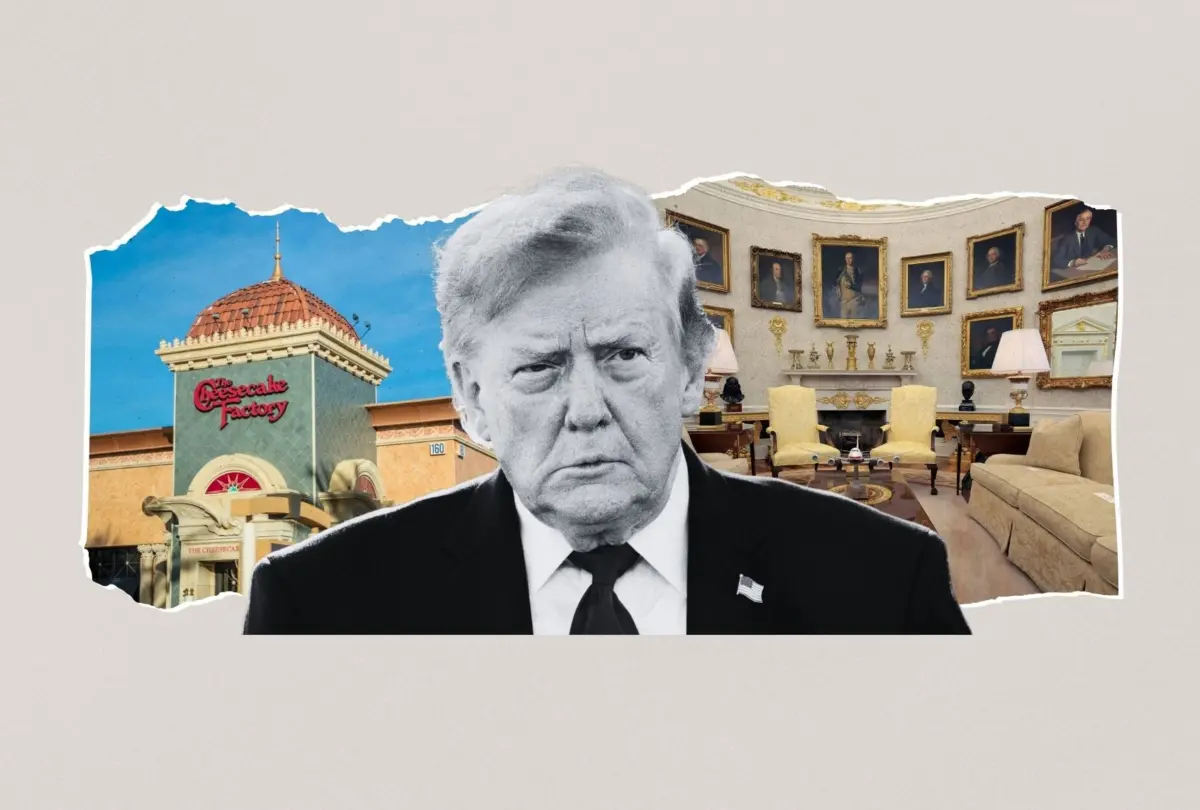
The intersection of political aesthetics and authoritarian propaganda has long been a subject of intense study for sociologists and political scientists. However, a recent war of words between former President Barack Obama and President Donald Trump has brought this phenomenon into sharp, modern relief. What began as a blistering rhetorical quip by Obama—who likened Trump’s heavily gilded, opulent redecoration of the White House to a bizarre hybrid of Saddam Hussein’s interior design and a Cheesecake Factory—has metastasized into a full-blown cultural flashpoint.
For years, President Trump’s unapologetic embrace of low-brow kitsch, schlock, and hyper-nationalistic nostalgia served as a powerful bonding agent for his base. It signaled a shared rebellion against cultural elites, intellectualism, and cosmopolitan standards of taste. Yet, as the political landscape shifts toward the 2026 midterms, this once-reliable populist aesthetic is showing profound structural cracks. Plummeting approval ratings, compounding economic pressures, and an increasingly diverse American populace have exposed Trump’s performative nostalgia not as an enduring cultural movement, but as a hollow escapist fantasy. The weaponization of corporate casual dining—most notably illustrated by Cabinet officials staging photo-ops outside suburban restaurants—highlights a desperate administration losing its grip on the cultural narrative.
Detailed Chronology: From Rally Quips to Corporate Stunts
The unfolding conflict traces a clear path from a weekend campaign trail barb to a desperate administrative public relations campaign.
The Opening Salvo
The friction ignited during a weekend campaign stop in Ohio, where former President Barack Obama took direct aim at the current administration’s architectural footprint. Describing Trump’s interior redesign of the executive mansion, Obama remarked that the heavy, gold-leaf-heavy modifications looked “like Saddam Hussein opened a Cheesecake Factory.”
The Truth Social Meltdown and Retaliation
True to form, President Trump responded immediately with a barrage of aggrieved online and in-person attacks. Utilizing Truth Social, Trump denounced Obama as a “grossly incompetent President” and launched baseless ad hominem accusations regarding foreign political figures. The following day, speaking to reporters, Trump escalated the rhetoric, asserting that Obama was “not a smart guy.”
The Mississippi Rally and the Defense of "Clean" Spaces
The grievance reached a fever pitch during a campaign rally in Mississippi designed to prop up the struggling re-election bid of Senator Cindy Hyde-Smith. Standing before his base, Trump wrestled publicly with the comparison. While conceding that the Cheesecake Factory is a “successful company,” he launched into a circuitous and defensive rationalization of his aesthetic choices. “A guy like Obama,” Trump told the crowd, “doesn’t understand the White House has to be clean, pristine, beautiful.”
The Cabinet-Level Photo-Op
In an effort to turn the cultural critique into a rallying cry, the administration’s inner circle quickly mobilized performative outrage. Treasury Secretary Scott Bessent—whose net worth is estimated at approximately $600 million—traveled to a suburban Maryland Cheesecake Factory for a meticulously orchestrated photoshoot. This stunt mirrored previous manufactured panics, such as the right-wing outrage surrounding corporate logo changes at Cracker Barrel, attempting to cast the administration’s leadership as the defenders of "real" everyday Americans against out-of-touch coastal elites.
Supporting Context & Metrics: The Sociological Anatomy of Kitsch
To understand why the Cheesecake Factory controversy matters beyond the realm of political theater, one must analyze how authoritarian and populist movements utilize kitsch as a psychological shield.
The Psychology of Schmaltz
As cultural analysts have frequently noted, authoritarian movements rely heavily on schmaltz, sentimentality, and manufactured nostalgia. These elements create a safe psychological harbor where followers can retreat from complex, challenging socioeconomic realities. Within the MAGA ecosystem, words like “clean” and “pristine” do not denote minimalism or architectural grace; rather, they serve as coded signifiers for a racially and culturally homogenous past.
For years, Trump has successfully equated demographic and cultural diversity with societal disorder, framing his opulent, faux-baroque interior design as a fortress of purity. His aesthetic choices—ranging from the gold-painted Oval Office to his well-documented fondness for musical theater anomalies like Cats—have allowed him to forge a profound, visceral bond with voters who share his deep-seated resentment of intellectual curiosity and cosmopolitan norms.
The Myth of the "Elites" vs. The Reality of the Consumer Base
The political efficacy of this strategy has historically hinged on redefining "elitism." In populist rhetoric, elitism is decoupled from actual wealth or institutional power and is instead weaponized as a code word for racialized paranoias. However, the attempt to cast corporate casual dining chains as bastions of white Christian americana fundamentally misunderstands modern consumer culture.
Unlike older, hyper-regional brands that once catered exclusively to a uniform demographic, modern corporate chains like the Cheesecake Factory have evolved into self-aware, campy cultural touchstones. Their massive, globally inspired menus—featuring items ranging from traditional American comfort food to wonton tacos and chicken shawarma—reflect an increasingly diverse and globally minded nation. By attempting to weaponize these brands, the administration is fighting a rear-guard action against a demographic and cultural reality that has already left them behind.
Official Statements and Political Fallout
The political fallout from the administration’s aesthetic and economic missteps has been starkly reflected in rapidly deteriorating polling data and shifting voter priorities.
+-----------------------------------------------------------------------------------+
|                         POLITICAL & ECONOMIC METRICS MATRIX                       |
+---------------------------+-------------------------------------------------------+
| Metric Domain             | Current Indicator / Public Sentiment Status           |
+---------------------------+-------------------------------------------------------+
| Presidential Approval     | Plummeting steadily amid persistent inflation concerns|
| Core Economic Grievance   | Rising costs of everyday goods outstripping wages     |
| Demographic Shift         | Broadening culinary and cultural tastes nationwide    |
| Strategic Miscalculation  | Assuming 2024 margins guaranteed a permanent mandate  |
+---------------------------+-------------------------------------------------------+
Following a narrow electoral victory in 2024, President Trump and architect-advisors like Stephen Miller convinced themselves they held an unassailable mandate for their hardline nationalist platform. Yet, subsequent data reveals that swing voters cast their ballots primarily out of economic anxiety and short-term memory regarding inflation, rather than an ideological commitment to cultural revanchism.
Administration policies—ranging from sweeping tariff proposals that threaten to drive up the cost of basic household goods to disruptions in supply chains affecting everyday staples (such as the tongue-in-cheek public concern over the viability of free restaurant chips and salsa)—have alienated the very working-class voters the movement purports to champion. The disconnect between an administration obsessing over interior decoration and gold-plated fixtures while everyday citizens grapple with stagnant wages and rising prices has drained the humor out of their political theater.
Future Outlook: The Limits of Performative Nostalgia
As the political cycle grinds toward the midterm elections, the viability of weaponized kitsch as a primary political strategy is rapidly reaching its expiration date.
The strategy of manufacturing "culture wars" over restaurant chains and interior design worked when times were relatively stable, and when the aesthetic of grievance could be easily dismissed as harmless political theater. However, in an environment defined by geopolitical tensions, volatile energy prices, and acute economic anxiety, superficial distractions lose their potency.
The fundamental problem facing the MAGA movement is not that its leaders lack media savvy, but that their vision of America has grown increasingly insular, paranoid, and disconnected from the lived experiences of a dynamic, multicultural public. No amount of Cabinet-level photo-ops in suburban restaurants can disguise the widening chasm between an administration trapped in an echo chamber of gilded self-absorption and a populace looking forward rather than backward. Ultimately, the Cheesecake Factory—in all its sprawling, unpretentious, globally influenced absurdity—will endure long after the fleeting, brittle aesthetic of the current administration has been relegated to a historical footnote.