

Executive Overview
In the sprawling, often predictable landscape of contemporary documentary filmmaking, rare is the project that genuinely destabilizes our understanding of truth, artifice, and human psychology. Enter You Can See Everything, an extraordinary new A24 feature-length documentary directed by Lance Oppenheim and co-steered by absurdist comedy auteur Nathan Fielder.
The film captures an unprecedented cultural collision: Nathan Fielder—whose entire artistic output (The Rehearsal, Nathan For You) is an elaborate, agonizingly self-aware exploration of social anxiety, staging, and the boundaries of human manipulation—spending intimate, unfiltered time with Elizabeth Holmes. Holmes, the disgraced founder of the defunct blood-testing juggernaut Theranos, stands as one of the most notorious corporate fraudsters of the twenty-first century. Convicted of swindling hundreds of millions of dollars from high-profile investors using a hollow promise of revolutionary medical technology, Holmes retreated into a carefully curated persona characterized by wide, unblinking eyes, a calculatedly deep baritone, and an unyielding resistance to accountability.
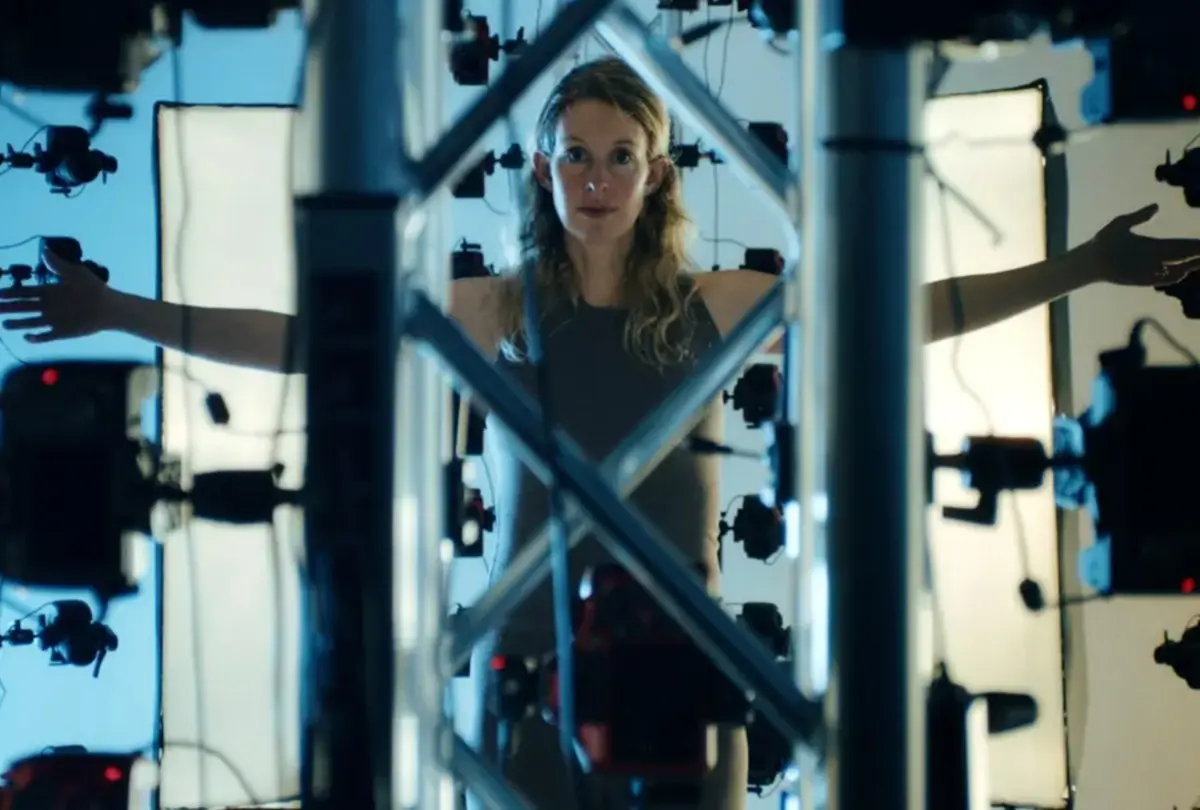
Set against the countdown to Holmes’s eleven-year prison sentence, You Can See Everything is neither a standard true-crime post-mortem nor a straightforward exercise in public vindication. Instead, it operates as a profound piece of metafiction. Fielder and Oppenheim sit with Holmes in a San Diego rental home, turning the camera into a mirror that reflects not just a fallen tech mogul, but the strange, symbiotic relationship between performance and authenticity in modern society. Blending deadpan humor with gut-wrenching vulnerability, the documentary exposes a profound, cosmic tragedy: a woman so thoroughly consumed by her own fabrication that she appears utterly incapable of distinguishing where observation ends and manipulation begins.
Detailed Chronology: Anatomy of a Collaboration
To trace the origins of You Can See Everything is to understand a convergence of two distinct worlds of calculated artifice. For years, media outlets, Hulu’s dramatized limited series The Dropout, and endless journalistic investigations have tried to dissect the rise and fall of Elizabeth Holmes. Yet, none of these accounts managed to penetrate the uncanny valley of Holmes’s internal reality.
Production on the documentary commenced in a tense window of time: precisely 34 days before Holmes was scheduled to surrender and begin serving her decade-long federal prison sentence. Having spent roughly seven years largely out of the public eye following her indictment and trial, Holmes made the calculated gamble of granting a full-scale documentary crew unprecedented access to her life.
The film opens not with grand indictments or financial spreadsheets, but with domestic intimacy. Sitting around a San Diego beach rental’s dinner table, Fielder and Holmes share a relaxed rapport that startles the viewer. Spread out before them are the disassembled components of a Theranos blood-analyzer prototype—the very machine whose catastrophic failures triggered her downfall. Holmes attempts to articulate how her claims of the device’s efficacy were supposedly misunderstood by the public and investors. Predictably, her syntax grows muddled, collapsing into circular logic.
Sensing the mounting tension, Fielder deploys his signature comedic armor. In a disarmingly deadpan delivery, he remarks, "Isn’t it funny that I hosted a show about business scams, and now you’re in trouble for a business scam?"
The ice breaks. Holmes genuinely laughs, remarking that the parallel hadn’t occurred to her. In that singular, micro-managed moment, Fielder achieves what journalists failed to do for years: he disarms her. Yet, the film’s title—derived from a text message Holmes sent to Fielder during production—functions as an obvious, brilliant red herring. Just as Fielder’s television experiments manipulate reality under the guise of truth, Holmes has spent her life performing a character. As the three-hour runtime glides by, the audience is left wrestling with a dizzying question: Which version of Elizabeth Holmes are we actually looking at, and does a true version even exist?
Supporting Context & Metrics: The Intersection of Comedy, Crime, and Conditioning
To fully contextualize the gravity of You Can See Everything, one must examine the psychological profiles of the primary figures orbiting Holmes during production, as well as the unique stylistic signatures brought by Fielder and Oppenheim.
The Domestic Power Dynamic: William Evans and the Echoes of Control
The documentary shifts its lens from corporate malfeasance to domestic reality, focusing heavily on Holmes’s husband, William Evans, a hotel-chain heir whose ego dominates the San Diego rental. Evans’s introduction to Holmes—recounted vaguely as a party where they spoke for an hour before he realized her identity, despite having toured a Theranos facility just days prior—sets an immediate tone of evasiveness.
Throughout the filming process, Evans actively attempts to police and redirect conversations, particularly when Fielder presses Holmes’s father, Christian Holmes, about the historical turning points in his daughter’s life. When asked about Sunny Balwani, Holmes’s former lover and Theranos business partner, Evans swiftly tries to shut down the line of inquiry.
However, Christian Holmes offers a devastating revelation, pinpointing a definitive psychological shift: a severe sexual assault Holmes endured at age 19 while attending Stanford University—an event widely documented as preceding her decision to drop out and launch Theranos.
This brings viewers to a chilling thematic crossroad. Is Evans genuinely protecting his wife, or do his behavioral patterns mirror the coercive control exhibited by Balwani and Holmes’s past abusers? Evans’s compulsion to control the narrative—whether dictating how Holmes scrambles eggs or managing her public image—highlights a tragic continuity in Holmes’s life: she has consistently gravitated toward partners who substitute their own agency for hers.
The "Who’s on First?" Breakthrough
Perhaps the most pivotal and emotionally resonant sequence in the film occurs during its first third. Fielder gathers Holmes and Evans on a couch to show them Abbott and Costello’s classic comedy routine, "Who’s on First?"
Fielder explains that the comedic misunderstanding—where a baseball player named "Who" creates endless linguistic confusion—reminded him of Holmes’s futile attempts to explain Theranos science using broken logic. Holmes watches the clip, offering polite chuckles. But when Fielder challenges her to explain why the joke is funny, she freezes. As Fielder methodically breaks down the punchline, Holmes breaks down entirely, weeping across from him out of sheer frustration at her inability to grasp the linguistic and social nuances of the joke.
In this brilliant scene, Fielder bridges the chasm between intellect and empathy. It underscores the profound loneliness of a mind that cannot bridge the gap between internal intention and external communication.
Official Statements and Critical Reception
While traditional press releases from A24 have emphasized the documentary’s groundbreaking visual style and unprecedented access, critical discourse surrounding You Can See Everything has focused primarily on its subversion of the true-crime genre.
Media analysts and cultural critics have noted that unlike standard exposés—which rely heavily on external narration, archival footage, and righteous indignation—You Can See Everything leans into uncomfortable ambiguity.
"Fielder and Oppenheim have constructed something entirely unprecedented," noted early festival reviews. "By introducing the metatheatric sensibilities of Nathan Fielder into the bleak reality of a federal convict days away from prison, the film refuses to offer easy catharsis. It forces the audience to confront the uncomfortable truth that humanity’s most catastrophic deceptions often stem from a desperate, tragic desire to be understood."
Industry insiders have also lauded the film’s pacing. Despite a sprawling runtime, critics observe that the documentary’s structural rhythm mirrors the psychological unraveling of its subject, shifting seamlessly from awkward corporate post-mortems to shattering domestic revelations.
Future Outlook: The Legacy of a Meta-Documentary Masterpiece
As You Can See Everything prepares for its wide theatrical and streaming rollout, its cultural footprint is already taking shape. The film arrives at a fascinating cultural juncture where public fatigue with traditional true-crime media has reached a fever pitch. Audiences are increasingly wary of exploitative documentaries that promise absolute truths while packaging sensationalized narratives.
By injecting meta-fictional self-awareness into the documentary format, Fielder and Oppenheim have fundamentally altered the blueprint for biographical non-fiction. The film suggests that in an age of hyper-curated digital personas, corporate spin, and systemic social masking, the boundary between "the con artist" and "the victim" is razor-thin.
For Elizabeth Holmes, serving her federal sentence behind bars, You Can See Everything will likely stand as the definitive cultural artifact of her post-empire existence—a monument built not out of blood-testing microfluidics, but out of celluloid, empathy, and inescapable human tragedy. For Nathan Fielder and Lance Oppenheim, the project cements their status as visionary chroniclers of modern absurdity, proving that sometimes, the only way to capture the unvarnished truth is through a meticulously constructed mirror.