

WASHINGTON — In a political development highlighting a deep and widening rift within the conservative movement, President Donald Trump has doubled down on an aggressive, unbridled vision for the artificial intelligence industry. Dismissing public anxiety over the environmental and infrastructural footprint of tech expansion as a politically motivated "hoax," the president announced the creation of a federal "AI Force" and vowed to appoint a national "AI czar."
Yet, even as the administration lays the groundwork to champion the tech sector without what Trump calls "stifling" regulations, Republican candidates nationwide are sounding alarm bells. Facing mounting voter fury over strained local power grids, skyrocketing electricity bills, and vanishing water resources, GOP campaigns are increasingly viewing unchecked data center expansion as a toxic liability heading into the November midterm elections.
The collision between Trump’s techno-optimist federal agenda and the hyper-local grievances of suburban and rural communities sets the stage for a high-stakes political showdown over the future of American infrastructure, energy policy, and economic security.
Executive Overview
The debate over artificial intelligence infrastructure has officially transcended the halls of Silicon Valley and the committee rooms of Capitol Hill, transforming into a frontline electoral battleground.
- The White House Push: President Trump has proposed a federal "AI Force"—stylized after the Space Force of his first term—alongside plans to name a specialized "AI czar." Trump frames the technology as an existential economic imperative and a high-stakes geopolitical race against China, predicting that AI could soon comprise up to 25 percent of the U.S. Gross Domestic Product (GDP).
- The Midterm Reality Check: In stark contrast to the White House’s bullish enthusiasm, veteran Republican pollster Tony Fabrizio warned GOP candidates in a recent internal memo that uncritical support for massive data center construction is a "losing position."
- Electoral Fall-Out: From the rural expanses of California to the swing-state battlegrounds of Michigan, local resistance is hardening. Republican candidates are breaking ranks with the administration, with figures like Michigan Senate nominee Mike Rogers advocating for a one-year moratorium on new data center builds to protect local resources and establish rigorous federal safeguards.
Detailed Chronology: From Silicon Valley Dreams to Main Street Backlash
The friction between national technological ambition and local environmental preservation has accelerated rapidly over the past several months, culminating in a dramatic political fracture in September 2026.
The Spark: The Infrastructure Footprint of the Generative AI Boom
Following the explosive commercialization of generative AI technologies, tech conglomerates embarked on a historic land-and-power grab. Building and cooling the massive warehouse-sized data centers required to train and run next-generation models demanded unprecedented amounts of electricity and water.
By mid-2025, rural and semi-rural communities across states like Texas, Virginia, Michigan, and California found themselves targeted for mega-scale campus developments. While tech executives promised high-tech revitalization, local residents quickly confronted the realities of humming industrial infrastructure: buzzing substations, surging utility bills, and fears of depleted aquifers.
Late Summer 2026: The Grassroots Revolt Goes National
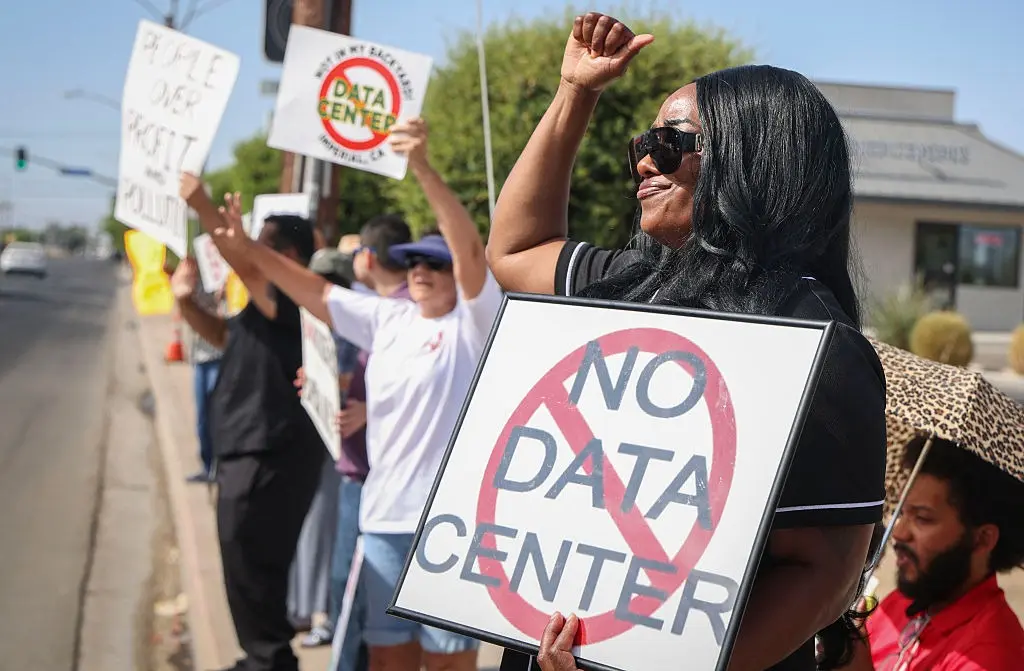
By August 2026, anti-data center sentiment had congealed into a nationwide movement. Protests broke out in rural California and suburban Texas, fueled by unusual coalitions of environmentalists, religious organizations, and conservative landowners wary of corporate overreach.
Tech oligarchs and political strategists alike began panicking as local zoning boards faced unprecedented public pressure to block permits. The backlash transformed what was once viewed as a niche tech policy issue into a kitchen-table concern for everyday voters.
September 15–19, 2026: The GOP Strategy Memo
Recognizing the political peril facing vulnerable Republican incumbents and challengers ahead of the midterms, senior pollster Tony Fabrizio dropped a political bombshell. In a strategy memo circulated to GOP campaigns, Fabrizio explicitly cautioned that blanket endorsements of AI infrastructure would alienate voters struggling with rising living costs and utility strains. He advised candidates to pivot toward addressing concrete concerns—such as grid reliability, energy pricing, and water conservation—rather than serving as unconditional cheerleaders for big tech.
September 19–20, 2026: Trump’s Counter-Offensive and the "AI Force" Announcement
Refusing to back down, President Trump took to social media to aggressively counter the growing narrative of caution. Hours before unveiling the "AI Force," Trump engaged his base on Truth Social, floating alternate names for the technology itself, asking followers whether "Artificial Intelligence" should be rebranded as "Superior Intelligence," "Extreme Intelligence," or "Supreme Intelligence."
On Saturday, September 20, 2026, Trump officially announced the creation of the AI Force and promised an imminent czar appointment. Dismissing data center opposition as a failed narrative, Trump claimed that communities hosting these facilities ultimately reap the rewards of higher salaries, lower taxes, and safer streets.
Supporting Context & Metrics: The Economic and Environmental Stakes
To understand why the White House and grassroots Republicans are violently disagreeing on this issue, one must examine the staggering macroeconomic figures and physical resource constraints driving the debate.
The Economic Promise vs. The Physical Cost
- GDP Projections: The Trump administration estimates that AI infrastructure and its downstream economic integration could eventually account for 25% of the United States Gross Domestic Product, making it a cornerstone of future American economic dominance.
- Geopolitical Competition: Proponents of rapid expansion argue that any domestic slowdown—whether driven by local zoning blocks or federal red tape—will directly benefit strategic rivals like China, which is investing heavily in its own state-backed computing infrastructure.
- The Energy Crunch: Modern data centers are ravenous consumers of power. A single hyperscale facility can require as much electricity as a small city. According to energy sector analysts, current regional power grids—many of which rely on aging infrastructure—are buckling under the sudden load, leading to legitimate concerns that residential ratepayers will shoulder the cost of grid upgrades.
- Water Consumption: Beyond electricity, closed-loop and evaporative cooling systems consume millions of gallons of water daily, triggering fierce pushback in drought-prone regions across the American West and Southwest.
Official Statements and Political Reactions
The divergence between executive rhetoric and legislative caution has exposed a deep ideological fault line within the Republican Party regarding the appropriate role of the federal government in managing private technological expansion.
"We will cherish it, help it, and watch over it, as it grows! We are not going to let bureaucrats hinder or stifle the greatest technological revolution in human history."
— President Donald Trump, via Truth Social announcement of the "AI Force."
Trump’s stance relies on the premise that traditional legal frameworks are sufficient to manage rogue actors. Rather than imposing preemptive zoning restrictions or federal environmental halts on data centers, Trump maintains that any harmful applications of artificial intelligence can be effectively prosecuted through existing civil and criminal justice systems.
Conversely, party strategists and candidates on the ground are feeling the immediate sting of voter anxiety.
"Unqualified support for building more AI data centers is a losing position for Republican candidates. Campaigns must address voter realities—energy prices, grid stability, and water preservation—rather than offering a blank check to tech developers."
— Tony Fabrizio, Senior GOP Pollster, in a September 2026 memo to campaigns.
Taking a step beyond mere strategic messaging adjustments, high-profile nominees are enacting hardline policy stances. In Michigan, Republican Senate nominee Mike Rogers broke decisively with the administration’s national narrative by endorsing a one-year legislative moratorium on new data center construction within the state. Rogers argued that state and federal authorities must hit the pause button to establish stringent safety guardrails before further physical infrastructure is locked into place.
Future Outlook: Navigating the AI Crossroads
As the nation barrels toward the November midterm elections, the artificial intelligence debate has exposed a fascinating tension at the heart of modern American conservatism: the historic tension between corporate free-market acceleration and populist, localist protectionism.
- The Midterm Calculus: For Republican candidates fighting in suburban and rural districts, local water tables and monthly electric bills will inevitably take precedence over abstract macroeconomic projections from Washington. Expect a growing number of candidates to distance themselves from federal techno-optimism in favor of localized moratoriums and stringent municipal oversight.
- The Federal Response: It remains entirely unclear how Trump’s newly proposed "AI Force" and forthcoming "AI czar" will attempt to bridge this gap. Without statutory authority or clear jurisdiction, the initiative risks becoming a symbolic advisory body rather than a functional regulator—particularly if state governments and local utility commissions continue to block physical data center permits.
- The Long-Term Trajectory: The United States faces a definitive trial of governance. Balancing the absolute necessity of winning the global AI race against China with the democratic rights of local communities to protect their immediate environments will require a delicate, highly coordinated policy framework—one that the current political landscape has yet to forge.
Ultimately, the clash over data centers is no longer just about servers, switches, and subgrids. It is a referendum on who dictates the physical landscape of twenty-first-century America: the tech oligarchs and federal executives dreaming of digital supremacy, or the local citizens demanding that their lights stay on and their water flows clean.