

Executive Overview
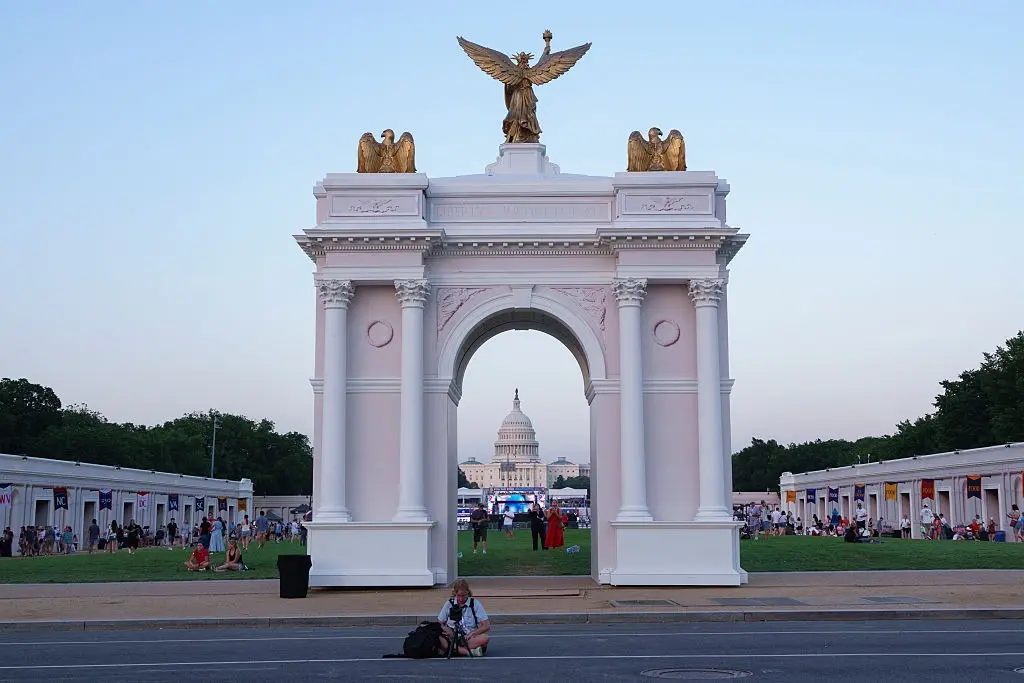
In a dramatic pivot that has sparked intense debate among urban planners, military analysts, and constitutional scholars, President Donald Trump has announced a radical redesign for his pet monument project near Arlington National Cemetery. Initially promoted as a grand triumphal arch to commemorate America’s semiquincentennial, the proposed 250-foot structure is now slated to serve a dual purpose: a historical landmark and a heavily armed military complex.
According to a Sunday statement posted by the president on Truth Social, the structure will house and rapidly deploy "large numbers of drones," position specialized snipers on its roof and surrounding plaza, and store vast quantities of sniper ammunition. Proponents argue that the integration of defensive capabilities into public monuments represents a forward-thinking approach to urban security in the 21st century.
However, a rigorous examination of the administration’s claims reveals significant discrepancies. The Pentagon has declined to confirm any formal military request for the site, historical claims regarding the arch’s origins are heavily disputed, and global architectural comparisons flatly contradict the administration’s statistical assertions. Furthermore, the sudden inclusion of drone and sniper operations introduces unprecedented regulatory and environmental hurdles, complicating an approval process that was already embroiled in federal litigation and historic-preservation reviews.
This report provides an in-depth, multi-faceted investigative breakdown of the controversial project, evaluating its historical context, strategic viability, regulatory obstacles, and a recurring pattern of policy justification utilized by the administration.
Detailed Chronology of the Project
The evolution of the Washington triumphal arch project has been marked by rapid shifts in design, purpose, and official justification. Tracing the chronology of the initiative highlights how a standard civic beautification project transformed into a militarized zone of contention.
- Pre-Civil War to Mid-20th Century: The conceptual lineage of monuments near the Potomac River and Arlington Memorial Bridge dates back generations. While various monumental designs were floated throughout the late 19th and early 20th centuries, the specific configuration approved by Congress in 1925 for the Arlington Memorial Bridge called for two modest, 166-foot neoclassical columns near Memorial Circle—neither of which constituted a massive triumphal arch, and neither of which was ultimately built.
- Early 2026: President Trump revives the concept of a monumental arch to serve as a defining centerpiece for national celebrations, pitching it primarily as a commemorative architectural feat.
- April to July 2026: The project faces immediate skepticism from historians and urban planners. Federal lawsuits are filed challenging the administration’s legal authority to erect such a massive structure on federal land without explicit congressional authorization. Concurrently, reviews by the National Capital Planning Commission (NCPC) highlight potential adverse effects on the surrounding historic landscape.
- September 18, 2026 (Friday): The Federal Aviation Administration (FAA) clears the 250-foot structure, determining that its height would not pose a substantial hazard to aircraft operating along flight paths serving nearby Ronald Reagan Washington National Airport. Notably, the FAA evaluation contains no assessment of or provision for drone operations originating from the site.
- September 20, 2026 (Sunday): President Trump issues a surprise announcement via social media, declaring that the arch will be converted into a "top grade Military Complex/Triumphal Arch" at the "strong request of the United States Military." The post outlines plans for drone deployment and sniper redoubts.
- September 20, 2026 (Later): Defense Department officials offer no elaboration on the president’s claims, while independent military experts express profound confusion over the strategic necessity of placing a tactical drone and sniper hub a mere mile away from the fully operational active-duty installation at Fort Myer.
Supporting Context & Metrics: History, Global Standards, and Security Realities
To understand the friction surrounding the proposed complex, one must analyze the empirical claims made by the administration against historical records and international urban planning data.
1. The Historical Record
President Trump asserted that the triumphal arch had been "planned since the Civil War Era many years ago." While it is true that monumental crossings of the Potomac River were contemplated during and immediately after the Civil War, the administration’s narrative conflates general 19th-century commemorative concepts with the specific architectural design currently under review. The 1925 congressional authorization explicitly detailed twin memorial columns, not a sweeping triumphal arch spanning a major traffic circle. Historians point out that retrofitting a historical rationale onto a contemporary aesthetic preference is a recurring motif in the administration’s infrastructure initiatives.
2. The "59 Top Cities" Metric
In defending the necessity of the arch, the president claimed that Washington, D.C., stands as the sole exception among the world’s "59 top cities and Capitals" without a triumphal arch. Independent researchers and architectural databases, including assessments by GlobalSecurity.org, have scrutinized this metric. When examining the world’s 65 largest metropolitan areas, researchers found that only eight feature structures historically or architecturally classified as significant triumphal or memorial arches (such as the Arc de Triomphe in Paris). The remaining 57 major global capitals and metropolitan areas—including massive global hubs like Tokyo, Beijing, Moscow, and Los Angeles—function entirely without such monuments.
3. Proximity and Redundancy
Military logistics experts have raised acute questions regarding the tactical utility of the proposed complex. Retired Marine Col. Mark Cancian and other defense analysts have publicly questioned why the Department of Defense would require a specialized sniper and drone facility at Memorial Circle when Fort Myer—a heavily secured, active U.S. Army base—lies approximately one mile away. The introduction of munitions storage and tactical drone launch sites within a civilian-heavy, highly visible tourist zone creates operational vulnerabilities that standard military installations are specifically designed to avoid.
Official Statements and Institutional Responses
The announcement has elicited a cautious, often silent response from federal agencies caught between executive directives and statutory oversight obligations.
- The Department of Defense: The Pentagon has maintained a strict posture of non-elaboration. When queried by journalists regarding which specific branch of the armed forces requested the conversion, or what precise national security threat the facility is designed to mitigate, defense spokespersons deferred entirely to the president’s public statements, offering no independent confirmation or tactical justification.
- The Federal Aviation Administration (FAA): While the agency’s Friday clearance confirmed that a static 250-foot structure would not disrupt commercial flight paths into Reagan National Airport, aviation safety advocates have noted that the introduction of "large numbers of drones" operating from a 250-foot elevation directly beneath busy terminal airspace introduces entirely new variables that were absent from the initial environmental and airspace impact reviews.
- Historic Preservation and Planning Bodies: Members of the National Capital Planning Commission have expressed dismay. According to reports from The Washington Post, preliminary consultations regarding historic preservation and environmental impact made zero mention of a military complex, explosive storage, or sniper perches. The inclusion of military hardware fundamentally alters the environmental impact statement (EIS) required for federal construction projects in the District of Columbia.
A Familiar Playbook: The White House Ballroom Precedent
Skeptics and investigative journalists have noted striking parallels between the militarization of the triumphal arch and the administrative handling of another high-profile Trump construction initiative: the White House ballroom.
When the White House ballroom project initially faced stiff legal opposition and skepticism from historic preservationists, it was pitched strictly as a civilian venue designated for state dinners, galas, and large diplomatic gatherings. However, as appellate courts issued stays and lawsuits mounted challenging the legality of the construction, the administration’s rhetoric shifted markedly.
The president began referring to the project as a "Military Complex/Ballroom," emphasizing subterranean security architecture, fortified command-and-control capabilities, and national defense necessities to insulate the project from local zoning laws and judicial challenges.
Observers argue that labeling the Arlington-area arch as a military drone and sniper complex follows this exact tactical playbook—transforming a contested civic monument into an unassailable national security asset to bypass local planning boards, avoid environmental reviews, and neutralize federal lawsuits.
Future Outlook and Regulatory Hurdles
As the project moves forward under its newly minted dual identity, it faces a gauntlet of domestic, legal, and operational challenges that threaten to stall construction indefinitely:
- Litigation and Congressional Authority: Federal lawsuits challenging the administration’s constitutional and statutory authority to construct the arch without explicit congressional authorization remain active in the federal court system. The addition of offensive and defensive military capabilities—such as drone fleets and sniper stations—may invite heightened judicial scrutiny over whether executive branch powers extend to establishing permanent tactical military installations on civilian federal land.
- NCPC and Environmental Reviews: The National Capital Planning Commission must review the revised plans. Given that the introduction of munitions storage and aerial drone launch platforms fundamentally changes the land-use profile of Memorial Circle, the project will likely be forced to undergo a lengthy, multi-year supplemental environmental review.
- Local and Regional Pushback: Local officials in Virginia and Washington, D.C., along with community associations, have expressed mounting concern over the militarization of a major tourist and commuter nexus. The prospect of active sniper perches and frequent drone sorties operating adjacent to Arlington National Cemetery and major commuter bridges is certain to draw fierce political opposition.
Ultimately, whether the U.S. military formally adopts the Memorial Circle complex or whether the initiative remains a contentious executive vision, the project underscores a fascinating intersection of architecture, national security doctrine, and executive power in contemporary American politics.