

Executive Overview
In the high-stakes, hyper-competitive arena of modern commerce, playing it safe is the fastest route to irrelevance. While legacy giants and deep-pocketed conglomerates wage wars of attrition fueled by endless ad-spend, true challenger brands must operate with a sharper, more surgical precision. Invisibility is a far greater threat than controversy, and capturing cultural mindshare requires agility, resourcefulness, and a willingness to provoke a reaction.
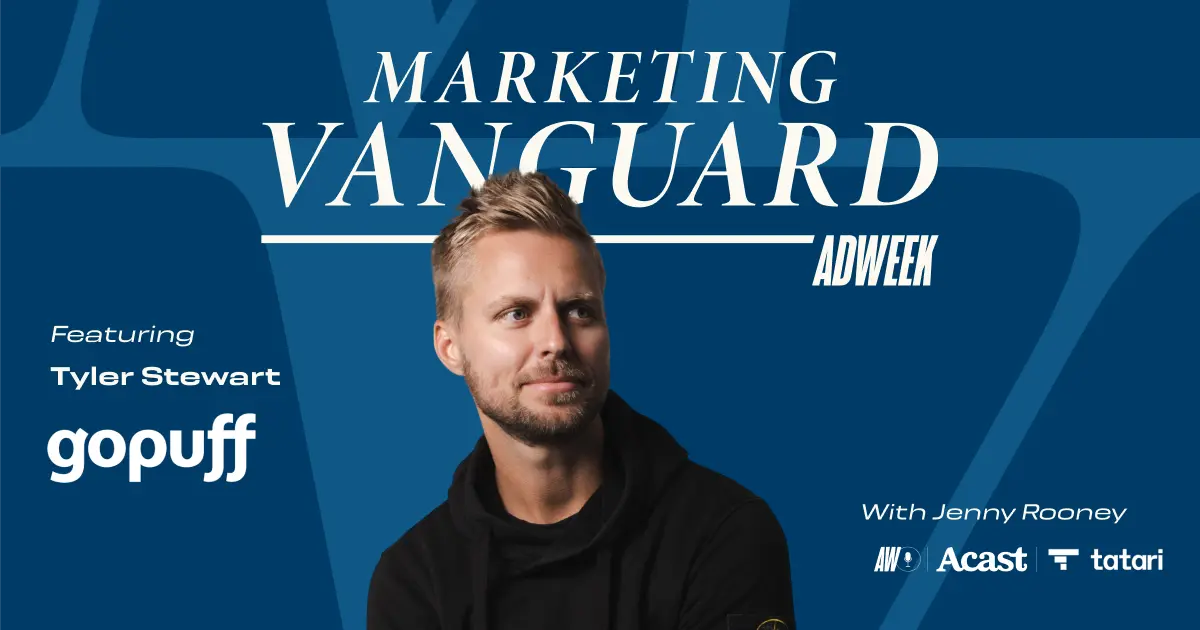
This was the core thesis delivered live from the Marketing Vanguard stage at Brandweek 2026. In an exclusive conversation, Jenny Rooney, Editor-in-Chief, sat down with Tyler Stewart, Head of Marketing at Gopuff, for a masterclass on competing in one of the most crowded, capital-intensive sectors of the digital economy. Recorded as part of a special vidcast series in partnership with Tatari, the discussion dismantled conventional marketing wisdom.
Stewart, whose diverse background spans sports entertainment, talent representation, and tier-one digital media properties including GQ, The Players’ Tribune, and Bleacher Report, brings a unique lens to instant commerce. Rather than attempting to out-muscle larger competitors dollar-for-dollar, Stewart leverages Gopuff’s proprietary first-party logistics, redefines traditional platform rivalries into symbiotic distribution partnerships, and champions a bold creative philosophy: “We’d rather be debated than ignored.”
This comprehensive report examines Stewart’s strategic blueprint, analyzing how Gopuff maneuvers against industry titans, monetizes first-party logistics, re-engineers the creator economy, and transforms the very definition of "instant" delivery into a cultural currency.
Detailed Chronology: The Evolution of Gopuff’s Brand Strategy
To understand how Gopuff commands attention today, one must examine the operational and creative evolution that brought the brand to the Brandweek 2026 stage. Stewart’s narrative is not merely a collection of clever marketing tactics; it is a systematic dismantling of how challenger brands must behave when they lack the balance sheets of legacy retail giants.
From Logistics Engine to Cultural Player
When Stewart transitioned from digital media into instant commerce, he recognized immediately that Gopuff’s greatest structural advantage—its end-to-end first-party logistics network—was also its most underutilized marketing asset. Unlike marketplaces that rely on fragmented third-party couriers and decentralized merchant networks, Gopuff owns its micro-fulfillment centers and inventory.
Initially, the industry viewed instant commerce through a purely functional lens: shaving minutes off a delivery time to win over convenience shoppers. Stewart realized this race to the bottom on delivery speeds commodity-trapped the category. Consumers ultimately do not care whether a bag of chips arrives in 18 minutes versus 22 minutes; they care about what the brand stands for and how seamlessly it integrates into their lifestyle.
By anchoring marketing initiatives in operational realities, Gopuff shifted its narrative from "we deliver fast" to "we deliver what matters, exactly when culture demands it." This foundational pivot allowed the brand to transition from a utility app to an active participant in pop culture, sports, and entertainment.
Reversing the Adversarial Paradigm: Competitors as Distribution Partners
One of the most provocative revelations from Stewart’s Brandweek session centered on Gopuff’s relationship with industry competitors. In a conventional corporate playbook, competitors are viewed strictly as adversaries to be crushed or outmaneuvered. Stewart, however, views the commerce ecosystem through a lens of pragmatic integration.
Because Gopuff controls its own first-party logistics infrastructure, it occupies a unique B2C and B2B hybrid position. Rather than treating platforms like DoorDash and Uber Eats solely as enemies, Gopuff has explored and executed strategies where these giants function as distribution partners. By listing products or leveraging their last-mile reach where synergistic, Gopuff expands its total addressable market without bearing the prohibitive customer acquisition costs (CAC) of fighting a solitary acquisition war across every digital channel.
This operational maturity sends a vital signal to contemporary marketers: competitive advantage does not stem from beating everyone else at their own game; it comes from establishing proprietary moats—such as owned logistics—that turn former adversaries into profitable distribution channels.
Supporting Context & Metrics: The Economics of the Attention Economy
Operating as a challenger brand in quick-commerce requires a rigorous understanding of the modern attention economy. Traditional marketing playbooks rely on sheer frequency and gross rating points (GRPs)—strategies engineered for brands with nine-figure media budgets. For Gopuff, deploying capital with that kind of blunt force is neither feasible nor desirable.
The Math of Resourcefulness vs. Capital
To contextualize Gopuff’s positioning, industry analysts point to the widening gap between legacy retail ad spends and digital-native challenger budgets. While mega-retailers can afford to saturate television, programmatic, and out-of-home channels simultaneously, challenger brands face diminishing returns on high-frequency, low-impact impressions.
Stewart approaches this economic reality through high-impact, culturally resonant interventions. Instead of spreading budget thin across ten superficial logo-placement sponsorships, Gopuff consolidates resources into deep, high-leverage partnerships. A prime example is the brand’s collaboration with icons like Tom Brady. Rather than simply renting Brady’s likeness for a standard 30-second commercial—a tactic where the celebrity’s equity overshadows the brand’s identity—Gopuff structures partnerships that build actual products, secure unique consumer access, and manufacture culturally compelling moments.
The Cost of Invisibility
During his session, Stewart crystallized this economic and creative philosophy into a single, defining maxim: “We’d rather be debated than ignored.”
In an era defined by content saturation, algorithmic homogenization, and ad-blocker adoption, safety is a massive financial liability. Brands that craft bland, focus-grouped campaigns designed to offend absolutely no one inevitably vanish into the background noise. They spend millions to achieve absolute invisibility.
Stewart’s metrics for success are not merely vanity impressions or polite click-through rates; they measure cultural velocity. Did the campaign start a conversation on social media? Did it force consumers to re-evaluate what an instant commerce brand can be? By provoking debate, Gopuff generates organic earned media that effectively multiplies the efficiency of its working media budget, driving down blended CAC while accelerating brand equity.
Official Statements & Insights
The dialogue between Jenny Rooney and Tyler Stewart at Brandweek 2026 yielded several critical programmatic takeaways for modern marketing leaders. Below are synthesized insights and direct extractions from Stewart’s philosophy on leadership, creative execution, and ecosystem strategy:
-
On Challenger Brand Realities:
"Playing it safe is expensive when nobody notices you. When you don’t have the luxury of outspending the competition dollar-for-dollar, your currency is ingenuity. You have to be willing to take creative risks that divide a room rather than put it to sleep."
-
On Operational Infrastructure as Marketing:
"Our first-party logistics aren’t just hidden supply-chain machinery; they are the bedrock of what allows us to be culturally responsive. When you own the supply chain, you can execute marketing ideas that other brands can only dream about because they are bogged down by third-party vendor friction."
-
On Deep Creator Partnerships vs. Logo Slaps:
"One deep creator partnership beats ten logo slaps every single day of the week. Consumers—especially younger demographics—have developed an impenetrable radar for shallow influencer marketing. If you aren’t building something authentic with talent, whether it’s an exclusive product, a unique format, or genuine creative collaboration, you’re just paying for rented noise."
-
On Redefining "Instant":
"Instant commerce was born as a logistical race, but it matures as a lifestyle proposition. Speed is table stakes. The real battle is winning the cultural moments when consumers realize they need something, and ensuring your brand is not just delivered to their door, but woven into the fabric of that moment."
Future Outlook: The Next Frontier of Instant Commerce
As the quick-commerce landscape matures past its hyper-growth pandemic era, surviving players must transition from pure growth-at-all-costs models to sustainable, brand-led profitability. What does the horizon look like for Gopuff and the broader instant commerce sector under strategic marketing frameworks like Stewart’s?
1. The Death of the Commodity Delivery Model
Consumers no longer view rapid delivery as a technological marvel; it is an expected utility. Consequently, the brands that win tomorrow will not be those that boast about shave-seconds on delivery apps, but those that curate the best lifestyle experiences. Expect Gopuff and its peers to increasingly blur the lines between retail, entertainment, and digital media, turning their apps into discovery engines rather than digital convenience stores.
2. The Rise of Hybrid Ecosystems
Stewart’s philosophy of turning competitors into distribution partners heralds a broader B2B evolution within consumer tech. As customer acquisition costs continue to rise across traditional digital channels, walled gardens will increasingly give way to porous, collaborative ecosystems. Brands that master logistics will find themselves acting as infrastructure providers for competitors, generating high-margin revenue streams that subsidize aggressive brand marketing.
3. Cultural Provocation as a Defensive Moat
As generative AI lowers the barrier to producing generic marketing copy and synthetic ad creatives, digital spaces will flood with an unprecedented volume of bland, optimized content. In this hyper-saturated future, human-led creative risk-taking—embracing Stewart’s ethos of being debated rather than ignored—will become the ultimate defensive moat. Brands with the courage to court controversy and spark genuine cultural discourse will capture the scarce resource of human attention.
Conclusion
Tyler Stewart’s masterclass at Brandweek 2026 serves as a definitive blueprint for modern marketing leadership. By rejecting the safety of conformity, weaponizing first-party logistics as a creative advantage, and redefining partnerships through the lens of deep collaboration rather than superficial endorsement, Gopuff proves that challenger brands do not need the deepest pockets to dominate the cultural conversation. They simply need the courage to be seen, heard, and debated.
