In the realm of digital product development, an old and pervasive adage holds true: “There are only two hard things in Computer Science: cache invalidation and naming things.”
While Phil Karlton’s famous maxim was originally aimed at software engineers, its truth has expanded exponentially across modern product teams. Today, designers, front-end engineers, product managers, and copywriters find themselves locked in a daily struggle to assign precise, scalable, and intuitive names to UI components, design tokens, color palettes, micro-interactions, layers, and entire product features.
Language is not merely a tool for labeling; it shapes our cognitive frameworks and dictates how cross-functional teams communicate. When a designer refers to a structural container as a "stack," an engineer codes it as a "flex-container," and a product manager labels it in a roadmap as a "grouping module," organizational friction inevitably ensues. This linguistic fragmentation creates dialects within the same team—the designer’s dialect, the developer’s dialect, the product manager’s dialect, and, most importantly, the user’s dialect.
The consequences of poor nomenclature stretch far beyond mere aesthetics or code tidiness. Confusing or overly complex naming conventions directly impact feature discovery, lower user adoption rates, complicate codebases, and create massive synchronization hurdles when scaling multi-brand, multi-themed design systems.
Fortunately, the digital design and development community has responded to this challenge with a wave of rigorous taxonomies, open-source repositories, and practical frameworks. This comprehensive guide synthesizes the best resources, methodologies, and architectural structures available today. Whether you are attempting to name an elusive UI element, build a bulletproof design token hierarchy from scratch, or brand a revolutionary new product feature, the tools and strategies explored below will help transform your nomenclature from a source of frustration into a streamlined system for success.
Detailed Chronology: The Evolution of Naming Challenges in Modern Product Design
To understand why naming has become such a high-stakes discipline, we must examine how digital production workflows have evolved over the past two decades.
The Wild West of Early Web Development
In the early days of the web, naming conventions were largely ad-hoc. Developers wrote HTML classes based on immediate visual characteristics (e.g., .blue-box, .big-bold-text). This approach worked for simple static pages, but as websites transformed into complex web applications, these presentation-driven names collapsed under their own weight. Changing a background color from blue to red meant either maintaining a misleading class name (.blue-box styled with red backgrounds) or embarking on a tedious, error-prone refactoring process across thousands of lines of code.
The Rise of Methodologies (BEM, SMACSS, and Atomic Design)
Recognizing the unsustainable nature of ad-hoc naming, the industry fought back with structured methodologies. Systems like BEM (Block, Element, Modifier), SMACSS (Scalable and Modular Architecture for CSS), and Brad Frost’s Atomic Design revolutionized how teams conceptualize user interfaces.
By categorizing components into atoms, molecules, organisms, templates, and pages, designers and developers gained a shared vocabulary. However, these systems introduced a new burden: strict syntax rules that required deep discipline. A slight deviation from a naming convention could break a build or invalidate a component contract within a design system.
The Design Token Era and Multi-Brand Complexity
Today, the frontier of naming challenges lies in design tokens—the atomic pieces of a design system (colors, typography scales, spacing metrics, elevation shadows) that bridge design tools like Figma with code repositories.
As enterprises scale to support multi-brand ecosystems, dark modes, and white-label products, token taxonomy has grown exponentially complex. A token can no longer simply be named primary-blue. It must account for brand variations, semantic contexts (e.g., background-color-interactive-hover), and primitive values. The sheer volume of variables has turned naming into an architectural discipline, requiring dedicated taxonomy maps and strict governance models to keep multidisciplinary teams aligned.
Supporting Context & Metrics: The Real Cost of Bad Naming
Why should organizations invest time and resources into establishing strict naming protocols? The data surrounding cognitive load, team velocity, and user adoption points to a clear return on investment.
1. Cognitive Load and Developer Velocity
Studies in software ergonomics show that developers spend up to 70% of their time reading and comprehending existing code rather than writing new lines. When variable names, class structures, and component identifiers are ambiguous—either too generic (e.g., .item-1, .box) or too specific (e.g., .sidebar-red-button-fixed)—developers experience a spike in cognitive load. They must mentally trace references across multiple files simply to understand what a UI element does.
2. Feature Discovery and User Churn
The naming crisis is not confined to code editors and Figma canvases; it directly affects end-users. Research into feature discovery indicates that low user adoption rates are rarely the result of poor utility. Instead, they stem from poor nomenclature.
When a product team invents internal jargon or clever branding for a new feature (e.g., calling an automated data-export tool "HyperStream"), users fail to discover, understand, or trust it. Features must be labeled according to the user’s "job-to-be-done." If a name does not instantly signal its practical value using the user’s native vocabulary, adoption flatlines.
Practical Frameworks: Tools and Resources for Naming Everything
When you find yourself staring at a blank screen, unable to settle on a name for a CSS property, a design token, an icon, or a product feature, you do not have to rely on guesswork. The community has built an impressive array of specialized tools and directories to inspire precision.
1. Inspiring Code and Class Names: Classnames
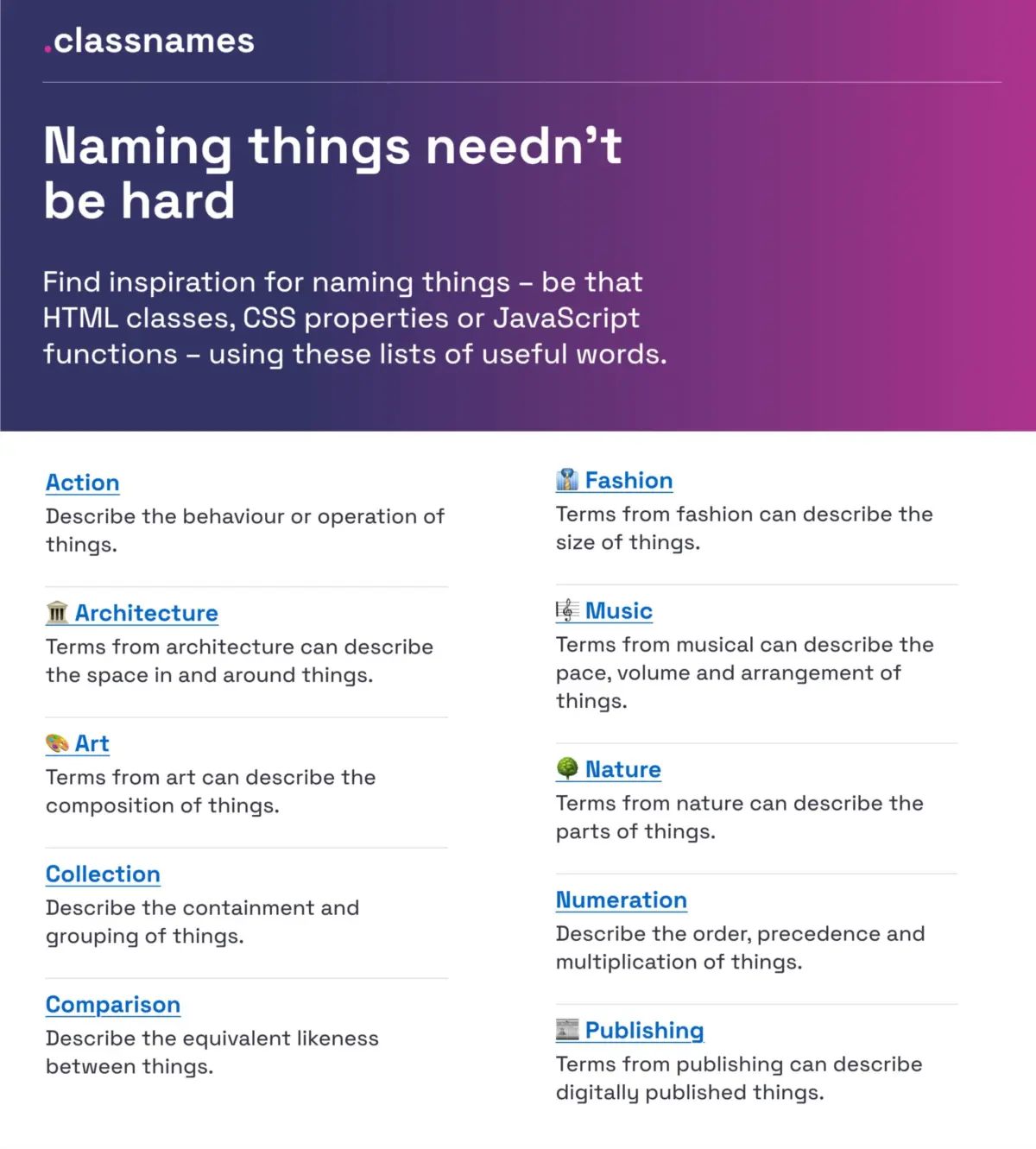
If you are struggling to name HTML classes, CSS variables, or JavaScript functions without falling back on tired conventions, Classnames (created by Paul Robert Lloyd) is an invaluable resource.
The Concept: It provides thematically grouped lists of words designed to get you thinking outside the box.
The Vocabulary: Beyond standard behavioral terms, order descriptors, and grouping words, it features rich thematic collections drawn from nature, art, theater, music, architecture, fashion, and publishing. These unexpected semantic connections help developers create expressive, readable codebases.
2. Taming Color Palettes: Color-Names and Color Parrot
Naming colors is notoriously subjective. Is a hex code #2E8B57 best described as "SeaGreen", "ForestMist", or "JadeDeep"? David Aerne maintains a massive, community-driven repository containing over 30,355 unique color names.
The Ecosystem: Backed by tools like Color Parrot, developers and designers can query specific color values and instantly retrieve human-readable names. This repository acts as an essential single source of truth, preventing teams from inventing conflicting, idiosyncratic names for the exact same brand colors.
3. Scaling Layers and Groups in Design Tools: Good Practices Design
Figma files frequently devolve into messy layers panels filled with Rectangle 40, Group Copy 2, and Frame 12. Javier Cuello has formalized a set of naming best practices that bring order to visual design assets.
The Core Rules: An effective name must have a logical structure, be concise, carry clear meaning, be universally understood across the team, and—crucially—avoid reference to visual properties (such as BlueButton or BoldText, which break the moment the design updates). Cuello provides exhaustive do’s and don’ts for naming sizes, states, layers, and nested components.
4. Decoding UI Components: The Component Gallery
When designing or building a standard interface element—such as an accordion, a modal, or a dropdown menu—knowing what the rest of the industry calls it prevents redundant reinvention. Iain Bean’s Component Gallery aggregates real-world interface components from dozens of production-grade design systems.
The Value: It catalogs over 50 UI components, displaying not only visual examples but also the various alternative names these components go by across different design systems. For a quick visual dictionary, companion tools like Name That UI offer rapid reference guides for everyday interface patterns.
5. Architecting Design Token Taxonomies: Intuit and Vodafone Case Studies
Scaling design tokens across massive multi-brand ecosystems requires sophisticated categorization.
Intuit’s Approach: Nate Baldwin documented how the parent company of Mailchimp, QuickBooks, TurboTax, and Mint built a flexible token taxonomy. Their system moves beyond isolated brand themes to serve as a foundational architecture serving millions of users across highly diverse products.
Vodafone UK’s Variables Taxonomy Map: Available as a public Figma community resource, Vodafone’s map breaks down design tokens into a meticulously structured, multi-tier system. Drawing inspiration from Nathan Curtis’s foundational work on token naming, the map outlines four distinct collection layers—moving seamlessly from brand primitives to semantic tokens and page-level applications. Anyone inspecting a variable name can instantly trace where the token lives, what it represents, and how it inherits values.
Romina Kavcic’s Token Guide: For teams building token systems from the ground up, Romina Kavcic’s Design Token Naming Guide + Builder and accompanying Design Token Names Inventory Spreadsheet offer practical, interactive tools to configure naming structures encompassing components, categories, states, and roles.
6. Branding Products and Services: Onym
When the naming challenge scales up from a CSS class or a design token to an entire product, service, or major feature, traditional brainstorming often stalls. Onym is an open-source repository that curates methodologies, vetting frameworks, brainstorm prompts, etymological resources, and recommended literature to guide brand naming sprints.
Official Statements & Expert Insights
Industry leaders continually emphasize that nomenclature is an organizational alignment tool disguised as a technical detail.
"The right name is the one that is well-understood and actively used by both the team and the users," notes interface design authority Vitaly Friedman. "So much time is wasted speaking about the very same thing but in different dialects—the designer’s dialect, the developer’s dialect, the product manager’s dialect, and the user’s dialect. That fragmentation is the root cause of team frustration."
When product teams invest the necessary cognitive overhead to establish a unified lexicon, the cultural and operational dividends are profound. Engineers stop guessing what a variable controls, designers stop duplicating component variants, and users effortlessly navigate features that speak their language.
Future Outlook: The Next Frontier in Digital Taxonomy
As the digital landscape marches toward automated design systems, AI-driven code generation, and hyper-personalized multi-modal interfaces, the importance of robust naming conventions will only intensify.
AI and Semantic Consistency
Artificial intelligence models rely heavily on semantic context. As AI-assisted coding tools (such as GitHub Copilot) and design-to-code generators become standard fixtures in our workflows, the clarity of our naming taxonomies will directly influence machine efficiency. Codebases with disciplined, predictable naming structures yield vastly superior AI-generated outputs compared to projects plagued by inconsistent, shorthand, or cryptically abbreviated variable names.
Design Tokens as Universal APIs
In the near future, design tokens will function less like static style sheets and more like universal APIs connecting disparate platforms—spanning web, mobile, spatial computing (AR/VR), and voice interfaces. A token name will need to be resilient enough to describe padding, depth, pitch, and opacity across entirely different mediums.
Conclusion: A Call to Action for Teams
Naming things remains hard, but it is no longer an insurmountable mystery. By leaning on community-driven resources like Classnames, Color-Names, The Component Gallery, and structured token guides from design system pioneers, product teams can replace guesswork with rigorous systems.
The next time your team encounters a naming conflict, do not sweep it under the rug. Log it, address it, and align your dialects. In doing so, you will eliminate friction, reduce user confusion, and build a healthier, more resilient digital ecosystem.