

Executive Overview
In the sprawling landscape of digital product design and software engineering, few challenges are as universally pervasive—yet quietly destructive—as the art of naming. "Naming is hard," a trite adage perhaps, but one that underpins millions of lost engineering hours, fragmented user experiences, and deep-seated organizational friction. The language we choose does more than merely label an artifact; it fundamentally shapes how we think about it, dictates the parameters of our conversations, and dictates whether a system scales gracefully or collapses under the weight of its own ambiguity.
When the nomenclature breaks down, confusion sets in across the entire product ecosystem. Stakeholders and practitioners find themselves locked in semantic gridlock over colors, icons, user interface (UI) components, and core product features. Designers speak in visual abstractions, developers in programmatic structures, product managers in business value metrics, and users in task-oriented realities. This divergence of dialects breeds friction.
Furthermore, poor naming typically manifests in two extremes: names that are too generic, rendering them utterly devoid of contextual meaning (such as calling a primary layout element ContainerA), or names that are too specific, trapping components in rigid silos that choke flexibility and code reuse.

To combat this systemic issue, a robust movement within the design systems and engineering community has emerged. Practitioners are no longer leaving nomenclature to intuition; instead, they are relying on open-source repositories, structured taxonomies, and cross-disciplinary frameworks. This report offers an investigative deep dive into the practical strategies, conceptual taxonomies, and indispensable resources required to master the nomenclature of modern digital architecture—from HTML classes and color palettes to complex multi-brand design tokens and customer-facing features.
Detailed Chronology and Evolution of Digital Nomenclature
To understand where UI and system naming stands today, one must examine its evolutionary trajectory. In the early days of the web, naming conventions were rudimentary, often relying on arbitrary shorthand or direct visual descriptions (e.g., .red-box or .big-header). As websites evolved into complex, dynamic web applications, and as design systems scaled across multiple platforms, these ad-hoc approaches failed catastrophically.
1. The Era of Ad-Hoc Styling (Late 1990s – Early 2010s)
During this formative period, developers named CSS classes based on what something looked like rather than what it was. A button might be .blue-rounded-button. If the brand guidelines shifted to a sharp, green aesthetic overnight, the codebase faced a cascade of breaking changes. Designers, meanwhile, kept layers and artboards in design tools like Photoshop or early Sketch files with chaotic titles like Rectangle copy 4 or Group 12. Collaboration was slow, and cognitive load was extraordinarily high.

2. The Rise of Methodologies and Scalable Taxonomies (2010s – 2020)
As digital products matured, the industry recognized the need for structured methodologies. Frameworks like BEM (Block, Element, Modifier) forced developers to think hierarchically, introducing a structured grammar to HTML and CSS classes. Simultaneously, the advent of design systems necessitated a unified language between designers and developers. Terms like "atoms," "molecules," and "organisms" (popularized by Atomic Design) gave teams a shared mental model for UI components.
3. The Modern Era: Tokens, Multi-Brand Systems, and Semantic Alignment (2020 – Present)
Today, the challenge has expanded beyond simple class names. Modern digital products operate across multi-brand ecosystems, dark/light themes, and cross-platform frameworks (Web, iOS, Android). This complexity birthed design tokens—the atomic pieces of a design system stored as variables.
Naming these tokens requires an advanced taxonomy that accounts for brand layers, primitive values, semantic intent, and component roles. Organizations like Intuit and Vodafone have pioneered enterprise-grade token taxonomies, shifting the industry from tribal knowledge to rigorous, scalable nomenclature frameworks. Concurrently, community-driven resources have materialized to help practitioners break out of lexical stagnation, providing structured paths for everything from micro-interactions to macro-product naming.

Supporting Context & Metrics: Navigating the Lexicon of Code and Design
Mastering nomenclature requires compartmentalizing the digital ecosystem into its core domains. Each domain—whether code, color, design tokens, or features—demands a specific linguistic approach.
How to Name Code and Class Names
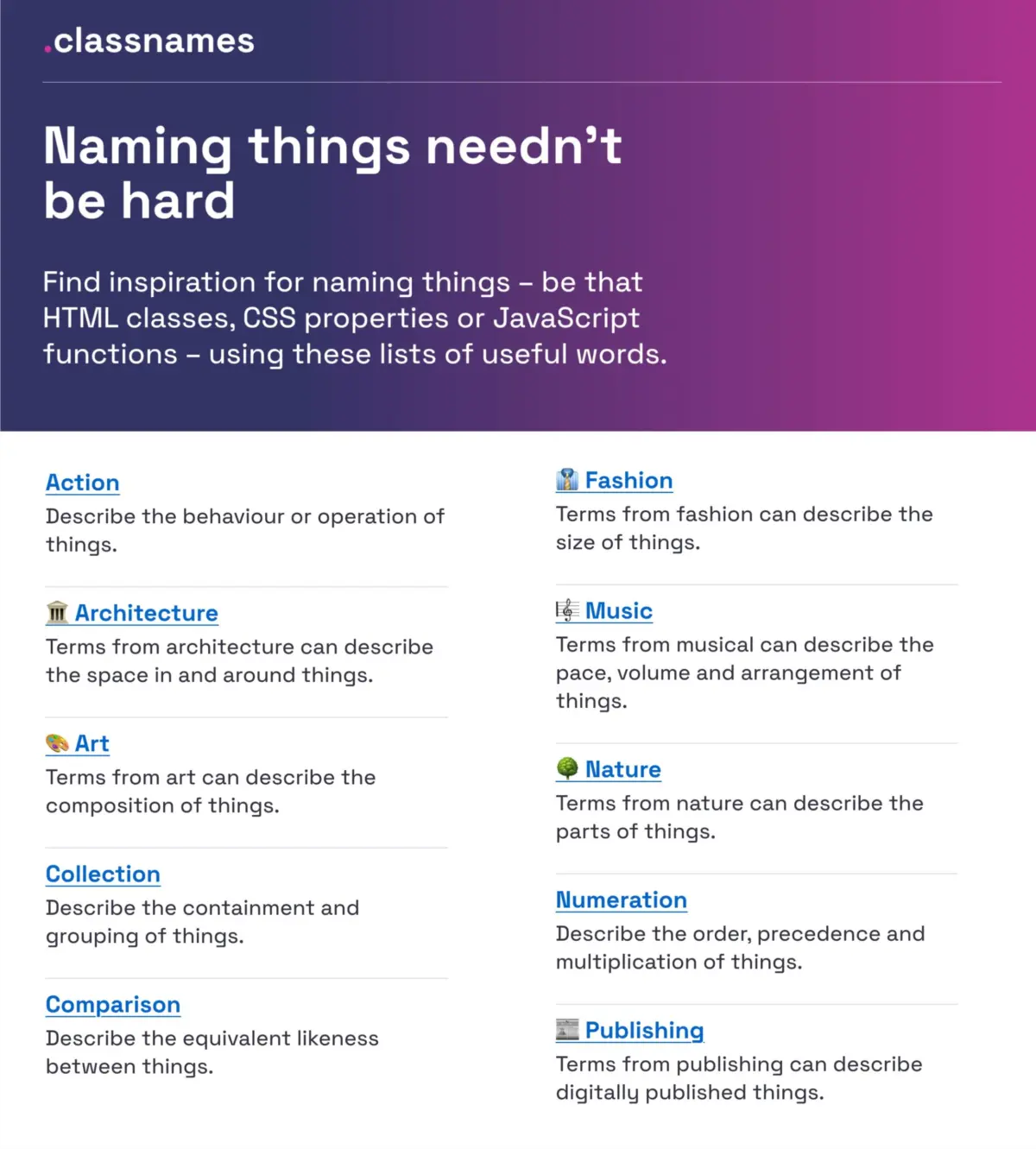
When developers and designers search for inspiration for HTML classes, CSS properties, or JavaScript functions, traditional vocabulary often falls short. Resources like Classnames (built by Paul Robert Lloyd) have emerged to bridge this gap by offering thematically grouped lists of words designed to provoke alternative thinking.
Rather than relying on tired computing tropes, Classnames provides terminology categorized by behavior, likeness, order, grouping, association, and unconventional thematic collections drawn from nature, art, theater, music, architecture, fashion, and publishing. This encourages developers to construct semantic, memorable hooks that remain resilient to design shifts.

Mastering Color Nomenclature
Naming colors programmatically has historically been a subjective nightmare. While one team member calls a hue #3498db "Dodger Blue," another might simply see "Light Blue." To eliminate this friction, David Aerne maintains an expansive repository of color names—Color Names—which aggregates over 30,355 unique color monikers sourced from diverse references and thousands of community contributions.
Equipped with companion tools like the color picker and name search (Color Parrot), teams can anchor their design tokens to predictable, human-readable strings rather than cryptic hex codes, smoothing handoffs between design tools and codebases.
Layer and Group Naming in Design Tools
In design environments like Figma, messy layers destroy scalability. Javier Cuello’s compilation of naming best practices highlights that an effective layer or group name must adhere to strict principles:

- It must possess a logical structure.
- It must be concise yet meaningful.
- It must use terminology universally understood by the team.
- Crucially, it must not be related to transient visual properties (e.g., avoid naming a frame
Grey Rectanglewhen it functions as aCard Background).
Adhering to strict do’s and don’ts prevents design files from becoming illegible digital graveyards, ensuring that design handoff is as frictionless as possible.
Structuring Design Token Taxonomies
Scaling design systems across massive enterprises presents a monumental linguistic challenge. When parent company Intuit—overseeing financial giants like Mailchimp, QuickBooks, TurboTax, and Mint—needed to unify their visual language, they faced an uphill battle with legacy token taxonomies.
Nate Baldwin’s extensive case studies on Intuit’s design token taxonomy reveal how a system can move beyond superficial branding to serve as a foundational architecture for disparate products. By establishing clear criteria for token categorization, Intuit mitigated the pain points of rigid brand constraints.

Similarly, the Vodafone UK Design System team released their Variables Taxonomy Map, a masterclass in handling complex, multi-brand, multi-themed environments. Built upon the foundational theories of Nathan Curtis, Vodafone’s mapping system breaks down design tokens into four distinct, interconnected layers:
- Brand/Primitives: Raw values (e.g., core hex codes, base spacing units).
- Semantic: Purpose-driven tokens (e.g.,
color.background.error). - Component: Specific allocations for individual UI elements.
- Page/Context: High-level contextual applications.
This orchestrated system ensures that any team member can inspect a variable’s name and immediately deduce its origin, intent, and exact scope of application. For practitioners looking to build similar frameworks from scratch, tools like Romina Kavcic’s Design Token Naming Guide + Builder and her Design Token Names Inventory spreadsheet offer interactive scaffolds and bird’s-eye spreadsheets to track themes and modes seamlessly.
UI Component Naming and the Power of Shared Vocabularies
When teams debate whether a sliding disclosure widget should be called an "Accordion," a "Collapsible," or a "Expander," they are wasting valuable cycle time. Iain Bean’s Component Gallery resolves this friction by aggregating real-world UI components drawn from dozens of production-grade design systems. Covering over 50 distinct interface elements, the gallery maps out alternative names for each component, making it an invaluable cross-reference for both designers and developers.

Complementing this is Name That UI, a visual dictionary specifically engineered to fast-track alignment on standard interface elements. By leaning on established industry standards rather than inventing novel terminology, teams reduce cognitive overhead for both internal builders and end-users.
Official Statements and Industry Insights
The philosophy of nomenclature transcends mere aesthetics; it is deeply intertwined with product adoption and user psychology.
Consider the challenge of launching new features. According to UX strategist Erin Gannon in her foundational guide, "What Do We Call This Thing?", low feature adoption is rarely a symptom of poor utility; rather, it is almost always a failure of discoverability and comprehension.

"Feature adoption takes time," Gannon notes. "First the feature must be discovered, then understood, then tried, learned, and eventually built into existing workflows. Good names are driven by user needs and problems. They should signal the value or outcome of a feature—the job-to-be-done—and tap directly into the user’s own language."
Industry thought leaders consistently emphasize that internal organizational jargon must never leak into customer-facing copy. When engineering teams name a backend capability a "State Synchronization Protocol" and expose that exact phrasing in the UI, users inevitably bounce due to cognitive dissonance. The fix? Ask real users to explain a feature or problem in their own vernacular, and adopt those exact linguistic constructs.
Furthermore, naming physical or digital products and services requires an entirely separate strategic apparatus. Repositories like Onym aggregate open-source tools, brainstorming frameworks, vetting methodologies, etymologies, and legal guidelines to help organizations navigate the treacherous waters of product naming without stepping into trademark minefields or cultural missteps.

Future Outlook: The Horizon of Semantic Systems
As artificial intelligence, automated design-to-code pipelines, and multi-modal interfaces continue to evolve, the importance of pristine nomenclature will only accelerate. AI-driven agents parsing design tokens, reading CSS classes, and generating UI components rely entirely on predictable, semantic syntax. Ambiguous naming conventions that survive today through human intuition will become critical failure points in autonomous development loops.
Organizations that invest in robust, systematic taxonomies today will reap compounding dividends tomorrow. By bridging the linguistic divides between designers, developers, product managers, and users, teams can eliminate the friction of conflicting dialects.
The mandate for the future is clear: treat nomenclature not as an afterthought, but as core infrastructure. Audit your design tokens, standardize your component libraries, listen closely to your users’ language, and maintain a rigorous backlog for naming conflicts. In doing so, you transform language from a barrier into the ultimate catalyst for cohesive, scalable digital experiences.