

Executive Overview
Few brands evoke as much nostalgic whiplash for early internet users as LimeWire. Once the undisputed titan of peer-to-peer (P2P) file sharing during the wild-west era of the 2000s—synonymous with downloaded MP3s, sluggish dial-up connections, and pop-up viruses—the platform has completed one of the most radical corporate and technological pivots in digital history. Today, LimeWire has been resurrected not as a software client for sharing media, but as a cutting-edge generative artificial intelligence (AI) content publishing ecosystem, creator studio, and Web3 marketplace.
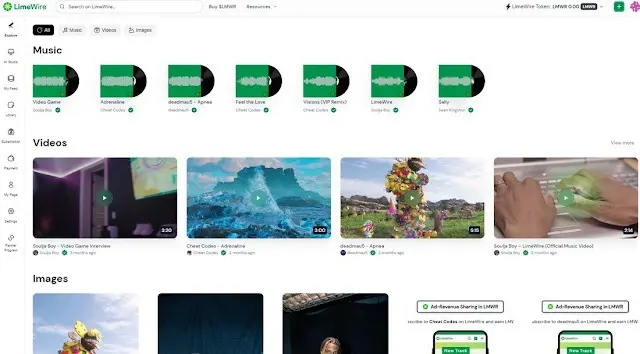
In its modern iteration, LimeWire marries the democratization of AI content creation with decentralized monetization frameworks. By integrating state-of-the-art generative models like Stable Diffusion and DALL-E, the platform enables everyday users, digital artists, and mainstream celebrities alike to conceptualize, edit, publish, and monetize AI-generated images, with roadmap expansions slated for audio and video production. Furthermore, LimeWire leverages blockchain infrastructure—specifically the Polygon and Algorand networks—to automatically mint user-generated creations as Non-Fungible Tokens (NFTs).
This comprehensive deep-dive investigates the technological architecture, monetization mechanics, tokenomic structure, and future trajectory of the reborn LimeWire ecosystem. By assessing its pricing tiers, revenue-share models, and cultural footprint, this report explores how LimeWire aims to cement itself as a cornerstone of the burgeoning Creator Economy.
Detailed Chronology: From P2P Infamy to AI Innovation
The Legacy Era: The Rise and Fall of P2P File Sharing (2000–2010)
To understand the significance of LimeWire’s current incarnation, one must contextualize its origins. Founded in 2000 by Mark Gorton, LimeWire operated as a Gnutella-based P2P client that allowed millions of users worldwide to share files directly from computer to computer. At its peak, it was arguably the most popular file-sharing application on the planet, fundamentally altering how society consumed music and digital media.
However, this decentralized distribution model placed LimeWire at the center of an intense legal war with the Recording Industry Association of America (RIAA). In May 2010, following a landmark federal court ruling (Arista Records LLC v. Lime Wire LLC), a U.S. district judge ordered the shutdown of the platform after finding it liable for copyright infringement and inducement. The shutdown left a permanent scar on the digital copyright landscape and consigned the LimeWire brand name to internet folklore.
The Rebirth: Transition to Web3 and Generative AI (2022–Present)
The dormant intellectual property was acquired in 2021 by Austrian serial entrepreneurs Julian and Paul Zehetmayr, who envisioned a completely reimagined utility for the brand. Initially announced in 2022 as an NFT marketplace for digital art and music, the platform quickly recognized the seismic shift occurring within the tech sector brought on by generative artificial intelligence.
Pivoting rapidly, the leadership team transformed the marketplace into "LimeWire Studio"—an all-in-one AI creation hub. By combining prompt-based image generation with built-in Web3 minting capabilities, LimeWire positioned itself at the intersection of two of the decade’s most disruptive technologies: generative AI and decentralized finance (DeFi). High-profile mainstream artists—including hip-hop icons Soulja Boy and Sean Kingston, alongside electronic music pioneer Deadmau5—subsequently adopted the platform to drop exclusive digital collectibles, signaling a tentative institutional validation of the transformed brand.
Supporting Context & Metrics: The LimeWire AI Studio Architecture
At the heart of the modern LimeWire ecosystem is its AI Studio, a browser-based suite designed to lower the barrier to entry for digital art creation while offering advanced controls for professional designers.
Advanced Multi-Model Integration
Rather than relying on a single, proprietary neural network, LimeWire aggregates some of the industry’s most powerful open-source and commercial generative models. The platform currently supports:
- Stable Diffusion 2.1
- Stable Diffusion XL (SDXL)
- DALL-E 2
This multi-model approach grants creators the flexibility to choose the underlying engine that best suits their artistic requirements. Users can execute simple text prompts or utilize complex parameter adjustments to steer output generation.
Stylistic Versatility and Customization
LimeWire’s interface enables creators to rapidly switch between distinct artistic paradigms without altering their core text prompts. Supported design styles include:
- Cinematic photography
- Digital and conceptual art
- Pixel art and retro aesthetics
- Anime and illustration
- Analog film simulations
Additionally, the platform incorporates granular controls such as samplers, negative prompts, and prompt guidance sliders. These features afford both novice hobbyists and seasoned digital artists the precision necessary to refine lighting, texture, composition, and detail density. Furthermore, LimeWire is actively developing its own proprietary AI model, signaling a strategic shift toward self-reliance and platform-specific aesthetic differentiation.
Monetization, Tokenomics, and Web3 Integration
What truly distinguishes LimeWire from standard AI content generators like Midjourney or stock generation tools is its end-to-end monetization framework. The platform treats every user-generated asset not merely as a temporary visual file, but as an ownable, tradable digital commodity.
Automated Blockchain Minting
Once a user generates and publishes an image on LimeWire, the platform automatically initiates an NFT minting process utilizing either the Polygon or Algorand blockchains. This cryptographic procedure assigns a unique digital signature to the asset, establishing provable scarcity, authenticity, and decentralized ownership.
Creators retain complete autonomy over how their minted content is distributed:
- Public Access: Content is made discoverable across the entire LimeWire ecosystem, allowing any user to view, interact with, and trade the associated NFTs on secondary markets.
- Subscriber-Only Exclusivity: Creators can gate their posts behind a paywall, restricting access exclusively to dedicated followers and premium subscribers, thereby fostering intimate creator-fan monetization loops.
The Creator Royalty Model
To incentivize long-term engagement, LimeWire implements a sustainable secondary-market royalty structure. Whenever a creator’s digital collectible is traded among community members on the marketplace, the original creator automatically earns a 2.5% royalty fee. This mechanism ensures that successful artists continue to benefit financially as their digital footprint and community appreciation grow over time.
Ad Revenue Sharing and LMWR Tokens
Beyond direct sales and secondary royalties, LimeWire introduces a programmatic ad revenue-sharing model. When creators publish content that attracts viewership from other platform users, they are entitled to a substantial cut of the generated advertising revenue—ranging from 50% to 70%, depending on their active subscription tier.
Payouts are distributed monthly in the form of LMWR tokens, LimeWire’s native utility cryptocurrency. These tokens can be:
- Traded on major decentralized and centralized cryptocurrency exchanges, including Kraken, ByBit, and Uniswap.
- Reinvested directly back into the platform to purchase prompt credits for continuous AI content generation.
Platform Pricing Tiers & Membership Benefits
LimeWire operates on a freemium model designed to accommodate casual creators while offering robust enterprise-grade capacities for professional digital artists and agencies.
Free Tier
- Cost: $0 / month
- Credits: 10 free credits upon signup (permitting up to 20 AI image generations per day).
- Ad Revenue Share: 50%
- Ideal For: Casual users exploring generative AI capabilities for the first time.
Basic / Tier 1 ($9.99 / Month)
- Monthly Credits: 1,000 credits (approx. 2,000 image generations).
- Ad Revenue Share: 50%
- Additional Perks: Pro profile badge, complete creation history, accelerated generation queues, ad-free experience, and early access to emerging AI models.
Intermediate / Tier 2 ($29 / Month)
- Monthly Credits: 3,750 credits (approx. 7,500 image generations).
- Ad Revenue Share: 60%
- Additional Perks: Pro profile badge, complete creation history, accelerated processing speeds, ad-free environment, and priority rollout of new AI architectures.
Advanced / Tier 3 ($49 / Month)
- Monthly Credits: 5,000 credits (approx. 10,000 image generations).
- Ad Revenue Share: 70%
- Additional Perks: Pro profile badge, complete creation history, high-priority generation queues, zero ads, and immediate early access to experimental features.
Enterprise / Tier 4 ($99 / Month)
- Monthly Credits: 11,250 credits (approx. 22,500 image generations).
- Ad Revenue Share: 70%
- Additional Perks: Maximum allocation of platform resources, Pro profile designation, comprehensive asset history, priority server routing, and top-tier ad revenue distribution.
Future Outlook & Industry Implications
The transformation of LimeWire from a banned P2P file-sharing network into a sophisticated generative AI and Web3 publishing platform represents a fascinating case study in brand rehabilitation and technological pivoting. By capitalizing on the explosive growth of generative artificial intelligence, LimeWire has successfully positioned itself as a democratization engine for digital art.
Looking ahead, the platform’s roadmap includes aggressive expansions into AI music and video generation tools. As generative audio and video technologies mature, integrating these capabilities into a unified ecosystem where content can be instantly minted, published, and monetized via ad-shares and crypto payouts could give LimeWire a distinct competitive advantage over standalone art generators.
However, challenges remain. Navigating the complex regulatory environment surrounding cryptocurrencies, managing the ecological and scalability concerns of blockchain minting, and sustaining user retention in an increasingly saturated AI software market will test the resilience of LimeWire’s leadership.
Nevertheless, for creators seeking an all-in-one ecosystem to experiment with artificial intelligence, build a dedicated subscriber base, and monetize their digital output through modern Web3 rails, the reborn LimeWire offers a compelling glimpse into the future of the decentralized digital economy.