

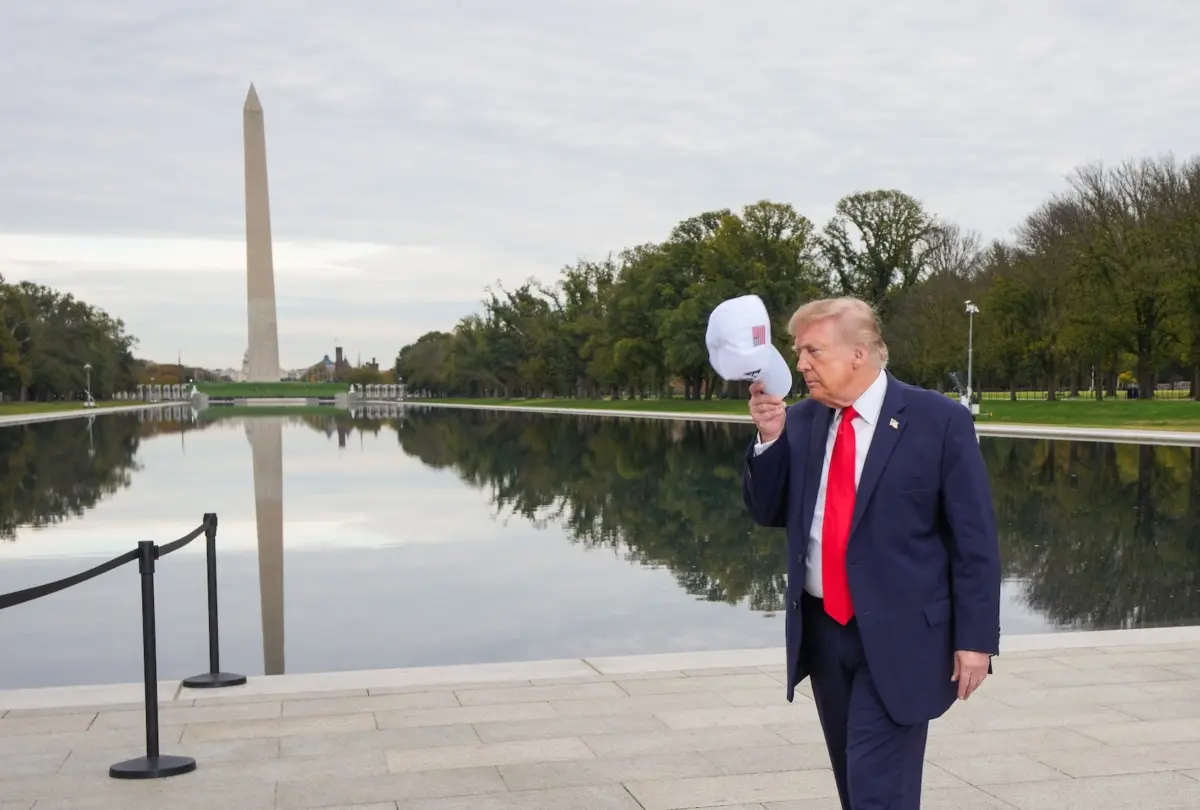
WASHINGTON — With just 24 hours remaining before the nation heads to the polls for the consequential 2026 midterm elections, President Donald Trump delivered an expansive, hour-long address at the Lincoln Memorial Reflecting Pool on Monday. Against the backdrop of shattered early voting records across the country and a shifting political map that threatens Republican congressional majorities, the president spent the opening portions of his remarks railing against local construction projects and reviving past controversies before eventually turning his focus to a stark electoral warning.
The address, delivered on a site that has carried significant political and administrative controversy throughout his second term, captured the high-tension atmosphere defining the final hours of the campaign cycle. As election analysts point to surging Democratic momentum across key battleground states, the president’s address underscored the existential stakes facing the GOP as it fights to retain control of both the House and the Senate for the remainder of his term.
Executive Overview
The 2026 midterm elections have evolved into a referendum on the administration’s second term, fueled by historic voter mobilization and tightening battleground margins. As of Monday, nearly 50 million Americans had already cast ballots nationwide, obliterating previous historical benchmarks in states ranging from South Carolina and Ohio to Texas, where early turnout surpassed the previous midterm record set in 2018.
However, final pre-election polling from prominent institutions, including the New York Times/Siena University and the Cook Political Report, suggests that this massive turnout wave may be working to the advantage of the opposition. Final projections indicate that Democrats hold distinct advantages in key Senate battlegrounds and are positioned to net between 15 and 25 seats in the House, potentially securing their strongest legislative majority since 2009.
In response to these tightening margins, President Trump used his final major public address of the campaign to frame the election in apocalyptic terms, warning supporters against a potential legislative wipeout while simultaneously acknowledging the historical headwinds typically faced by sitting presidents during midterms.
Detailed Chronology: The Lincoln Memorial Address
Speaking before the Lincoln Memorial Reflecting Pool on the afternoon of November 2, 2026, President Trump began his address with a mixture of grievances and off-the-cuff remarks. More than 20 minutes into the speech—which at various points touched on local Washington, D.C., infrastructure developments and renewed conspiracy theories regarding monument vandalism—the president pivoted directly to the looming electoral contest.
Jokingly suggesting that the iconic Washington landmark should be renamed in his honor, Trump quickly shifted to a darker assessment of the political landscape. Seeming to foreshadow potential major Republican losses in both legislative chambers, he characterized the vote as "the most important midterm, I believe, in our lifetime."
"When you vote, remember a party that hates America cannot be allowed to rule over the people who built our country," Trump told the gathered crowd, before leveling sharp rhetorical attacks at the Democratic Party. He claimed that Democrats intended to "blow all of this up by electing communist jihadists."
Later in the address, the president attempted to rally his base by emphasizing the power of voter turnout, while simultaneously acknowledging the well-documented historical curse that plagues sitting executives during midterm cycles.
"If the people that voted for me and voted in the last election where we had such a great victory, if they go out and vote, just a good portion of them, we will win in a landslide," Trump stated. He added, "Now that doesn’t happen because usually whoever the sitting president is, Republican or Democrat, uh, good or bad, good president, great president, bad, for some reason the sitting president doesn’t win the midterms, but we gave this a very strong shot."
Supporting Context & Metrics: Record Turnout Meets Shifting Polls
The final stretch of the 2026 campaign has been defined by unprecedented voter engagement, creating a complex logistical puzzle for pollsters and election administrators alike.
The Early Vote Surge
National data indicates that approximately 50 million ballots have already been processed, driven by record-breaking participation in several critical regions:
- Texas: Over 7.7 million voters cast ballots early, shattering the high-water mark established during the 2018 midterm cycle.
- Ohio and South Carolina: Both states reported unprecedented early turnout rates, with surges in suburban and urban centers alike.
- Demographic Shifts: Reports from multiple swing states indicate a notable increase in the share of registered Democrats participating early, though election experts caution that traditional party registration metrics do not always map cleanly onto individual voting choices.
Despite the heavy early volume, the New York Times noted that roughly half of the total expected electorate is projected to vote on Election Day itself. This dynamic leaves significant uncertainty regarding the final outcome, as late-breaking physical turnout could alter margins in close races.
Final Electoral Projections
Polling aggregates released in the final 48 hours before the polls open paint a challenging picture for the incumbent administration:
- The Senate Battlegrounds: Final New York Times/Siena University surveys show Democrats leading in all seven states most likely to determine control of the upper chamber: Michigan, Kansas, Texas, Maine, Ohio, and more narrowly in Alaska and Iowa.
- House Projections: Final analyses from the Cook Political Report incorporate additional projected shifts for Democrats in North Carolina, Florida, Tennessee, and Virginia. The report forecasts a Democratic gain of 15 to 25 seats, potentially establishing a 230- to 240-seat majority—the party’s strongest standing in the House since 2009.
Official Statements and Campaign Reactions
The stark rhetoric from the White House on the eve of the election drew immediate reactions from political commentators, election integrity advocates, and opposition leaders.
Democratic campaign committees pushed back sharply against the president’s characterizations, choosing instead to focus their final messaging on economic issues, healthcare access, and the defense of democratic institutions. Leadership figures across the aisle framed the final hours of the campaign as a critical opportunity for voters to establish a legislative check on the executive branch for the remainder of Trump’s term.
Meanwhile, local officials in Washington, D.C., along with federal park authorities, maintained heightened security postures around the National Mall following the president’s remarks, monitoring both the immediate event spaces and broader metropolitan infrastructure as the nation transitions from campaigning to voting.
Future Outlook: What to Watch on Election Night
As the nation prepares for polls to open on November 3, 2026, political observers are focusing on several key indicators that will dictate the trajectory of American politics for the remainder of the decade:
- Senate Tipping Points: Watch early returns from key Midwestern and Sun Belt Senate races—particularly Ohio, Michigan, and Texas. If Democratic leads in these competitive states hold, path-to-majority projections for the upper chamber will materialize rapidly.
- Suburban House Districts: The battle for the House of Representatives will likely be decided in suburban districts across states like Virginia, North Carolina, and New York. Shifts in these areas will reveal whether the late early-voting surge among Democratic-leaning segments translated into decisive margins.
- Election Day Turnout Dynamics: Given that nearly half of all votes are expected to be cast on Election Day, watch for potential reporting discrepancies between early vote tallies (which may lean one way depending on state processing laws) and same-day in-person voting patterns.
- Legislative Consequences: A transition of power in either the House or the Senate—or a decisive sweep of both—would fundamentally alter the balance of power in Washington, effectively turning the final years of Donald Trump’s second term into an era of divided government and intense legislative oversight.
As the rhetoric fades and the ballots are cast, the American electorate stands at a historic crossroads, waiting to see whether the midterms will validate the administration’s agenda or enact a sweeping course correction.
