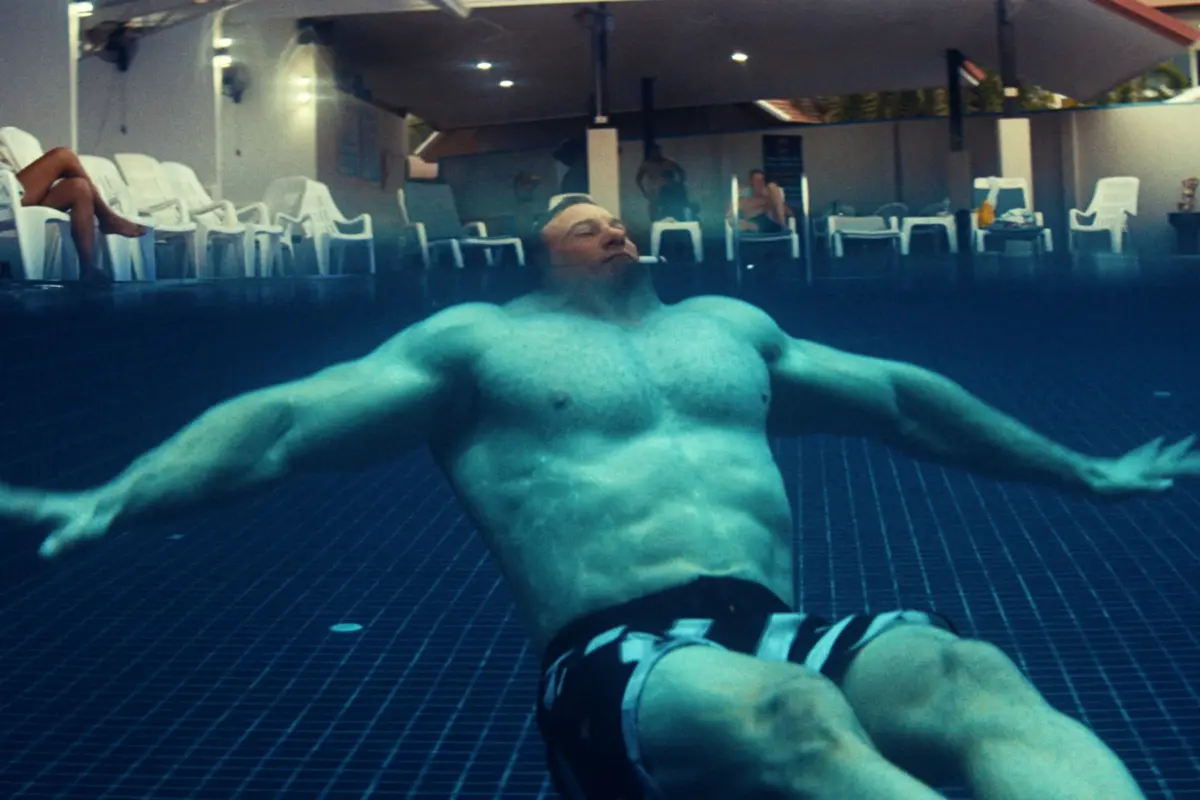
In the sprawling, hyper-monetized ecosystem of the modern internet, the pursuit of self-optimization has crossed the line from healthy lifestyle choices into a dangerous, high-stakes subculture. At the center of this movement is Anthony Hughes—better known to his quarter-million YouTube subscribers as Tony Huge. An OG fitness and steroid influencer, Hughes pioneered a gospel of aggressive biohacking, chemical experimentation, and unapologetic excess.
Now, a blistering new three-part Hulu docuseries, Get Huge: Looksmaxxing to Death, peels back the glossy veneer of the manosphere to expose the devastating human toll left in Hughes’ wake. Directed by Stacey Lee (The Secrets of Hillsong) and executive produced by Jennings Brown and Brett Neichin, the series offers a disturbing, borderline-psychedelic look at the Pattaya, Thailand compound where Hughes orchestrates his daily regimen of weightlifting, recreational narcotics, unverified chemical cocktails, and round-the-clock streaming.
While Get Huge begins as an investigation into a mysterious death within Hughes’ inner circle, it rapidly unfurls into a broader journalistic indictment of the "looksmaxxing" and biohacking phenomena. It exposes how digital echo chambers, starved of genuine mental health support, successfully prey upon vulnerable young men desperate for community, validation, and a sense of "alpha" purpose. As the series reveals, the quest to become superhuman is frequently a fast-track to self-destruction.
Detailed Chronology: From the U.S. FDA to the Shadows of Pattaya
To understand the phenomenon of Tony Huge, one must trace the timeline of a movement that mutated from fringe bodybuilding forums into a viral, mainstream digital epidemic.
The Genesis of an Influencer
Anthony Hughes originally trained as a bankruptcy attorney before realizing that his true calling lay in the burgeoning, unregulated world of underground fitness enhancement. Recognizing a massive market of men seeking radical physical transformations, Hughes began posting on YouTube to promote his proprietary line of supplements.
However, his methods—which routinely involved pushing unapproved, illicit, and high-risk substances—drew the attention of federal regulators. Fleeing an active Food and Drug Administration (FDA) investigation, Hughes packed up his operations and relocated to Pattaya, Thailand, a coastal city known for lax regulation, cheap living, and a thriving expatriate underworld.
Building the Compound
In Thailand, Hughes doubled down on his content creation. Surrounded by what he openly refers to as his "harem" of Thai women, Hughes streamed nearly nonstop. His content combined heavy-duty weightlifting with live chemical injections, punctuated by his infamous catchphrase: "A day natty is a day wasted."
Hughes marketed his lifestyle not merely as a fitness regimen, but as an absolute liberation from societal norms. He framed Pattaya as a utopian sanctuary where men could escape Western decadence and achieve their ultimate masculine potential.
The Invitation and the Tragedy of Leo Longevity
In 2022, Hughes’ web of influence drew in Laith Abdallah Algaz, a fellow biohacking influencer widely known online as Leo Longevity. Algaz had built a following discussing nootropics, life extension, and controversial physical enhancement protocols—including penis-stretching techniques later popularized by modern looksmaxxing stars like Clavicular.
Enticed by Hughes’ promises of brotherhood and collaborative growth, Algaz moved from the West to Pattaya, taking up residence in Hughes’ immediate circle.
The partnership, however, proved fatal. In January 2023, Algaz was found dead inside a bathroom in the home he shared with Hughes. He was only 34 years old. An autopsy later revealed the cause of death to be blunt force trauma, sending shockwaves through the online fitness community and transforming digital influencers into amateur true-crime sleuths overnight. While Hughes has consistently denied any involvement in Algaz’s death, the mystery severely fractured his online community and drew the intense scrutiny of documentary filmmakers.
Supporting Context & Metrics: The Anatomy of the "Looksmaxxing" Epidemic
What started as Tony Huge’s niche experiment a decade ago has metastasized into a multi-billion-view viral phenomenon known as looksmaxxing—a subculture centered on optimizing facial symmetry, body composition, and physical dominance by any means necessary.
The Metrics of Online Extremism
250,000+: Tony Huge’s baseline YouTube subscriber count prior to continuous platform bans.
3 Parts: The structure of Hulu’s Get Huge: Looksmaxxing to Death, filmed extensively over months in Thailand starting in 2024.
Millions: The cumulative viewership commanded by looksmaxxing stars (such as Clavicular and Elon Muscular) who trace their ideological lineage directly back to Hughes’ early protocols.
The Psychology of the "Lost Boy"
According to executive producer Jennings Brown, the secret to Hughes’ enduring appeal does not lie merely in the size of his muscles or the shock value of his content. Rather, Hughes capitalized on a severe cultural deficit: an entire generation of young men experiencing profound isolation, economic anxiety, and a lack of traditional rites of passage.
"We found this string of deaths connected to Tony. He’d been pushing these men to experiment on their bodies. He actively was bringing in these lost boys who clearly needed a father figure and found it in Tony," Brown explains.
Director Stacey Lee points out that the performance of masculinity in these digital spaces is entirely one-dimensional, designed explicitly to trigger algorithmic engagement. Behind the bluster, however, lies deep-seated psychological distress.
"When you have these deeper emotional issues, they aren’t going to be solved by a hit of testosterone or making [your] jawline bigger," Lee notes. "Looksmaxxing is a direct lineage from what Tony started all those years ago. Except it’s more nihilistic, because it’s [saying] the consequences of the future do not matter if you can make it, be successful, be a Chad, be Alpha right now."
Official Statements and Behind-the-Scenes Access
The production of Get Huge was marked by unprecedented, high-risk access. Director Stacey Lee, alongside executive producers Jennings Brown and Brett Neichin, spent months living alongside Hughes and his inner circle in Pattaya. The production team embedded themselves within the gym sessions, the pharmaceutical runs, and the chaotic, marathon-length streaming sessions.
Navigating the Narrative
Capturing Hughes meant navigating a man acutely aware of his own mythos. According to the filmmakers, Hughes routinely oscillated between attempting to distance himself from the dark rumors surrounding his compound and weaponizing the conspiracy theories to drive up his engagement metrics.
On the Performance of Masculinity:"Within this influencer space, it’s about the performance of masculinity. They control this one-dimensional viewpoint that’s very over the top because that’s what drives traffic," Lee shared with reporters. "What was important to us was to see if we could puncture that and better understand the difference between the performance of masculinity versus the reality behind the scenes."
On the Cycle of Self-Destruction:"They’re on this quest of self-optimization to become superhuman, but it ultimately leads to self-destruction," Brown emphasized regarding
the psychological profile of Hughes and his followers.
The Toll Mounts: The Tragic Death of Connor Murphy
The dangers of Hughes’ orbit were further underscored by the tragic trajectory of another prominent creator featured in the docuseries: Connor Murphy.
A former fitness YouTuber who struggled to break into mainstream acting, Murphy pivoted hard into the biohacking and self-optimization space. Seeking a fresh start, Murphy relocated from Los Angeles to Thailand, where he became a fixture in Tony Hughes’ content stream. Adopting Hughes’ relentless routine of intense physical exertion and chemical injections, Murphy’s online persona grew increasingly erratic.
In July 2026—just weeks after the Hulu documentary crew wrapped up production in Thailand—Murphy drowned at the age of 32. When local authorities searched his residence, they found his home utterly trashed. Witnesses reported that the influencer had been exhibiting signs of severe mental instability in the days leading up to his death.
Throughout Get Huge, viewers are given a heartbreaking window into Murphy’s deteriorating mental health. Rather than stepping back to seek professional psychological help, Murphy and those around him often leaned further into the content grind, utilizing their very struggles as fuel for more extreme videos while dismissing vital warning signs.
Future Outlook: Who Is Watching the Next Generation?
As Get Huge: Looksmaxxing to Death streams to global audiences on Hulu, the documentary arrives at a critical cultural inflection point. What was once dismissed as a bizarre, fringe internet subculture a mere two years ago has now saturated mainstream youth culture.
The primary concern of the docuseries’ creators is not just the legacy of Tony Huge, but the structural vacuum that allowed him to thrive. In an era where traditional institutions often fail to provide young men with healthy frameworks for identity, mental health, and community, the digital "manosphere" steps in with easy, toxic answers.
"Tony came up 10 years ago with this philosophy of radical transparency. He got insanely popular because he was doing things that no one else was willing to do, and that formula worked," reflects Stacey Lee. "Connor comes up in this era, and other influencers come up in this era, and they’re all pushing the envelope further and further. And who’s watching but the next generation?"
Ultimately, Get Huge serves as both a gripping investigative true-crime exposé and a cautionary tale. It forces viewers to confront the dark side of digital fame—a space where real human lives are sacrificed on the altar of the algorithm, and where the ultimate price of chasing perfection is death.