

By: Mitchell Parton
Senior Commerce Reporter
Executive Overview
As artificial intelligence rapidly shifts from a novelty tool into the primary interface for consumer discovery, tech giants are aggressively staking their claims on the future of transactional ecosystems. In a major milestone for agentic commerce, Google has officially launched its Universal Cart in the United States, rolling out the feature natively across both the Gemini app and Google Search.
This rollout represents the realization of a strategy first introduced in January, when Google announced the Universal Commerce Protocol (UCP)—a global shopping framework built to interface seamlessly with AI agents while powering native checkouts across Google’s sprawling digital ecosystem.
For brands, retailers, and digital marketers, the stakes could not be higher. As AI agents increasingly mediate product discovery, traditional consumer journeys—which typically involved browsing a brand’s standalone website—are being fundamentally bypassed. Google is positioning itself as an indispensable gatekeeper and infrastructure partner, ensuring that brands can successfully surface within AI-driven recommendations. While Google absorbs the product discovery and transaction phases, underlying merchants retain core e-commerce responsibilities, including inventory management and order fulfillment.
This comprehensive report explores the architecture of Google’s Universal Cart, the strategic implications of the Universal Commerce Protocol, and what this paradigm shift means for the future of digital retail, brand visibility, and the broader e-commerce economy.
Detailed Chronology: From Protocol to Deployment
The commercialization of generative AI has moved at a blistering pace, and Google’s journey toward an agent-driven retail ecosystem has been meticulously calculated over the past year.
January: Laying the Foundation with UCP
Earlier in the year, Google signaled a massive pivot in how consumers buy goods online by unveiling the Universal Commerce Protocol (UCP). Developed in collaboration with major retail partners (such as a high-profile alignment with retail giant Walmart), UCP was designed to solve a fundamental friction point in the early days of generative AI: how to bridge the gap between conversational AI recommendations and actual, frictionless purchases.
Before UCP, asking an AI assistant to find a specific product usually resulted in a list of external links. The consumer still had to navigate to individual merchant websites, recreate their shopping carts, enter shipping addresses, and complete checkout on a third-party domain. UCP sought to eliminate this fragmented experience by standardizing how commerce data, inventory status, pricing, and checkout mechanics are communicated across disparate platforms.
By building a standardized protocol, Google laid the groundwork for native, embedded purchasing. AI agents were no longer restricted to pointing users toward destinations; they could orchestrate the transaction from start to finish within a single conversational window.
Spring and Summer: Interweaving Commerce into Core Services
Following the announcement of UCP, Google methodically integrated commerce features deeper into its core consumer touchpoints. Search engine results pages (SERPs) began prioritizing dynamic, shoppable modules, while the Gemini ecosystem transformed from a purely informational assistant into an action-oriented shopping companion.
During this period, industry analysts noted a subtle yet profound shift in consumer behavior. Users increasingly relied on conversational prompts—such as “Find me a lightweight, waterproof running jacket under $150 suitable for a rainy marathon”—rather than traditional keyword queries. Google’s algorithms leveraged advanced multimodal capabilities to parse these complex requests, pull real-time inventory catalogs, and curate hyper-personalized product carousels.
This Month: The U.S. Rollout of Universal Cart
The culmination of these technological and strategic developments arrived this month with the official U.S. launch of the Universal Cart on the Gemini app and Google Search.
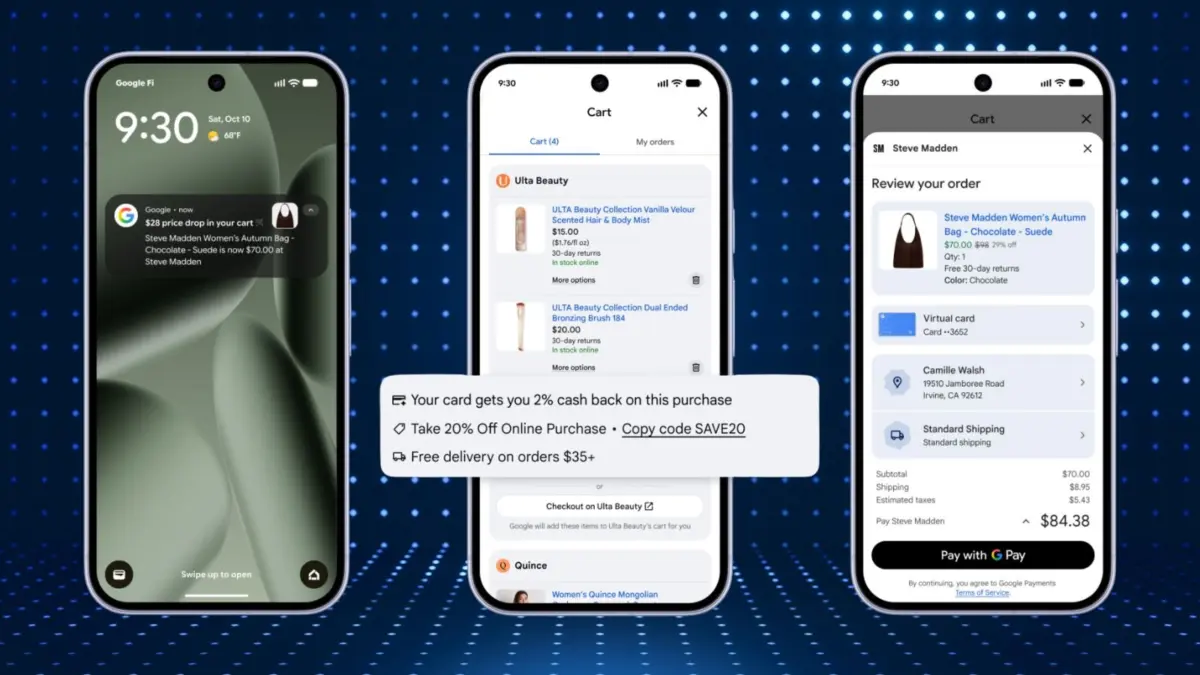
With Universal Cart active, users can now aggregate products from multiple distinct brands and merchants directly within a unified Google interface. If a consumer discovers a pair of running shoes via Gemini and a water bottle through a Google Search recommendation, both items can be added to a single, centralized "Universal Cart." The user completes the transaction natively within Google’s environment, experiencing a unified checkout flow without ever visiting the individual merchant websites.
Supporting Context & Metrics: The Shift Toward Agentic Retail
To understand why Google is aggressively pushing Universal Cart, one must examine the broader transformation currently reshaping the digital economy: the transition from search-driven e-commerce to agentic commerce.

The Decline of the Direct-to-Site Journey
For over two decades, the dominant e-commerce funnel followed a predictable pattern:
- Discovery: A consumer uses a search engine, social media platform, or ad to find a product.
- Navigation: The consumer clicks an outbound link, landing on the brand or retailer’s domain.
- Evaluation: The user browses the site, reads reviews, selects sizes or variants, and adds the item to a local cart.
- Conversion: The user checks out using the merchant’s native payment gateway.
Today, this linear funnel is fracturing. Consumers—particularly younger demographics accustomed to frictionless app experiences—are growing increasingly intolerant of friction-heavy web navigation. When AI agents can instantly compare prices, evaluate reviews, check real-time stock levels, and synthesize recommendations in seconds, forcing a consumer to manually navigate a slow-loading e-commerce site feels outdated.
Industry metrics underscore this behavioral shift:
- Rising AI Discovery: A rapidly growing percentage of product discovery now originates within conversational AI interfaces, smart assistants, and generative search summaries rather than traditional, blue-link search queries.
- Conversion Lift via Reduced Friction: Early retail partners participating in agent-driven checkout systems report significantly higher conversion rates. By eliminating account creation walls and multi-step checkouts on third-party sites, cart abandonment rates drop precipitously.
- The "Zero-Click" Economy: Just as zero-click informational searches reduced traffic to publishers, the rise of Universal Cart threatens to decouple product discovery from merchant website traffic.
The Division of Labor: Platform vs. Merchant
A critical nuance of Google’s Universal Cart model is how responsibilities are divided between the tech giant and the underlying retailers:
- What Google Owns: Product discovery, semantic search curation, conversational recommendations, UI/UX interface management, aggregation (the Universal Cart itself), and the front-end checkout experience.
- What Retailers Own: Core e-commerce infrastructure, inventory synchronization, product data governance, pricing strategies, customer service, and post-purchase order fulfillment (shipping, logistics, and returns).
This division creates a complex strategic calculus for brands. While merchants benefit from accessing Google’s massive high-intent buyer audience and enjoying higher conversion rates, they surrender direct ownership of the top-of-funnel customer experience.
Official Industry Perspectives and Strategic Implications
As news of the U.S. rollout reverberates across the digital marketing and retail sectors, industry experts are weighing in on the profound implications of Google’s latest move.
The Brand Dilemma: Visibility vs. Disintermediation
For brand marketers and e-commerce directors, the arrival of Universal Cart presents both an extraordinary opportunity and an existential threat.
On one hand, failing to integrate with Google’s Universal Commerce Protocol and Universal Cart risks rendering a brand invisible to millions of consumers who now rely on Gemini and AI-driven search for shopping. Inclusion in Google’s AI recommendations is quickly becoming the new "Page One ranking" of e-commerce.
On the other hand, disintermediation remains a major concern. When a consumer buys a product through Google’s Universal Cart, the direct relationship between the brand and the buyer is altered. Brands may receive less direct first-party data (such as direct email sign-ups and browsing behavior on their proprietary sites), making customer retention and loyalty building more challenging. Furthermore, brands must compete within a standardized AI-curated interface where product differentiation can easily be reduced to price, specs, and algorithmic score rather than immersive brand storytelling.
Retail Media and Advertising Opportunities
The launch of Universal Cart also opens up entirely new frontiers for Retail Media Networks (RMNs) and sponsored placements. As Google cements its role as a transactional hub, brand advertisers will undoubtedly look for ways to secure preferred placement within Gemini’s product recommendations and Universal Cart suggestions.
Advertising in an agentic commerce era will not rely on traditional keyword bidding alone. Instead, brands will need to optimize their product data feeds for semantic AI consumption—ensuring that generative models clearly understand a product’s attributes, sustainability credentials, sizing nuances, and compatibility vectors so that the AI agent confidently recommends them to users.
Future Outlook: What’s Next for Agentic Commerce?
The U.S. rollout of Google’s Universal Cart is merely the opening salvo in what promises to be a fierce battle for dominance in agentic commerce. As we look ahead over the next 12 to 36 months, several key trends are poised to shape the landscape:
- Ecosystem Interoperability Battles: Google is not alone in pursuing agentic commerce. Competitors across Big Tech—including Amazon, Apple, and Microsoft—are developing their own conversational shopping and assistant-driven checkout protocols. The industry will watch closely to see whether UCP becomes a widely adopted open standard or if the market fractures into walled gardens.
- Evolution of Merchant Tooling: A new ecosystem of software-as-a-service (SaaS) providers will emerge to help mid-market and enterprise retailers optimize their inventory data feeds for AI agent protocols, ensuring real-time synchronization with Universal Cart and competing platforms.
- The Redefination of Brand Loyalty: As AI agents increasingly make objective recommendations based on user parameters, traditional brand loyalty may face headwinds. Brands will need to double down on experiential marketing, community building, and unique product innovation to ensure that consumers explicitly instruct their AI agents to choose their brand over generic alternatives.
- International Expansion: Following the initial U.S. rollout, commercial pressures will likely accelerate the global expansion of Universal Cart into European, Asian, and Latin American markets, accompanied by localized regulatory compliance regarding consumer privacy and data handling.
Conclusion
Google’s official launch of Universal Cart in the U.S. marks a watershed moment in retail history. By seamlessly blending product discovery, conversational AI via Gemini, and native checkout into a unified ecosystem, Google is fundamentally rewriting the rules of e-commerce. For retailers and brands, adapting to this new agentic reality is no longer an experimental strategy—it is an absolute prerequisite for survival in the modern digital economy.