

Executive Overview
DHAKA, Bangladesh — In the murky, fast-flowing depths of the Meghna River, rescue divers and recovery teams labor against time and treacherous currents following one of the nation’s most devastating maritime disasters in recent memory. The early morning collision between the passenger vessel MV Shariatpur-1 and an oncoming cargo ferry has left at least 32 people dead, scores more unaccounted for, and a nation once again confronting the grim realities of its precarious inland waterways.
Carrying at least 250 passengers—many of them fast asleep in cabins or on open decks—the ill-fated ferry went down swiftly after the impact, settling more than 20 meters (70 feet) below the surface in Munshiganj district, approximately 40 kilometers (25 miles) south of the capital, Dhaka. While an initial wave of survivors managed to swim to safety or were pulled from the water by passing vessels, local authorities and grieving families fear the final death toll will climb significantly higher as dive teams attempt to breach the submerged hull.
The disaster has reignited intense public scrutiny over lax safety regulations, rampant vessel overcrowding, and poor navigational enforcement across Bangladesh’s vast river networks—a labyrinth of waterways that serves as the lifeblood of transport for millions, yet frequently transforms into a watery grave.
Detailed Chronology: The Final Voyage of the MV Shariatpur-1
The journey of the MV Shariatpur-1 began as a routine transit from the southern district of Shariatpur toward the bustling urban hub of Dhaka. For most passengers on board, the overnight trip was meant to be uneventful. Families traveled together for business, medical visits, or, in the case of several individuals, to coordinate significant milestone events.
The Midnight Calm Before the Collision
In the dark hours of early Tuesday morning, as the vessel cut through the waters of the Meghna River in Munshiganj district, the majority of the passengers were asleep. Among them was Mohammad Dulal Dewan and six members of his extended family, who had secured a cabin on the ferry. Their ultimate destination was Dhaka, where they planned to gather for a bittersweet occasion: seeing off family member Shamim Fakir, who was scheduled to board a flight to the United States early Wednesday morning.
"We were seven in a cabin in the ferry, and six of my family members are still missing," Dewan recounted to reporters, his voice heavy with shock and exhaustion.
The Impact and the Capsize
Without warning, the peace of the night was shattered. In the predawn darkness, the MV Shariatpur-1 collided violently with an oncoming cargo ferry. The sheer force of the impact breached the passenger vessel’s structural integrity, allowing tons of water to pour into the hull within minutes.
"Everything happened before I could understand anything," Dewan said, describing the chaotic moments of the crash. As the vessel listed heavily and began its rapid descent into the riverbed, panic erupted among the sleeping passengers.
In the pitch-black chaos, survival often came down to pure instinct and split-second decisions. Driven by desperation, Dewan managed to break free from the flooding interior, plunged into the frigid river, and swam away from the suction of the sinking hull. He was ultimately spotted and pulled from the water by crew members aboard another passing ferry that had rushed to the scene.
The Immediate Aftermath and Rescue Operations
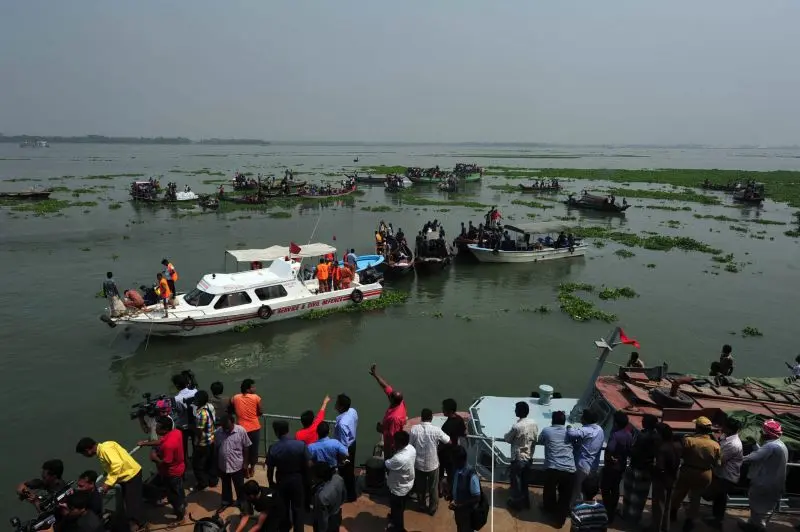
By dawn, word of the disaster had spread, drawing a massive multi-agency response. Law enforcement, the Bangladesh Inland Water Transport Authority (BIWTA), the Fire Service and Civil Defence, and specialized divers from the Bangladesh Navy converged on the disaster zone.
Using sonar equipment and mapping techniques, the water authority successfully traced the sunken remains of the MV Shariatpur-1 resting 70 feet underwater. However, swift river currents, poor visibility beneath the surface, and the tangled wreckage of the cabin spaces severely hampered initial rescue dives.
While approximately 30 people were rescued alive in the immediate aftermath of the sinking, recovery workers faced the grim task of retrieving bodies as they drifted downstream or floated to the surface near the wreckage site. By Tuesday evening, the confirmed death toll stood at 32, but officials cautioned that this number was merely a baseline.
Official Statements and Relief Efforts
As families gathered anxiously along the riverbanks holding photographs of their missing loved ones, local and national authorities faced mounting pressure to provide answers and accelerate recovery efforts.
Government and Law Enforcement Response
Mohammad Azizul Alam, the administrative chief of Munshiganj district, told reporters that local administration offices had set up an emergency registration desk for families seeking news of missing relatives. By late Tuesday, authorities had compiled a formal missing persons list containing 61 names, though officials warned that the actual number of unaccounted individuals could be even higher due to unregistered passengers boarding the ship.
"We believe many bodies are still trapped inside the sunken ferry, and the rescue operation is still on," stated Shahabuddin Khan, the police chief of Munshiganj. "Our divers, alongside naval teams and firefighters, are making every effort to enter the submerged compartments, but underwater conditions are extremely challenging."
Khandker Shamsuddoha Khandaker, chairman of the Bangladesh Inland Water Transport Authority, briefed media outlets on the technological challenges of the operation. He confirmed that the ferry’s exact location had been mapped and marked, allowing heavy salvage cranes to move into position to prepare for lifting the vessel out of the silt.
The Human Toll: Shattered Hopes
The human cost of the disaster resonates deeply through stories of interrupted lives. Shamim Fakir, the traveler bound for the United States whose journey prompted the family gathering on the ferry, remained among the missing as night fell on Tuesday. Instead of preparing for an international flight, his relatives were left standing on the riverbanks of Munshiganj, waiting for divers to surface with news.
For survivors like Mohammad Dulal Dewan, the physical escape from the sinking ferry offered no solace. The sudden loss of six family members in a matter of seconds left him stranded between life and a profound, paralyzing grief.
Supporting Context & Metrics: A History of Waterway Peril
To understand the frequency of such tragedies in Bangladesh, one must look at the geography of the country itself. Known globally as the "Land of Rivers," Bangladesh is crisscrossed by a massive deltaic network formed by the Ganges, Brahmaputra, and Meghna rivers, alongside hundreds of smaller tributaries. For millions of citizens, water transport is not merely an option—it is an absolute necessity for economic survival, commerce, and daily commuting.
The Grim Statistics of Inland Navigation
Despite the vital role that ferries play in the nation’s infrastructure, the safety record of the sector has long been a subject of national shame and international critique.
- Annual Casualties: Hundreds of people die every year in maritime accidents across Bangladesh.
- Historical Loss of Life: Industry estimates and historical records indicate that nearly 4,000 people have lost their lives in ferry-related disasters since 1977.
- Overcrowding and Enforcement: Maritime experts note that operators routinely flout safety standards, ignoring passenger capacity limits, operating without adequate life-saving equipment, and failing to adhere to strict nighttime navigation rules.
Why Bangladesh Ferries Are Vulnerable
- Lack of Regulation and Oversight: Many vessels operating in regional waters are poorly regulated, with local operators often bypassing mandatory safety inspections.
- Overloading: Particularly during peak travel seasons, religious holidays, and weekends, ferries are frequently packed far beyond their maximum safe weight thresholds, severely compromising their center of gravity and stability.
- Inadequate Technology: A significant portion of the domestic fleet lacks modern radar, GPS collision-avoidance systems, or adequate lighting for safe navigation during heavy fog or pitch-black river conditions.
- Cargo and Passenger Mixed Traffic: The collision between the MV Shariatpur-1 and the cargo ferry highlights a persistent hazard: passenger vessels and heavily loaded, unlit cargo boats frequently share congested, narrow river channels without standardized traffic separation schemes.
Future Outlook and Structural Reforms
Following every major maritime disaster in Bangladesh, a familiar cycle unfolds: public outrage, government pledges of strict accountability, the formation of investigative committees, and temporary crackdowns on rogue operators. However, critics argue that systemic change rarely follows these reactive measures.
Demands for Systemic Overhaul
Civil society groups, maritime safety advocates, and grieving families are once again demanding permanent structural reforms rather than temporary political gestures. Key recommendations put forward by safety experts include:
- Mandatory Modernization: Upgrading the domestic fleet with modern navigation, tracking, and collision-avoidance technology.
- Strict Port Authority Enforcement: Establishing rigorous, incorruptible checkpoints at all major river ports to prevent vessel overcrowding before departure.
- Separation of Traffic Lanes: Creating dedicated, marked channels for heavy cargo carriers to prevent them from intersecting with high-speed passenger ferry routes, especially during nighttime hours.
- Legal Accountability: Imposing severe criminal penalties on vessel owners and operators whose negligence or violation of safety rules results in the loss of life.
The Road Ahead for Munshiganj
As recovery operations enter their next phase, the immediate priority for authorities remains the retrieval of all victims trapped within the wreckage of the MV Shariatpur-1 and the safe salvage of the vessel itself. For the communities along the Meghna River, however, the scars left by Tuesday’s tragedy will take much longer to heal.
Until profound, lasting reforms are implemented across Bangladesh’s waterways, the daily commute for millions will continue to carry a silent, terrifying shadow of uncertainty—where a peaceful night journey can turn into a struggle for survival beneath the dark river currents.