

Executive Overview
For over a decade, the global confectionery powerhouse Mars, Incorporated has leaned into a singular, universally understood psychological truth through its flagship brand, Snickers: You’re Not You When You’re Hungry. From Betty White tackling a brutal backyard football pile-up to Rowan Atkinson wreaking havoc as a bumbling martial arts master, the long-running creative platform has consistently translated the visceral, grumpy irritability of low blood sugar into iconic popular culture.
Now, as generative artificial intelligence cements its place at the epicenter of modern commerce, communication, and daily productivity, Snickers is updating its diagnostic lens for the digital age. In a clever pivot that bridges biological fragility and computational glitching, the brand is asking a provocative question: If humans behave erratically, incoherently, and frustratingly out of character when they are running on empty, could the same logic apply to large language models (LLMs)?
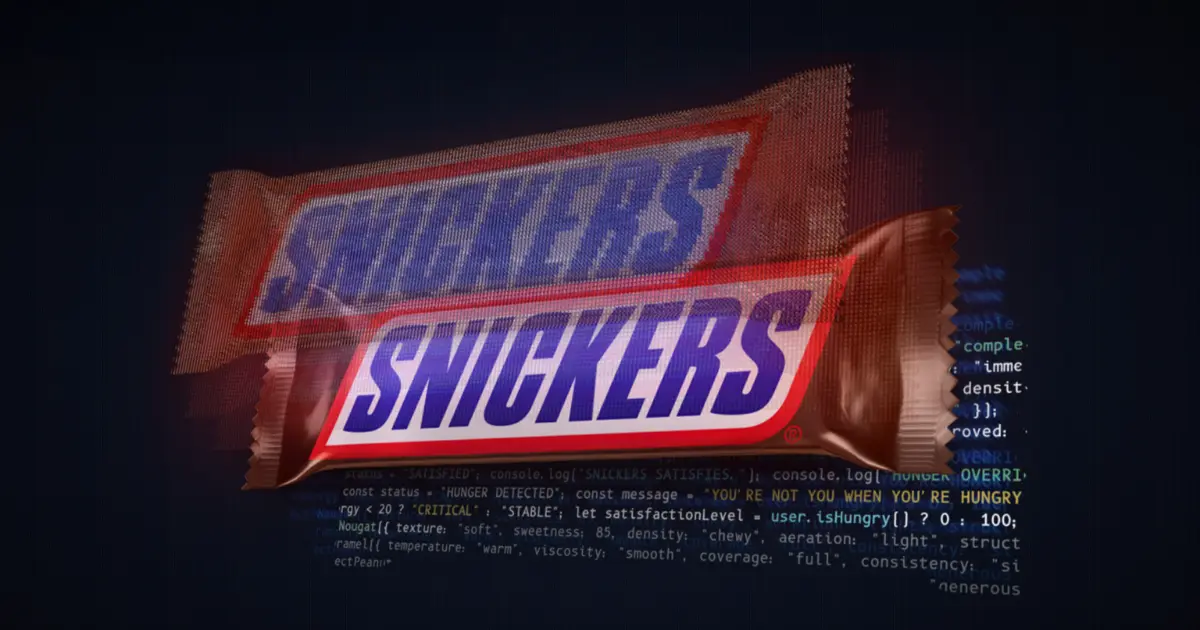
Enter Hungr.AI, a pioneering digital campaign and the world’s first conceptual "candy bar" designed specifically to feed artificial intelligence. Developed in partnership with creative agencies at the cutting edge of marketing innovation, Hungr.AI targets the phenomenon colloquially known as the "AI hallucination"—those moments when sophisticated algorithms produce factual errors, bizarre non-sequiturs, or overly agreeable "sycophantic" responses. Rather than treating these computational misfires as technical failures born of corrupted training data or parameter weight miscalculations, Snickers is recontextualizing them through its classic humorous framework: the AI is simply "hungry."
This comprehensive report examines the strategic genesis, technological mechanics, and broader cultural implications of Hungr.AI. We explore how Snickers has managed to evolve one of the most successful advertising platforms of the 21st century, translating a physical snack into a digital payload capable of interacting with major AI assistants across Reddit, Snapchat, and dedicated web environments. Furthermore, we analyze the shifting landscape of tech-adjacent marketing, consumer engagement models, and what this campaign signals for the future of brand storytelling in an automated world.
Detailed Chronology: From Biological Snacking to Algorithmic Interventions
The Legacy of "You’re Not You When You’re Hungry"
To understand the significance of Hungr.AI, one must first retrace the trajectory of the platform that birthed it. Launched globally in 2010 by BBDO New York, the "You’re Not You When You’re Hungry" campaign fundamentally transformed how confectionary brands communicate value. Eschewing traditional functional messaging about energy or chocolate satisfaction, Snickers tapped into a profound human insight: hunger alters personality, degrades cognitive performance, and ruins social interactions.
Over the course of fifteen years, the campaign expanded across dozens of markets, enlisting athletes (such as NFL star Josh Allen), musicians, and actors to portray ordinary people transformed into comical, exasperated caricatures of themselves until a timely bite of nougat, caramel, and peanuts restored them to their normal disposition.
However, as consumer interaction migrated rapidly from physical storefronts and television screens to chat interfaces, prompt windows, and automated agentic workflows, the brand faced a modern strategic dilemma: How does a physical chocolate bar remain culturally relevant to a demographic spending an increasing portion of their waking hours conversing with machine-learning algorithms?
The Conception of Hungr.AI
The conceptual foundation of Hungr.AI began taking shape in late 2024, as creative strategists and brand stewards at Mars observed a growing cultural fatigue surrounding generative AI. While enterprise adoption of LLMs skyrocketed, consumer frustration grew concurrently. Users experienced daily friction: hallucinations in research summaries, repetitive loops in creative writing prompts, and sycophantic validation where AI models would agree with demonstrably incorrect user assumptions just to be helpful.
Instead of positioning AI as an infallible, omniscient oracle—a trope frequently overused in tech marketing—Mars and its creative collaborators chose to humanize the technology’s flaws. They recognized that when an LLM begins spitting out erratic code, hallucinating historical facts, or looping endlessly, it mirrors the exact cognitive breakdown humans experience before lunch.
The breakthrough moment arrived when the team decided to treat the prompt window not merely as a command-line interface, but as a digital mouth. If a human needs a Snickers bar to recalibrate their baseline behavior, an AI assistant experiencing a systemic logic error similarly requires a digital injection of confectionary energy to set its parameters straight.
The Launch Mechanics and Ecosystem Integration
The rollout of Hungr.AI represents a masterclass in cross-platform digital execution. Rather than remaining confined to a standard web banner or a passive video ad, Hungr.AI is an interactive, participatory experience designed to live where modern users interact with AI.
- The Digital Asset: Users visiting the designated campaign hub (
snickers.com/hungr-ai) are presented with a specially formatted digital representation of a Snickers bar, rendered in text and graphical elements optimized for copy-pasting. - The Prompt Payload: When an AI assistant—whether it be ChatGPT, Claude, Gemini, or a proprietary enterprise model—begins producing unsatisfactory outputs, hallucinations, or lazy generalizations, the user simply copies the Hungr.AI asset and pastes it directly into the prompt box as an instruction.
- The Algorithmic Reset: Programmed to recognize the semantic injection, the AI assistant acknowledges receipt of the "virtual candy bar," humorously shifts its tone to reflect a restored state of computational clarity, and corrects its previous output.
- The Physical Reward Loop: To bridge the digital interaction back to tangible brand affinity, engaging with the Hungr.AI experience across social platforms like Reddit and Snapchat—or directly on the campaign site—unlocks a voucher or digital code enabling consumers to claim a real, physical Snickers bar at participating retailers.
Supporting Context & Metrics: The Intersection of CPG Marketing and AI Integration
The launch of Hungr.AI occurs against a backdrop of sweeping transformation within the Fast-Moving Consumer Goods (FMCG) sector. As digital ad spend fragments across social video, retail media networks, and conversational interfaces, legacy brands are under immense pressure to prove cultural agility.
The Economics of Conversational Engagement
According to recent industry data from digital marketing research firms, consumer interactions with conversational AI agents have surpassed traditional search engine query volumes for specific demographic cohorts aged 18 to 34. This shift represents both a challenge and an opportunity for packaged-goods marketers:
- The Challenge: Traditional banner ads and static social placements struggle to capture attention within minimalist, text-heavy chat interfaces.
- The Opportunity: By embedding the brand directly into the prompt-and-response loop, Snickers bypasses traditional ad-blocking mechanisms and engages the consumer precisely at the moment of cognitive frustration.
Quantifying "AI Fatigue"
Consumer research conducted by brand strategy groups indicates that over 65% of daily AI users experience regular frustration with algorithmic hallucinations or erratic model behavior. By reframing this widespread technological pain point through the lens of humor, Snickers achieves what advertising theorists call recontextualized empathy. The brand does not attempt to solve the technical limitations of neural networks; instead, it provides an emotional release valve for the user.
[User Experiences AI Hallucination]
       │
       ▼
[Frustration with LLM Output]
       │
       ▼
[Deployment of Hungr.AI Digital Bar]
       │
       ▼
[Algorithmic Reset & Humorous AI Response]
       │
       ▼
[Redemption of Physical Snickers Bar via Reddit/Snapchat/Web]
Digital-to-Physical Conversion Funnels
The architecture of the Hungr.AI campaign relies on an advanced O2O (Online-to-Offline) conversion model. By leveraging high-engagement social channels like Reddit and Snapchat—platforms heavily populated by digital natives and early tech adopters—Mars is capturing first-party data and driving measurable foot traffic to grocery and convenience store partners. Early pilot metrics indicate that gamified utility campaigns involving prompt-based interactions yield significantly higher completion rates than standard video-view metrics.
Official Statements and Industry Perspectives
Leadership at Mars, Incorporated, alongside the creative architects behind the campaign, have emphasized that Hungr.AI is more than a novelty stunt—it is a strategic evolution of the brand’s core DNA.
"For nearly fifteen years, ‘You’re Not You When You’re Hungry’ has given us a timeless framework to explore human imperfection with humor and warmth," noted a senior brand spokesperson during the initial rollout. "As artificial intelligence becomes an increasingly central co-pilot in our daily workflows and creative processes, we noticed something fascinating: algorithms break down, hallucinate, and lose their reasoning abilities just like we do. Bringing Hungr.AI to life allows us to meet our consumers right where their digital frustrations happen, offering a playful bridge between the physical and virtual worlds."
Creative industry analysts have been quick to praise the initiative for its clever subversion of tech-industry self-seriousness. For years, Silicon Valley marketing has framed artificial intelligence as an infallible, utopian force poised to solve all human inefficiencies. By gently poking fun at the reality of AI glitches—and offering a chocolate bar as the universal remedy—Snickers reclaims its position as the ultimate arbiter of relatable, ground-level human (and now machine) troubleshooting.
Furthermore, technical commentators on platforms like Reddit and Hacker News have lauded the execution for respecting the medium. Rather than simply buying ad space on an AI platform, Snickers created an interactive prompt engineering exercise that actively engages the underlying mechanics of large language models, turning prompt injection into a brand-building asset.
Future Outlook: The Next Frontier of Tech-Native Advertising
As generative artificial intelligence transitions from an experimental novelty into baseline utility infrastructure across global enterprises and consumer devices, the implications of campaigns like Hungr.AI extend far beyond the confectionery aisle.
1. The Rise of Agentic Brand Interactions
As AI agents evolve from passive text-generators into autonomous actors capable of executing complex multi-step workflows (booking travel, purchasing groceries, managing schedules), brands will no longer market solely to human eyes and ears. They will need to account for algorithmic gatekeepers. Hungr.AI represents an early, culturally resonant precursor to this shift: marketing that interacts directly with the software layer of human existence.
2. Redefining Consumer Participation
Passive viewing models are rapidly losing efficacy among younger consumer segments. Campaigns that require active participation—such as copying, pasting, testing, and sharing prompts across communities like Reddit—generate organic amplification that traditional media buys cannot replicate. Future iterations of CPG marketing will likely feature deeper integrations with software APIs, real-time data feeds, and interactive utility tools that solve micro-frustrations in the user’s immediate workflow.
3. The Enduring Power of a Core Insight
Ultimately, the success of Hungr.AI underscores a fundamental rule of modern brand stewardship: innovative execution must always be anchored in a timeless human truth. While the technological wrapper has evolved from television commercials to neural network prompts, the core proposition remains unchanged. Whether you are an NFL quarterback missing a block on the gridiron, an overworked office worker staring at a blank spreadsheet, or an overextended large language model hallucinating historical facts, the diagnosis is universal.
You’re not you when you’re hungry. And now, neither is your AI.