

Executive Overview
It has been a harrowing week across the United States, marked by a rare and unsettling succession of high-profile technological failures, heightened public anxiety, and sharp political clashes. Over the span of just a few days, critical infrastructure components—ranging from global corporate email systems and commercial aviation networks to major financial institutions and classified intelligence databases—experienced severe, cascading malfunctions. While federal officials have maintained that these disruptions were isolated, routine technical issues rather than the work of a coordinated cyberattack, the psychological impact on an already jittery American public has been profound.
Simultaneously, the media landscape has amplified these anxieties, with cable news commentators openly discussing emergency "prepper" stockpiles while critics demand greater governmental transparency. Compounding this climate of public distrust, controversies surrounding high-ranking government travel during the height of the crisis have drawn fierce scrutiny. Away from the digital grid, the defense of a free press took center stage as The Washington Post honored investigative reporter Hannah Natanson, whose home was infamously raided by the FBI earlier this year. Capped off by the release of former President Joe Biden’s heavily criticized memoir, Promise Me, America, this week has underscored the deep fractures and persistent anxieties defining contemporary American society.
Detailed Chronology: A Week of Technological Cascades
The wave of technical failures began innocuously enough but quickly snowcanned into a national crisis, touching nearly every facet of modern American life.
The Microsoft Outlook Outage
The trouble commenced early last week when Microsoft’s ubiquitous corporate email infrastructure, Outlook, suffered a massive global outage that spanned two full workdays. The digital blackout severely crippled communications across multiple industries. Businesses, government agencies, local school districts, and critical healthcare providers experienced catastrophic disruptions, halting everything from routine administrative correspondence to urgent patient scheduling. As ABC News reported, the incident served as a jarring reminder of how deeply dependent modern society is on a handful of centralized tech ecosystems.
The FAA Ground Stop
The panic escalated exponentially on Friday when the Federal Aviation Administration (FAA) took the unprecedented step of grounding every departing commercial flight across the United States. It marked only the second time in U.S. history—with the immediate aftermath of September 11, 2001, being the first—that a nationwide ground stop of this magnitude was ordered.
Up to 20,000 flights were ultimately canceled or severely delayed, stranding hundreds of thousands of travelers in airports nationwide. While the official airspace shutdown lasted for several hours, the operational ripple effects continued to disrupt travel schedules for days. Preliminary investigations by federal authorities point toward a newly installed network router at the center of the system failure, prompting intense congressional and internal inquiries into the fragility of the nation’s aviation architecture.
Banking Sector Glitches
Just as travelers were beginning to piece their journeys back together, the financial sector took a hit. On Monday morning, customers of several major U.S. banks reported widespread outages, delayed transactions, and missing account balances.
According to The New York Times, JPMorgan Chase—the nation’s largest banking institution—experienced significant trouble processing standard transactions and warned that its internal technical issues might have inadvertently created operational bottlenecks for customers utilizing rival financial institutions. The simultaneous breakdown of communication, transportation, and finance left millions wondering if the nation’s critical infrastructure was facing an unprecedented systemic vulnerability.
The NSA Network Blackout
The sequence of digital failures culminated on Tuesday when a classified computer network utilized by the National Security Agency (NSA) went offline due to an unexpected technical malfunction.
As The Wall Street Journal reported, sources familiar with the incident clarified that the NSA was merely executing a routine software update to patch existing vulnerabilities within the system, known as NSANet. Officials stressed that the outage was strictly temporary and that there was zero evidence of an adversarial cyberattack or foreign intrusion. Nevertheless, the timing—occurring hard on the heels of the Microsoft, FAA, and banking debacles—heightened public alarm.
Supporting Context & Metrics: Assessing the Digital Fragility
The convergence of these four distinct infrastructural collapses in rapid succession is historically rare. Security experts and cybersecurity analysts have spent the past week parsing the data to determine whether these incidents point to systemic vulnerabilities or are merely a statistical anomaly of random, overlapping failures.
| Date / Incident | Sector Affected | Scale of Disruption | Primary Suspected Cause |
|---|---|---|---|
| Mid-Week (Microsoft Outlook) | Corporate & Public Communications | Global workdays disrupted; healthcare & schools impacted | Software / Cloud infrastructure glitch |
| Friday (FAA Ground Stop) | Commercial Aviation | Up to 20,000 flights canceled / nationwide grounding | Newly installed network router failure |
| Monday (Banking Outages) | Financial Services | JPMorgan Chase and multi-bank transaction delays | Internal database / processing software issue |
| Tuesday (NSA Network Down) | National Intelligence | Temporary offline status for classified communications | Routine software patching update |
Despite the lack of empirical evidence pointing to foreign actors, state-sponsored hackers, or domestic saboteurs, the psychological toll has been measurable. Focus groups and social media tracking indicate that public trust in the resilience of core U.S. infrastructure has plummeted.
This anxiety has naturally spilled over into popular culture and media discourse. On cable news networks, commentators openly leaned into dystopian hypotheticals. During a broadcast of Fox News’ The Five, co-host Jesse Watters jokingly referred to the FAA ground stop as a helpful "dry run" for potential national security crises—such as an alien invasion or an escalation with Canada—while noting that his own family was stocking up on bottled water, non-perishable foods, and firearms.
Fellow Fox host Sean Hannity similarly described himself on-air as a "mini-prepper," detailing his personal stockpile of emergency rations, medical supplies, and self-defense tools for worst-case scenarios, prompting fellow anchor Martha MacCallum to remark that such preparations were becoming increasingly prudent.
Official Statements and Political Reactions
As public concern mounted—fanned in part by viral speculation across platforms like TikTok—political figures offered sharply contrasting responses to the week of tech failures.
Traveling abroad in the Philippines, President Donald Trump downplayed the cascading outages when questioned by reporters. Dismissing the panic, Trump remarked: "It’s life, it’s life. When you’re big and powerful and you have all the money, things like that happen. It’s fine."
Conversely, political commentators and former administration officials argued that the White House needed to adopt a far more proactive and transparent communication strategy. Karoline Leavitt, former White House press secretary and current Fox News contributor, voiced her own anxieties regarding her personal banking accounts during an appearance on Fox & Friends.
"What I would say to the White House is transparency is key," Leavitt urged. "It’s going to help the country grapple with what’s going on… The White House needs to take that message wide and loud. When the president returns, there should be a message directly to the American people… saying what they know and what they believe to be true, to really calm the temperature."
The Mullin Travel Controversy
While administration spokespersons attempted to reassure the public that the government was fully functioning, controversy erupted over the travel arrangements of high-ranking officials during the crisis.
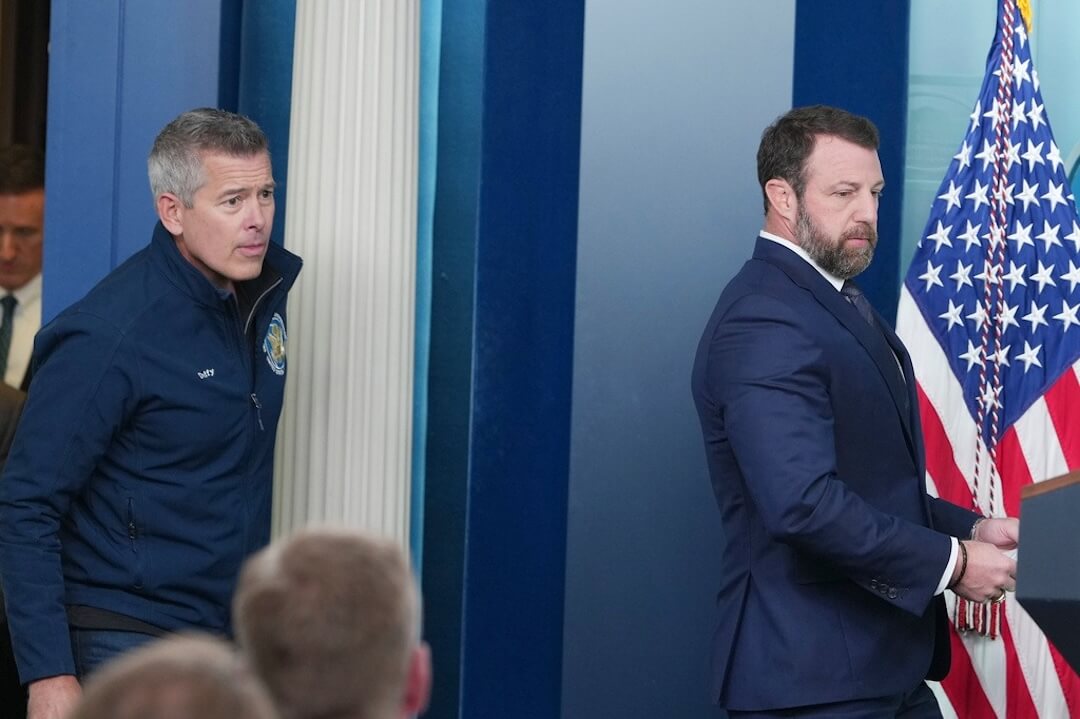
The New York Post reported that Homeland Security Secretary Markwayne Mullin utilized a government aircraft to fly to Baton Rouge, Louisiana, to attend the Texas-LSU college football game. The flight occurred while thousands of everyday Americans remained stranded in airports nationwide following the FAA ground stop. Notably, less than 24 hours prior to his departure, Mullin and Transportation Secretary Sean Duffy had been addressing reporters in the White House briefing room regarding the aviation shutdown.
The Department of Homeland Security fiercely defended the trip, issuing a statement explaining that Secretary Mullin is legally mandated to travel via government aircraft to maintain secure communications and satisfy constitutional continuity-of-government protocols. Furthermore, the agency noted that the flight departed nearly 24 hours after U.S. airspace was officially reopened and that Mullin was spotted in the private box of Ben Bordelon, CEO of Bollinger Shipping—a defense contractor that recently secured billions in DHS contracts, including a $2.2 billion icebreaker deal. Critics argued that regardless of the legal justifications, the optics of attending a luxury college football suite while the nation’s transit system reeled were deeply damaging.
The Battle for the Free Press: Honoring Hannah Natanson
Away from the digital grid and political bickering, the fundamental pillars of American democracy faced scrutiny on Tuesday as The Washington Post honored investigative reporter Hannah Natanson with the prestigious Ben Bradlee Award, named for the publication’s legendary former editor.
Earlier this year, Natanson became the center of a profound press freedom controversy when FBI agents executed a search warrant on her private residence as part of an ongoing federal investigation into a government contractor’s handling of classified materials. During the raid, federal agents seized her personal laptop, a Washington Post-issued work computer, her mobile phone, and a personal Garmin watch.
Addressing her colleagues upon receiving the award, Natanson delivered a sobering update on the status of her investigation:
"Those devices remain in government custody. My sourcing network, built up over a year to span more than 1,200 contacts, has fallen silent… I do not know if I will ever get my devices, or my sources, back."
Washington Post Executive Editor Matt Murray condemned the seizure as an aggressive government overreach, emphasizing that the battle was fundamentally about executive power and constitutional protections rather than partisan politics. "It is, of course, equally important to underscore that this particular action, this battle, was pursued by the Trump administration," Murray told the newsroom. "That is a fact. It is the Trump administration that has been fighting in court to hold Hannah’s materials…"
Despite enduring both these legal assaults and massive newsroom layoffs earlier in the year—which saw the departure of roughly 300 staff members—Post leadership expressed unwavering confidence in the resilience of their journalistic mission. Publisher and CEO Jeff D’Onofrio invoked Ben Bradlee’s enduring maxim, "Our best today; better tomorrow," rallying the newsroom to continue pursuing accountability journalism regardless of political headwinds.
Literary Postscript: Biden’s Memoir Sparks Mixed Reviews
Adding a final layer of media narrative to a packed week, former President Joe Biden officially released his post-presidency memoir, Promise Me, America, on Tuesday. While pre-publication excerpts detailing private conversations and unexpected compliments from Donald Trump generated brief media buzz, the broader critical reception of the book has been decidedly harsh.
Literary and political critics lambasted the memoir for its defensive posture and lack of self-reflection. Writing for The New Yorker, Amy Davidson Sorkin dismissed the book as "startlingly dull," arguing that Biden remains stubbornly
in denial regarding the missteps of his administration. Similarly, The Wall Street Journal reviewer Barton Swaim wrote that Biden made a terrible decision attempting to run for re-election, and an equally poor one in publishing the memoir.
In The New York Times, critic Jennifer Szalai observed that while the former president readily enumerates his legislative victories, he repeatedly falters when confronted with his administration’s defining controversies:
"The true test of a book like this is whether its author will own his losses, too. Biden, for his part, does not. He is so preoccupied with burnishing his legacy that he gets awkward and defensive when addressing the two issues many readers will be most curious about: his handling of the war in Gaza, and his decision to run for a second term."
Future Outlook
As America navigates the remainder of the week, the cumulative weight of technological instability, political friction, and institutional distrust leaves the nation at a fragile crossroads. While federal agencies continue to audit their network systems to prevent a recurrence of the Microsoft, FAA, and banking outages, the broader question of infrastructural resilience remains unanswered.
For the public, the events of the past several days serve as a sobering reminder of the invisible threads holding modern civilization together—and how quickly those threads can fray. Whether the White House will heed calls for greater transparency to calm public anxiety, and how the ongoing legal battles over press freedoms will evolve, will dictate the national conversation in the weeks to come.
