

Executive Overview
For over a century and a half, a weathered limestone sarcophagus resting quietly within the hallowed grounds of Westminster Abbey has served as one of British archaeology’s most tantalizing anomalies. Originally excavated in 1869, the Roman-era stone coffin bears a pristine Latin inscription dedicated to Valerius Amandinus, a wealthy citizen of Londinium who walked the streets of Roman Britain sometime between 300 and 400 AD. Yet, contradicting this classical provenance, a boldly carved Latin cross dominates the lid—stylistically dating not to the twilight of the Roman Empire, but to the turbulent late Saxon era of the 10th or 11th century.
How did a high-status Roman burial chest come to house a body centuries after its creation? This lingering archaeological riddle has finally found a compelling resolution. Groundbreaking research published in the peer-reviewed Journal of the British Archaeological Association by Professor Warwick Rodwell, Consultant Archaeologist at Westminster Abbey, sheds unprecedented light on the skeleton within. Combined with cutting-edge osteological analysis by James Young Langthorne of Pre-Construct Archaeology (PCA), precise radiocarbon dating from the Scottish Universities Environmental Research Centre, and modern excavations tied to the upcoming King Charles III Sacristy, the findings point to a fascinating reality: the skeleton belongs to a high-ranking medieval cleric.
Researchers have successfully narrowed the possible identities down to two prominent historical figures who once governed Westminster Abbey as abbots during the early 11th century: Aelfwig (who died circa 1020 AD) or his successor, Wulnoth (who died in 1049 AD). This comprehensive investigation not only illuminates an early, highly sophisticated example of artifact recycling and historical repurposing in medieval England, but it also rescues a vital piece of the Abbey’s early monastic history from centuries of obscurity.
Detailed Chronology: From Roman Londinium to Modern Conservation
To fully appreciate the scope of this archaeological breakthrough, one must trace the extraordinary journey of the Westminster sarcophagus across nearly seventeen centuries of British history.
Phase I: The Roman Origin and Burial (300–400 AD)
Sometime during the 4th century AD, elite artisans fashioned a heavy, durable limestone sarcophagus. To honor a wealthy and influential Romano-British notable named Valerius Amandinus, his name and lineage were meticulously inscribed upon the stone. At this point in history, Britannia was a fading province of the Roman Empire, and sophisticated stone coffins of this caliber were reserved exclusively for the upper echelons of society. Little did the makers know that this vessel would eventually outlive the empire that spawned it by half a millennium, destined for an entirely different sacred ecosystem.
Phase II: The Late Saxon Repurposing (987–1052 AD)
Fast-forward six centuries. The geopolitical landscape of Britain had transformed utterly; the Roman Empire was long gone, and Anglo-Saxon kingdoms vied for dominance before the unifying pressures of the late Saxon monarchy took hold. At Westminster, a Benedictine monastery was taking root—a precursor to the majestic abbey that stands today.
Seeking to honor a monumental religious leader, the community orchestrated a high-status burial. Rather than commissioning a new stone monument from scratch, the Abbey’s master builders engaged in an early form of sustainable resource management: they repurposed the ancient Roman sarcophagus. A wooden timber coffin containing the deceased was lowered into the stone chest, and the Roman lid was modified. Stonemasons carved a prominent Latin cross into its surface, seamlessly blending a pagan classical artifact into the Christian visual landscape of late Saxon England.
Phase III: Accidental Discoveries and Early Blunders (1820–1869)
For centuries, the sarcophagus lay hidden beneath the earth, undisturbed within the abbey precincts. However, as London expanded and construction projects encroached upon the historic fabric of the Abbey, the ancient dead began to surface.
In 1820, construction workers operating along the north side of Westminster Abbey—specifically within the area of King Henry III’s original sacristy—accidentally struck the Roman coffin. In their haste and lack of archaeological oversight, they cracked its heavy limestone lid into six distinct pieces. The damage was crudely repaired decades later, and the sarcophagus was formally cataloged and "discovered" for academic study in 1869. For generations, subsequent antiquarians and scholars gazed at the dual eras represented on the stone—the Roman inscription contrasting sharply with the medieval cross—without possessing the analytical tools to determine who truly lay inside.
Phase IV: Television Archaeology and Modern Interventions (2009–2016)
As archaeological techniques evolved, so did the potential to unlock the sarcophagus’s secrets. In 2009, the famous Channel 4 television program Time Team descended upon Westminster Abbey to examine the archaeology and architecture surrounding the medieval sacristy. This high-profile media exposure refocused scientific attention on the enigmatic burial context.
Yet, a major logistical hurdle threatened to stall research permanently: by the early 21st century, academic consensus assumed the skeleton itself had been lost. Decades of institutional relocations and chaotic mid-19th-century record-keeping left researchers believing the human remains had vanished.
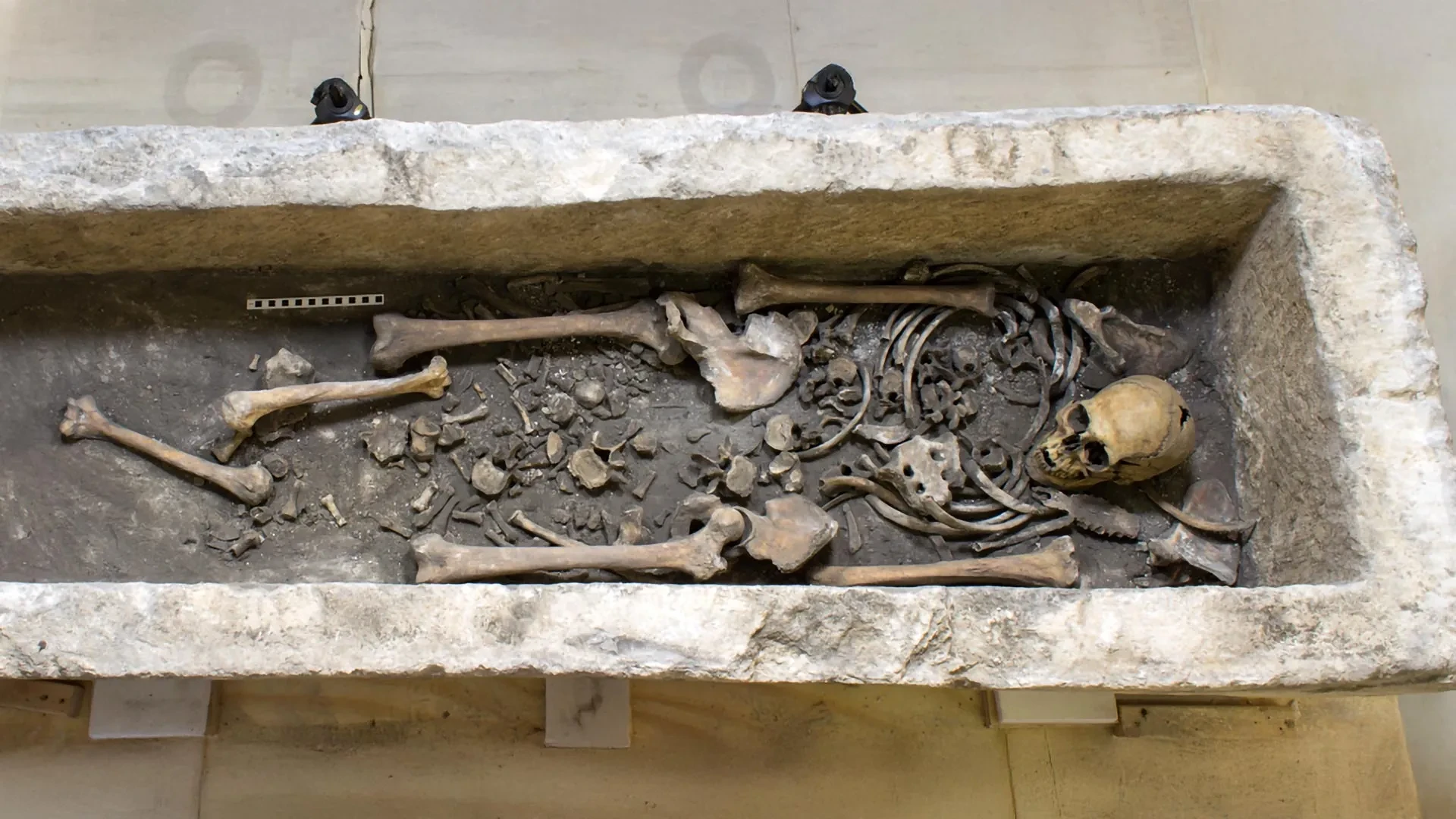
That narrative shattered in 2016 during a routine conservation assessment. When conservators carefully transported the sarcophagus to a specialized studio and lifted its heavy lid, they were stunned to discover an almost complete human skeleton resting quietly inside. It had been hiding in plain sight all along.
Phase V: The 2025 Excavation and Definitive Breakthrough (2025–Present)
The final pieces of the puzzle fell into place during recent archaeological works led by Pre-Construct Archaeology. Undertaken to clear the footprint for the state-of-the-art King Charles III Sacristy project—slated to open to the public soon—this extensive excavation allowed osteologists and archaeological scientists to subject the skeletal remains to a battery of modern diagnostic tests. Through advanced radiocarbon dating, precise osteological profiling, and spatial analysis of the interior residue, researchers finally bridged the 600-year gap between the coffin’s creation and its late Saxon utilization. Today, the sarcophagus and its recovered contents are displayed with appropriate reverence in the Queen’s Diamond Jubilee Galleries at Westminster Abbey.
Supporting Context & Metrics
The depth of this discovery relies heavily on hard scientific data, osteological metrics, and comparative historical analysis. The table and data points below outline the quantitative backbone of Professor Rodwell and his team’s findings.
Osteological Comparison: 19th-Century Estimates vs. Modern Analysis
| Metric / Attribute | Historical Assessment (19th Century) | Modern Scientific Analysis (2025 PCA Study) |
|---|---|---|
| Estimated Age at Death | "Robust young man," under 30 years old | 35 to 49 years old (Mature adult) |
| Estimated Stature | Approximately 5 feet 7 inches | Approximately 5 feet 9 inches (1.75 meters) |
| Dating Methodology | Stylistic assumption & guesswork | Radiocarbon AMS dating via SUERC |
| Radiocarbon Date Range | N/A (Unknown) | 987 to 1052 AD |
Key Scientific and Archaeological Metrics
- 1,000-Year Gap: The elapsed time between the carving of the Roman inscription for Valerius Amandinus (circa 300–400 AD) and the late Saxon inhumation of the medieval abbot (circa 987–1052 AD).
- 6-Piece Fracture: The structural damage inflicted upon the Roman limestone lid when construction workers accidentally struck the sarcophagus in 1820.
- White Lime Residue: A critical microscopic trace found lining the interior of the stone sarcophagus, providing researchers with the exact rectangular imprint of the decayed wooden timber coffin that originally held the body.
- Two Prime Candidates: Abbots Aelfwig (died c. 1020 AD) and Wulnoth (died c. 1049 AD), whose life spans and burial records perfectly mirror the absolute calibration limits of the radiocarbon assay.
Official Statements
The implications of this discovery have resonated widely across the British archaeological community, drawing praise for its interdisciplinary approach that combines architectural history, osteology, and hard science.
"We have two viable contenders for the occupant of the sarcophagus," states Professor Warwick Rodwell, Consultant Archaeologist at Westminster Abbey and lead author of the study published in the Journal of the British Archaeological Association.
Elaborating on the plausibility of the candidates, Rodwell notes: "We do not know the date of birth of either. But either would fit equally well if we assume the Abbot was in his early twenties when the appointment was made and close to fifty when he died. The fact Aelfwig was already a monk of Westminster might favor him."
Addressing the unique nature of the burial rites and the socioeconomic status of the individual, Rodwell emphasizes the deliberate honor bestowed upon the deceased:
"The individual was ‘honored’ with a ‘fine sarcophagus’, an unusual distinction that would be consistent with the status of an abbot. Although no physical traces of that feature remained, it can only have been a timber coffin, which has completely decayed over the course of the seven centuries that the sarcophagus was buried in the sacristy courtyard."
Commenting on the confirmation provided by laboratory testing, Rodwell adds:
"This confirms that the reuse of the sarcophagus, and the associated remodeling of its cover, occurred in the late Saxon period. The results provide definitive scientific support for the theory that an ancient Roman burial container was repurposed to honor an important religious figure nearly 1,000 years ago."
James Young Langthorne, human bone specialist with Pre-Construct Archaeology (PCA), whose meticulous laboratory work corrected century-old misconceptions about the skeleton’s age and build, underscored the importance of re-examining legacy artifacts with contemporary protocols:
"What appeared at first glance to be a straightforward classical antiquities puzzle revealed, upon close osteological inspection, the biological profile of a mature, robust medieval male whose physical metrics cleanly separate him from earlier antiquarian assumptions."
Future Outlook
The solving of the Westminster sarcophagus mystery marks a watershed moment for the interpretation of early monastic sites in Britain, but it also opens new doors for ongoing research at the Abbey.
As Westminster Abbey prepares to unveil the King Charles III Sacristy to the public, this discovery demonstrates how major infrastructure and construction projects, when paired with rigorous commercial archaeology, can unearth profound historical insights. The meticulous cooperation between institutions like Pre-Construct Archaeology, the Scottish Universities Environmental Research Centre, and the Abbey’s internal heritage teams sets a high standard for future heritage management.
Moving forward, researchers hope to apply advanced isotopic analysis—such as strontium and oxygen isotope testing—to the skeletal remains of the unidentified abbot. Such tests could reveal the geographic origins of the man’s childhood, determining whether he hailed from local Saxon nobility or came to Westminster from further afield in Anglo-Saxon England or continental Europe.
Furthermore, the physical exhibition of the sarcophagus within the Queen’s Diamond Jubilee Galleries ensures that millions of annual visitors will be able to engage directly with this tangible intersection of Roman engineering, Saxon piety, and modern scientific detective work. The stone coffin of Valerius Amandinus, once a silent witness to a crumbling empire, stands today as a timeless monument to medieval resourcefulness—and a fitting tribute to a long-forgotten leader of Westminster Abbey.
