

Executive Overview
For most children approaching the winter holidays, writing a letter to Santa Claus is an exercise in unbridled imagination. They ask for bicycles, video game consoles, chemistry sets, and dolls. But when nine-year-old Angel was asked what he wanted most in the world for Christmas, his mind was entirely consumed by a much heavier, adult reality. At the top of his holiday wishlist sat a single, heartbreaking request: an immigration lawyer.
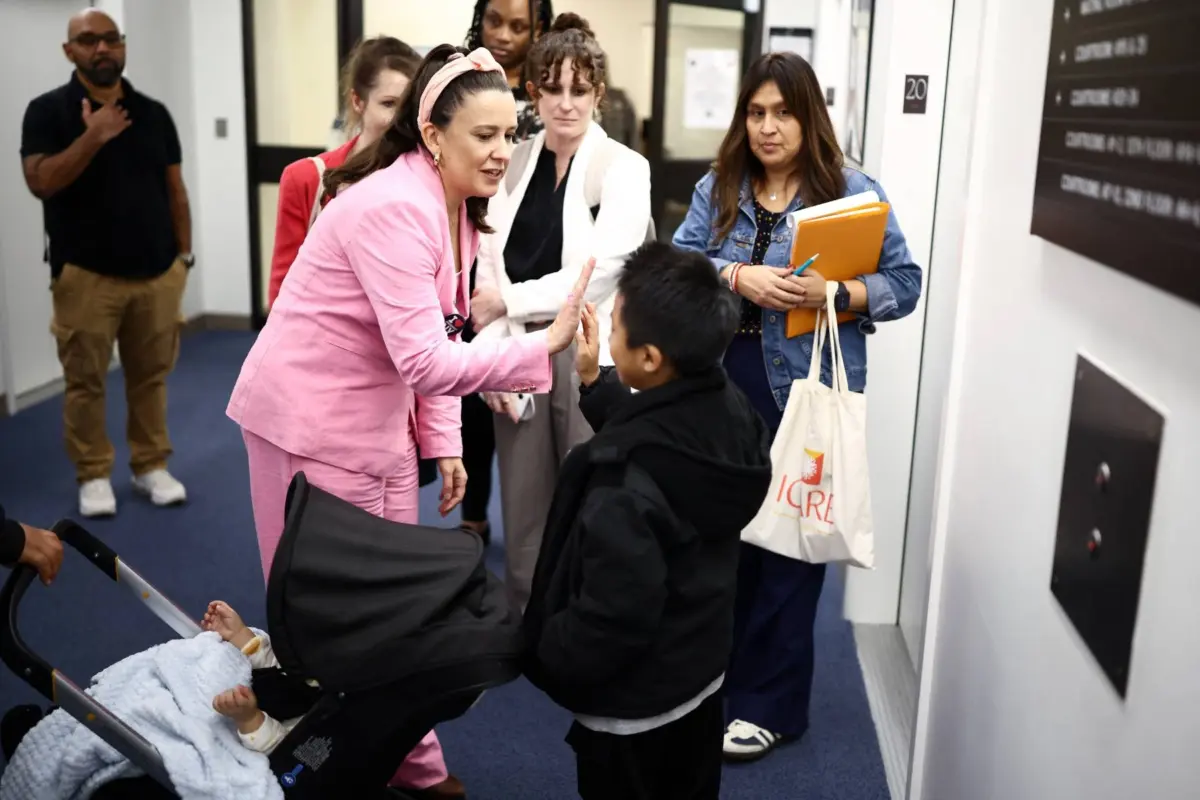
In a moment that has since sparked a national conversation, viral children’s educator and YouTube personality Rachel Griffin Accurso—better known to millions of families globally as "Ms. Rachel"—met Angel at a federal immigration court in Manhattan. Angel was standing at the podium alone, forced to navigate the labyrinthine complexities of U.S. immigration proceedings without legal representation.
Accompanied by Congressman-elect Brad Lander, Ms. Rachel used her platform to spotlight a harrowing systemic failure: unaccompanied minors and young children facing deportation without legal counsel. The encounter highlights a glaring loophole in the American legal infrastructure—unlike criminal court, where defendants are constitutionally guaranteed a public defender if they cannot afford one, immigration court is classified as a civil proceeding. Consequently, even toddlers and elementary-school children must advocate for themselves against seasoned government prosecutors if they cannot secure or afford private representation.
This report examines the events that unfolded at the Manhattan federal immigration court, the broader systemic challenges facing children in the U.S. immigration system, the policy implications of unrepresented minors, and Ms. Rachel’s expanding role as an outspoken advocate for vulnerable children both domestically and globally.
Detailed Chronology: The Day at the Manhattan Immigration Court
The events unfolded on a Monday morning inside the federal immigration courthouse in Manhattan. The atmosphere inside the courtroom was tense, bureaucratic, and overwhelmingly sterile—an environment ill-suited for children, let alone a nine-year-old boy.
Ms. Rachel had arrived at the courthouse alongside Congressman-elect Brad Lander to observe proceedings and draw public attention to the treatment of immigrant families. What she witnessed, however, exceeded her expectations of the system’s harshness.
Standing before the judge was Angel, a fourth-grader who should have been sitting in a traditional classroom setting. Instead, he stood alone at the microphone, clutching the edge of the dais, addressing an immigration judge about his family’s precarious legal status. According to local reporting from ABC 7, the presiding judge granted Angel’s mother a strict deadline of December 15 to secure legal representation, placing immense pressure on a family already grappling with poverty, cultural adjustment, and the threat of removal.
During a break in the proceedings, Ms. Rachel interacted with Angel and asked him to write down a list of the things he wanted for Christmas. Without hesitation, the nine-year-old wrote down an immigration lawyer as his primary wish.
Moved to immediate action, Ms. Rachel declared publicly on her social media channels: "I am getting Angel a lawyer."
The educator later described the emotional toll of the courtroom experience in an interview with reporters:
"It’s heartbreaking. I care so much about every child and I just want to see every child thriving in school and my heart goes out to anyone going through this. I think about how that makes a child feel whether or not you are removable… I don’t want any child to hear that word associated with them."
In a video shared to her millions of followers, Ms. Rachel expressed her utter disbelief at seeing a child forced to represent himself:
"Kids representing themselves in immigration court is so wrong. I saw Angel up at the mic without a lawyer and I couldn’t believe it. He’s 9 years old! Hearing kids hear the word ‘removable’ over and over about themselves… Heartbreaking. Stop the cruelty!"
Supporting Context & Metrics: The Crisis of Unrepresented Minors in U.S. Immigration Courts
To fully understand the gravity of Angel’s situation, one must examine the staggering statistics governing America’s immigration dockets. The backlog in the U.S. immigration court system has ballooned to historic proportions, surpassing millions of active cases. Within this massive backlog, tens of thousands involve unaccompanied minors or children whose families arrived at the southern border seeking asylum.
The Legal Representation Gap
Unlike criminal courts, the Sixth Amendment right to counsel does not apply in immigration court because immigration proceedings are classified under civil law. While adults facing deportation frequently struggle to afford attorneys, the plight of children is uniquely stark.
Data compiled by organizations such as the Transactional Records Access Clearinghouse (TRAC) at Syracuse University consistently reveals a harsh reality: children who have legal representation are vastly more successful in their immigration cases than those who do not.
- The Representation Disparity: Studies indicate that unrepresented children—even those as young as toddlers—are ordered deported at rates exponentially higher than those who have a lawyer by their side.
- Navigating Complex Statutes: U.S. asylum law and immigration statutes are notoriously complex, often compared by legal scholars to the intricacies of the tax code. Expecting a nine-year-old child to understand concepts like "credible fear," "persecution," or "withholding of removal" is not only unrealistic; legal advocates argue it violates fundamental standards of due process and human rights.
The Psychological Toll of the "Removable" Label
Beyond the legal ramifications, child psychologists and advocates have long warned about the developmental and emotional damage inflicted on children who are thrust into adversarial legal proceedings.
When children sit in courtrooms or stand at microphones hearing legal professionals and judges repeatedly label them as "removable" or "illegal," it instills toxic stress and profound anxiety. For children like Angel, whose formative years should be defined by safety, education, and play, the constant existential dread of deportation can lead to developmental regression, depression, anxiety disorders, and long-term trauma.
Ms. Rachel’s critique zeroed in on this precise psychological harm. By centering her advocacy on the lived experience of the child, she challenged the cold, bureaucratic language of the state, reminding the public that immigration policy ultimately impacts living, breathing human children with names, dreams, and holiday wishes.
Official Statements and Political Reactions
The presence of Congressman-elect Brad Lander alongside Ms. Rachel at the Manhattan courthouse underscored the intersection of grassroots advocacy and political action. Lawmakers at both the municipal and federal levels have faced mounting pressure from civil rights groups to address the systemic deficiencies within the immigration court apparatus.
The Call for Policy Prioritization
Reflecting on the systemic failures she witnessed, Ms. Rachel made a direct appeal to policymakers, urging them to re-evaluate their legislative priorities:
"I think our problems would really be a lot less if we all just focus on taking care of kids and centered kids in policies."
This sentiment echoes the arguments put forward by immigration reform advocates who have long pushed for the creation of a federally funded universal representation program for children in immigration court. Proponents argue that ensuring every child has legal counsel is not only a matter of humanitarian decency but also a matter of judicial efficiency. Attorneys help organize evidence, prepare clients, and ensure that only legally sound cases proceed, thereby streamlining an overburdened court docket.
Criticism of Family Detainment and Hardline Rhetoric
Ms. Rachel’s intervention in Manhattan is part of a broader pattern of outspoken advocacy. She has frequently used her immense digital footprint—spanning YouTube, Instagram, and TikTok—to criticize aggressive immigration enforcement policies, including past family detainment practices and inflammatory political rhetoric targeting immigrant children.
Critics of these policies argue that treating children as administrative obstacles or political leverage points degrades the moral standing of the nation. Supporters of stricter enforcement, however, argue that robust legal processing and deportation mechanisms are necessary to maintain border integrity and manage national security. Yet, even within polarized political debates, the spectacle of a nine-year-old child standing entirely alone at a legal microphone has repeatedly united humanitarian observers in bipartisan discomfort.
Beyond Borders: Ms. Rachel’s Broader Advocacy Landscape
While Ms. Rachel is globally recognized for her educational programming aimed at toddlers and preschoolers—helping young children develop speech, language, and social-emotional skills—her public profile has increasingly evolved into that of a prominent humanitarian voice. Her recent advocacy for Angel in Manhattan is consistent with a series of high-profile stances she has taken regarding children suffering from conflict, poverty, and displacement worldwide.
The $1 Million Pledge for Gaza
In September, Ms. Rachel made international headlines when she pledged a $1 million donation to the Palestine Children’s Relief Fund (PCRF). Her contribution matched a similar $1 million pledge made by musician Macklemore, who had faced professional backlash—including being forced off Ed Sheeran’s Loop tour—due to his vocal support for Palestinians amid the Israel-Hamas war.
In an in-depth interview with Rolling Stone, Ms. Rachel explained the deeply personal motivation behind her activism:
*"When I see a mom who has a
baby who is starving and they can’t get any milk, I see that and [think], ‘What if that was me and Susie?’ With Gaza, I couldn’t not speak out."*
By connecting her maternal empathy for her own child to the plight of starving mothers and babies in conflict zones and immigration courts alike, Ms. Rachel has effectively bridged the gap between early childhood education and global human rights advocacy. Her followers, largely composed of parents and caregivers, have responded with widespread mobilization, demonstrating that issues affecting children—whether in Gaza, at the southern U.S. border, or inside a Manhattan federal courtroom—resonate deeply across demographics.
Future Outlook: What Lies Ahead for Angel and the Immigration Debate?
As the December 15 deadline approached for Angel’s mother to secure legal representation, the immediate fate of the nine-year-old hung in the balance. True to her word, Ms. Rachel’s intervention ensured that Angel would not face the legal machinery alone; a qualified immigration lawyer has stepped in to represent him pro bono or through supported channels, offering the family a fighting chance within a daunting legal framework.
However, advocates emphasize that Angel’s case is merely the tip of the iceberg. Thousands of other children continue to stand at courtroom microphones every week across the United States, unrepresented and unprotected.
Key Questions for the Future of Child Immigration Law:
- Legislative Reform: Will federal lawmakers heed the calls of advocates and establish a federally guaranteed right to counsel for unaccompanied minors and child defendants in immigration court?
- Judicial Discretion: Will immigration judges be granted greater discretionary powers to pause or administratively close cases involving young children until stable legal guardianship and representation can be guaranteed?
- The Role of Public Figures in Advocacy: As internet personalities and entertainers increasingly leverage their massive platforms for social causes, how will public pressure influence state and federal policy decisions regarding vulnerable populations?
For now, the image of a nine-year-old boy asking for an immigration lawyer for Christmas remains a damning indictment of a system in desperate need of reform. As Ms. Rachel and other child advocates continue to press for systemic change, Angel’s story serves as an urgent reminder that policies enacted in distant legislative chambers have immediate, profound, and heartbreaking consequences for the most vulnerable among us.
