

By the Global Media & Entertainment Desk
Published November | Special Industry Report
Executive Overview
As the holiday season reaches its traditional fever pitch during Thanksgiving week, the intersection of live sports and digital commerce is undergoing a historic tectonic shift. Leading this charge is Amazon Prime Video, which has strategically positioned Black Friday—traditionally the domain of crowded brick-and-mortar storefronts and frantic online shopping carts—as its single biggest sports and entertainment day of the year.
For industry insiders, media analysts, and Madison Avenue executives, this isn’t merely an expanded programming block; it is a calculated masterstroke designed to rewrite the rules of modern broadcasting. By blending high-stakes, premium live sports with deeply integrated shoppable media experiences, Amazon is orchestrating a 15-hour cross-disciplinary marathon that captures the captive attention of millions of consumers when they are most economically active.
The lineup for this year’s spectacle is formidable, spanning three distinct major sports leagues. It kicks off with the precision and prestige of the PGA Tour’s Farmers Insurance Skins Game, rolls directly into prime-time gridiron action with a high-profile National Football League (NFL) Black Friday matchup between the Denver Broncos and the Pittsburgh Steelers, and culminates late into the evening with a high-octane NBA Emirates Cup doubleheader featuring the Miami Heat visiting the New York Knicks, followed by the Los Angeles Lakers traveling to face the San Antonio Spurs.
Yet, beyond the athletic prowess on display, the true narrative of this 15-hour broadcast event lies in the boardrooms of global brands and advertising agencies. Black Friday has evolved from a simple retail holiday into an advanced data-gathering and product-conversion engine. For Amazon, this massive sports broadcast serves as the ultimate top-of-funnel conversion tool, seamlessly merging the passive entertainment of television viewing with the active transaction ecosystem of Prime.
This special report investigates the structural mechanics of Amazon’s grand experiment. We will examine the detailed chronology of the day’s events, analyze the supporting economic metrics and technological infrastructure powering the broadcast, evaluate official statements from key stakeholders, and project the long-term future outlook for the streaming industry as live sports become the anchor of modern e-commerce strategies.
Detailed Chronology: A 15-Hour Masterclass in Live Sports Programming
To comprehend the sheer scale of Amazon’s Black Friday broadcast strategy, one must examine the meticulously choreographed timeline of the day. Rather than relying on a single marquee event, Prime Video has engineered a continuous 15-hour programming gauntlet designed to minimize viewer churn, maximize audience retention across demographics, and capture multiple distinct advertising windows throughout the holiday.
Morning Block: Teeing Off with the PGA Tour
- 9:00 a.m. ET: The day commences not with retail commercials or morning talk shows, but with the crisp swing of a golf club. Amazon brings the prestigious Farmers Insurance Skins Game from the PGA Tour directly into living rooms and mobile devices nationwide at 9:00 a.m. ET.
- Strategic Intent: By capturing the early-morning audience—comprising early risers, holiday travelers, and golf aficionados—Amazon establishes an immediate broadcast footprint. Morning sports viewing habits are traditionally underserved on traditional television networks outside of holiday parades. By offering elite golf competition, Prime Video captures an affluent, highly coveted demographic before the chaotic rush of holiday shopping truly begins.
Afternoon Block: Prime-Time Gridiron Showdown
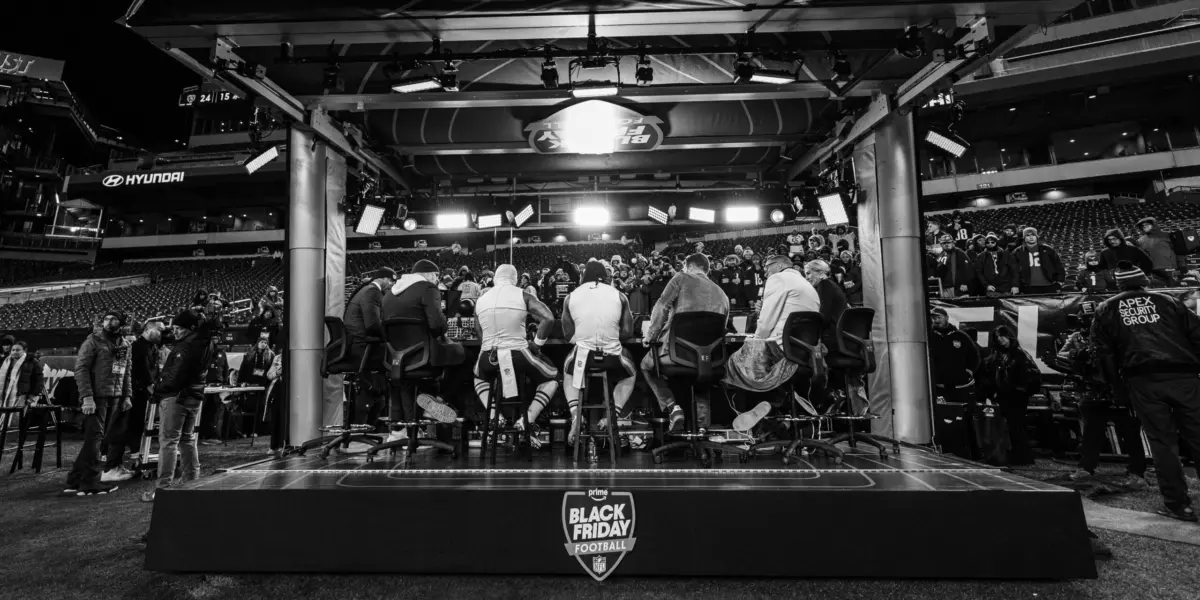
- 3:00 p.m. ET: As families gather around living rooms to digest Thanksgiving leftovers and prepare for the afternoon shopping expeditions, the tempo shifts dramatically with the flagship event of the day: the NFL Black Friday Football game.
- The Matchup: This year features a high-stakes, fiercely contested clash between the Denver Broncos and the Pittsburgh Steelers.
- Strategic Intent: The NFL remains the undisputed king of American television ratings. Securing a dedicated Black Friday afternoon window ensures that Amazon commands the cultural conversation during peak afternoon hours. As millions of viewers sit transfixed by the battle for playoff positioning on the gridiron, the broadcast environment provides an unparalleled canvas for high-impact commercial spots, dynamic product placements, and real-time interactive shopping prompts displayed directly on screen.
Evening Block: Hardwood Thrillers and the NBA Emirates Cup
- 7:00 p.m. ET: As evening descends and consumers settle back into their homes after navigating brick-and-mortar retail or wrapping up online purchases, Amazon transitions audiences from the gridiron to the hardwood. The first leg of an NBA Emirates Cup doubleheader tips off at 7:00 p.m. ET as the Miami Heat travel to Madison Square Garden to face the storied New York Knicks.
- 9:30 p.m. ET: The marathon reaches its crescendo late into the night with a marquee Western Conference showdown. LeBron James, the Los Angeles Lakers, and their global legion of fans descend upon Texas to battle the San Antonio Spurs at 9:30 p.m. ET.
- Strategic Intent: The inclusion of the NBA Emirates Cup is a calculated play for younger, more digitally native, and internationally diverse audiences. Basketball fans exhibit high social media engagement and propensity for mobile-device multitasking—behavioral patterns that align perfectly with Amazon’s vision of interactive, shoppable television.
Supporting Context & Metrics: The Economics of Streaming Sports and Retail Integration
To fully understand why Amazon is investing billions of dollars into securing broadcast rights for the NFL, NBA, and PGA Tour, one must look closely at the convergence of digital advertising metrics, subscriber acquisition costs, and the unique economics of Black Friday.
The Death of Traditional Cable and the Rise of the Sports-Centric Ecosystem
For decades, traditional cable bundles relied on sports programming as the indestructible glue keeping subscribers tied to high monthly fees. As cord-cutting accelerates, tech giants like Amazon, Apple, Google (YouTube TV), and Netflix have recognized that live sports represent the ultimate fortress against churn.
Unlike scripted dramas or reality television—which viewers can binge long after a season airs—live sports are perishable commodities. They must be watched in real-time. This urgency commands undivided attention, making live sports the most valuable real estate in the modern media landscape.
However, Amazon’s playbook differs fundamentally from traditional broadcast networks like CBS, NBC, or ESPN. While traditional networks rely entirely on linear advertising revenue (commercial breaks) and affiliate fees, Amazon operates a closed-loop economic engine. A viewer watching the Broncos-Steelers game on Prime Video isn’t just an impression for a car manufacturer or a fast-food chain; they are a logged-in user with a saved credit card, a one-click shipping address, and a comprehensive purchase history.
The Black Friday Multiplier Effect
The timing of this 15-hour sports marathon is not accidental. Black Friday represents the single highest-volume shopping day of the year in North America, historically characterized by intense consumer intent to buy. By pairing this retail holiday with top-tier athletic competition, Amazon achieves several critical economic milestones:
- Subscriber Acquisition: Millions of non-Prime members tune into these exclusive broadcasts, driving trial sign-ups and long-term ecosystem lock-in.
- First-Party Data Harvesting: The integration of live sports with retail browsing allows Amazon to map viewing habits directly to purchasing behavior, yielding unprecedented consumer insights.
- Commanding Premium Ad Rates: Advertisers are willing to pay astronomical CPMs (Cost Per Mille) when they know their commercials are reaching an audience that is primed to spend money and equipped with frictionless digital checkout tools.
| Metric Category | Traditional Broadcast Event | Amazon Prime Video Black Friday Marathon |
|---|---|---|
| Audience Reach | Passive viewers via linear TV | Logged-in digital consumers with active payment profiles |
| Monetization Channels | Commercial ad spots, subscription fees | Ad spots + direct in-stream e-commerce conversion |
| Data Feedback Loop | Delayed, generalized Nielsen ratings | Real-time attribution tracking (View-to-Purchase) |
| Content Duration | 3 to 4 hours per individual game | 15 continuous hours of diversified cross-sport programming |
Official Statements and Industry Perspectives
The seismic shift represented by Amazon’s Black Friday sports strategy has elicited strong reactions from industry leaders, media analysts, and corporate partners eager to capitalize on this new frontier.
Inside the Amazon Strategy
Speaking on condition of anonymity, senior executives within Amazon’s Prime Video and advertising divisions have emphasized that the company views live sports not as a standalone media product, but as the connective tissue linking entertainment, logistics, and retail.
"We are no longer merely streaming a game; we are orchestrating an entire consumer lifestyle experience," noted one senior media strategist involved in the production planning. "When a fan tunes in at 9 a.m. for golf, stays through the afternoon for NFL football, and winds down with the NBA at night, they are spending an unprecedented amount of uninterrupted time within our ecosystem. Every element—from the broadcast graphics to the interactive features—is engineered to remove friction between what a consumer sees and what they can acquire."
Advertiser Enthusiasm and Madison Avenue’s Response
Major global brands have rushed to secure ad inventory across Amazon’s expanded holiday sports lineup. Marketing agencies report that demand for Black Friday commercial packages on Prime Video has outpaced available inventory by significant margins.
Marcus Vance, Chief Media Officer at a leading global advertising holding company, shared his perspective on the trend:
"For years, television advertising has suffered from an attribution problem: brands knew people were watching, but proving that a 30-second spot drove an actual sale was notoriously difficult. Amazon has completely flipped the script. When you combine the massive cultural gravity of the NFL and the NBA on Black Friday with Amazon’s checkout infrastructure, you create an advertising vehicle that traditional linear television simply cannot compete with."
League Commissioners and Sports Executives
Representatives from the PGA Tour, the NFL, and the NBA have also voiced immense enthusiasm regarding their partnerships with Amazon, citing the tech giant’s unparalleled ability to reach younger, tech-savvy demographics that are abandoning traditional cable packages.
A league spokesperson close to the NBA Emirates Cup partnership remarked:
"Collaborating with Prime Video allows us to place our premier early-season tournament in front of massive global audiences during one of the most culturally significant retail weekends of the year. The technological innovation and distribution reach that Amazon brings to the table elevate the fan experience to entirely new heights."
Future Outlook: The Next Frontier of Streaming and Commerce
As the dust settles on Thanksgiving week and the holiday shopping season accelerates toward its December peak, industry analysts are already looking ahead to the long-term implications of Amazon’s Black Friday sports marathon. What we are witnessing today is merely the opening salvo in a much larger transformation of global media and retail.
1. The Rise of Fully Shoppable Television
The boundary between content and commerce is rapidly dissolving. Over the next three to five years, expect interactive overlays on streaming platforms to evolve from simple QR codes or promotional banners into fully integrated, zero-friction shopping experiences. Imagine watching a star NFL quarterback wearing a specific branded jacket on the sidelines during the Broncos-Steelers game, tapping your remote or mobile screen, selecting your size, and completing the purchase without ever missing a single snap of the game. Amazon’s infrastructure makes this future not just possible, but inevitable.
2. Aggressive Bidding Wars for Holiday Sports Rights
The overwhelming commercial success of Amazon’s Black Friday sports strategy is guaranteed to send shockwaves through the sports broadcasting rights market. Competitors such as Apple, Netflix, YouTube, and traditional media conglomerates will be forced to reevaluate their own holiday scheduling strategies. We anticipate fierce bidding wars for exclusive holiday sports windows as media companies realize that sports are the ultimate antidote to digital fatigue and ad-blocker adoption.
3. Deeper Algorithmic Personalization
As artificial intelligence and machine learning models continue to advance, future iterations of Amazon’s sports broadcasts will likely feature hyper-personalized feeds. Viewers may soon have the option to choose specialized audio commentary, customized camera angles, or targeted advertising feeds tailored precisely to their past shopping history, demographic profile, and geographic location.
Conclusion
Amazon Prime Video’s 15-hour Black Friday sports marathon is far more than an impressive lineup of golf, football, and basketball. It is a watershed moment in the evolution of modern entertainment and commerce. By fusing the unyielding cultural power of live sports with the unrivaled logistical might of the world’s largest online retailer, Amazon has established a formidable blueprint for the future—proving once and for all that in the modern media landscape, the game is only half the experience.
