

Grief, Outrage, and Questions After a Pre-Dawn Massacre in Panjwai
KABUL, Afghanistan — In the desolate, sun-bleached expanse of the Panjwai district in Kandahar province, a young man sits slumped against the trunk of a gnarled tree, his knees pulled tightly to his chest. His head hangs heavy, shielding a face etched with incomprehensible trauma. When he finally looks up, his eyes are wide, hollow, and overflowing with tears.
The source of his agonizing sorrow rests just a few yards away in the beds of flatbed pickup trucks.
In one vehicle, the lifeless body of a toddler with a brutally bloodstained face lies wedged between two murdered adult men. In the bed of an adjacent truck, a scorched wool blanket is pulled back to expose the charred, blackened legs and feet of two more victims. These are merely a fraction of the 16 innocent villagers—including young children and infants—who were slaughtered in their sleep during a rampage that unfolded in the pre-dawn hours of a Sunday morning.
According to Afghan local officials and international investigators, the perpetrator of this horrific act was not a member of an insurgent faction, but a uniformed U.S. soldier who allegedly slipped away from a nearby military outpost to wage a localized war of terror on sleeping families.
Executive Overview
The Panjwai massacre stands as one of the most destabilizing incidents of the protracted war in Afghanistan, severely fraying the fragile fabric of trust between local communities and the international military coalition. The Sunday morning raid targeted two distinct villages in a region long recognized as the strategic heartland and birthplace of the Taliban. Yet, the victims were not combatants; they were civilians—predominantly women, young children, and the elderly—who had recently returned to their ancestral homes under the explicit security guarantees of the United States military.
While top-tier American leadership, including President Barack Obama, immediately offered formal condolences and promises of a transparent, thorough investigation, those diplomatic gestures rang hollow in the dust-choked alleys of Kandahar. Local religious leaders reported that a single extended family suffered the staggering loss of 11 members in a matter of minutes. As grieving survivors buried their dead, investigators meticulously sifted through blood-spattered living quarters, collecting shell casings and documenting a crime scene that defied military logic and human decency.
The incident instantly galvanized geopolitical tensions. While the International Security Assistance Force (ISAF)—the U.S.-led NATO mission in Afghanistan—insisted that the massacre was the isolated act of a rogue soldier acting alone, many local residents remained deeply skeptical, convinced that multiple armed individuals must have participated. Meanwhile, revelations regarding the accused soldier’s military background—including multiple combat tours in Iraq and a traumatic brain injury (TBI)—pushed the debate over the psychological toll of prolonged counterinsurgency warfare to the forefront of national and international discourse.
Detailed Chronology of Events
The nightmare began before dawn on Sunday in the Panjwai district, an area historically plagued by intense insurgent activity. Under the cover of darkness, a U.S. Army staff sergeant stationed at a local forward operating base allegedly walked away from his post, heavily armed and equipped with night-vision gear and his service weapon.
Moving silently through the rural community, the gunman forced his way into civilian residential compounds where families lay sleeping.
"One guy came in and pulled a boy from his sleep and he shot him in this doorway," a traumatized mother recounted, her voice trembling as she sat inside the shattered remains of her home. "Then they came back inside the room and put a gun in the mouth of one child and stomped on another child."
The systematic carnage spanned multiple homes across two separate villages. Rather than a chaotic firefight, survivors described a deliberate, methodical execution of the most vulnerable members of the community. In one residential compound, entire family units were wiped out in their beds. By the time the rampage concluded, 16 civilians lay dead, their bodies bearing close-range bullet wounds and, in several instances, severe burns.
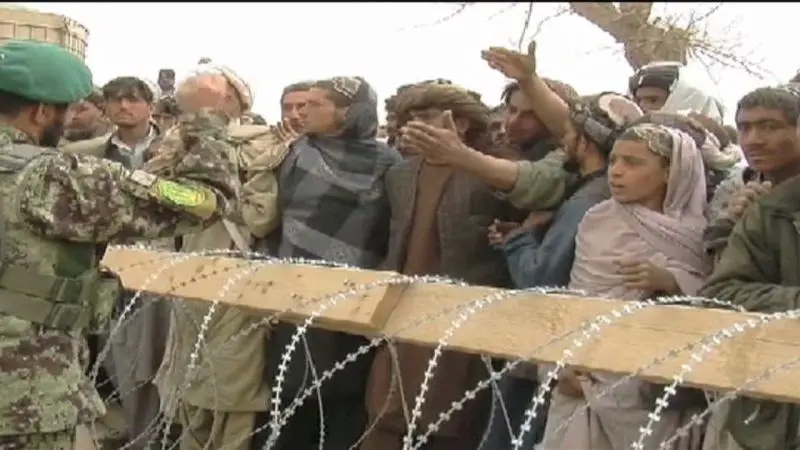
As the sun rose over Kandahar, the horrific reality of the night began to emerge. Grief quickly dissolved into blind rage. Survivors and grieving family members loaded the bodies of the victims—including four young girls and four boys, all roughly two years of age—onto the backs of pickup trucks to transport them for immediate burial according to Islamic custom.
"Four girls and four boys. They are 2-year-olds. Are these Talibs?" shouted a mother, her voice cracking with fury and inconsolable grief from the back of one of the transport vehicles.
As local villagers worked through the agonizing task of digging graves, forensic investigators and military police moved in. They combed the dirt pathways and blood-soaked interiors of the mud-brick homes, recovering discarded shell casings and cataloging the physical evidence of a massacre that would send shockwaves across the globe.
Supporting Context & Metrics: The Accused Soldier and the Panjwai Setting
The Profile of the Accused
As the investigation intensified, new and troubling details regarding the suspect emerged from Department of Defense officials speaking to the press.
- Military Specialty: The accused soldier was a seasoned staff sergeant and a qualified infantry sniper, expertly trained to deliver lethal fire at distances of up to 800 meters.
- Deployment History: Prior to his assignment in Afghanistan, the sergeant had completed three arduous combat tours of duty in Iraq.
- Medical Background: During his time in Iraq in 2010, the soldier sustained a severe traumatic brain injury (TBI) resulting from a vehicle accident. Following medical treatment, evaluation, and rehabilitation, he was formally cleared by military medical boards to return to active duty status, subsequently deploying for his first tour in Afghanistan.
The Geography of Betrayal
The choice of location added profound irony and bitterness to the tragedy. Panjwai is widely recognized as the birthplace and spiritual heartland of the Taliban movement, having served as a formidable insurgent stronghold for over a decade. However, the families targeted in Sunday’s raid were returnees.
Many residents had fled the district years earlier due to relentless combat between coalition forces and insurgents. Months prior to the massacre, however, numerous families accepted assurances from the nearby U.S. military base that the area had been sufficiently pacified and secured.
"This base told us to come back to our villages… we will not bother you. This is your land, and this is your own village," one female survivor recalled bitterly. "But these dogs came and grabbed us."
Local residents noted that they had not spotted a single Taliban fighter in the immediate vicinity for at least five months prior to the incident, making the sudden, unprovoked assault by American forces feel like the ultimate betrayal.
Official Statements and Diplomatic Fallout
The international response was swift, defensive, and deeply concerned with averting a catastrophic breakdown in coalition relations.
U.S. and NATO Responses
President Barack Obama issued an immediate statement conveying profound sorrow and offering personal condolences to the bereaved families and the Afghan people, calling the incident "tragic and shocking" and assuring that the United States would hold any responsible parties fully accountable.
Concurrently, ISAF military commanders moved quickly to contain the narrative regarding the scale of the attack. Addressing local rumors and eyewitness assertions that multiple American soldiers were involved in the ground assault, ISAF leadership issued categorical denials.
"The killings appear to be the result of a single soldier, who walked away from his outpost and acted alone," an ISAF spokesperson stated, emphasizing that coalition forces were cooperating fully with Afghan authorities to establish the facts.
The Question of Jurisdiction
The massacre immediately triggered a fierce jurisdictional dispute between Washington and Kabul. Afghan lawmakers, bowing to intense public pressure and overwhelming national outrage, demanded that the accused soldier be handed over immediately to face a public trial held on Afghan soil under domestic law.
The Pentagon, however, firmly rebuffed those demands. Defense Department spokesman George Little clarified the legal and administrative framework governing the case during a press briefing:
"The soldier was never in the custody of Afghan forces and will not face punishment under the Afghan justice system. The U.S. military has strong means to address wrongdoing. There is an agreement in place with the government of Afghanistan, so that the investigation — and when appropriate, prosecution — will be done through U.S. military channels."
This refusal to submit to the Afghan judicial process threatened to inflame existing grievances regarding the legal immunity enjoyed by foreign military personnel operating within the country, further straining the bilateral partnership between Washington and the administration of Afghan President Hamid Karzai.
Future Outlook: Implications for the Military Mission and Bilateral Relations
The Panjwai massacre represents a watershed moment for the international military intervention in Afghanistan. Coming on the heels of other high-profile cultural and operational flashpoints—such as the accidental burning of Qurans at Bagram Air Base—the shooting severely tested the patience of the Afghan public and political establishment.
The immediate aftermath brought heightened fears of widespread violent protests and coordinated retaliatory attacks against coalition personnel. Although the Taliban quickly issued public statements vowing violent revenge for the deaths of the 16 villagers, large-scale civil unrest was temporarily averted as grieving families focused their energy on mourning and burying their dead.
Nevertheless, the long-term strategic fallout is profound. The incident accelerated discussions regarding the accelerated drawdown of foreign combat troops and forced military planners to re-evaluate base security protocols, the monitoring of individual troop movements, and the psychological screening mechanisms utilized for soldiers returning to combat zones after sustaining traumatic brain injuries.
For the villagers of Panjwai, however, geopolitical strategies and military inquiries offer little comfort. As investigators pack up their forensic kits and the international community debates jurisdiction and military justice, a grieving father staring at the empty dirt floor of his home is left with a solitary, unanswerable reality: a war fought thousands of miles from home had arrived in their bedrooms, leaving behind an indelible scar on the soul of a community that trusted a promise of safety.