

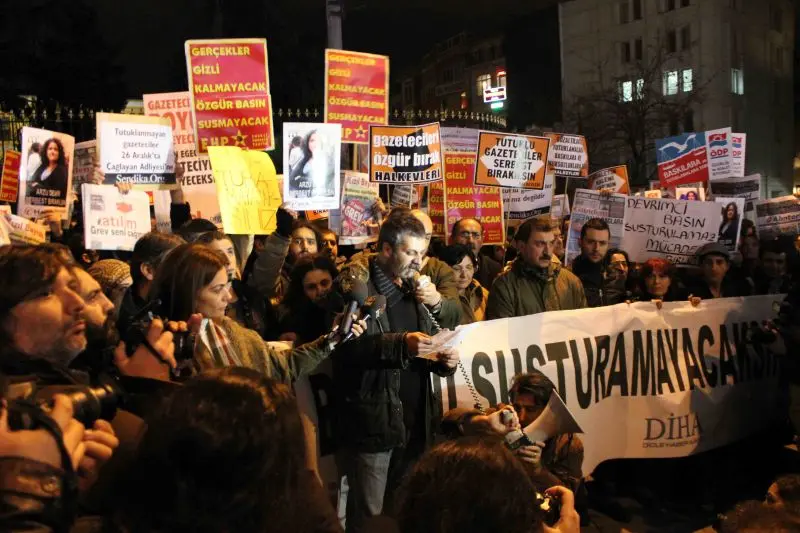
ISTANBUL — In a development closely watched by international human rights organizations, legal watchdogs, and foreign governments alike, an Istanbul court ordered the provisional release of four prominent journalists on Monday. The decision marks a potential turning point in a high-stakes legal saga that has long served as an international litmus test for the state of freedom of expression and judicial independence in Turkey.
Among those released are investigative journalists Ahmet Şık and Nedim Şener, whose names have become synonymous with the global debate over state censorship and political persecution in modern Turkey. Having spent precisely 375 days behind bars prior to their release, the two reporters walked out of prison into the waiting arms of joyous supporters, waving Turkish flags and chanting, "Free press cannot be silenced." Coskun Musluk and Sait Cakir were also ordered released pending the continuation of their trial. All four defendants continue to vehemently deny the charges against them.
The court’s decision to grant release pending trial was justified under Turkish law by the "likelihood of reclassifying the crime" and the substantial "time spent under custody," according to the semi-state-run Anatolia News Agency. While international watchdogs have welcomed the development, they caution that the release of four individuals—while significant—does little to alter the systemic crisis facing journalism in Turkey, where roughly 100 reporters remain incarcerated.
As the legal proceedings press forward toward the next scheduled hearing on June 18, the case continues to cast a long shadow over the administration of Prime Minister Recep Tayyip Erdoğan and the ruling, Islam-rooted Justice and Development (AK) Party. Critics argue that despite the government’s rhetoric of reform, the systemic use of vague anti-terrorism and penal statutes to silence critical inquiry remains an existential threat to Turkish democracy.
Detailed Chronology: The Ergenekon Probe and the Imprisonment of Şık and Şener
To understand the weight of Monday’s court ruling, one must examine the sprawling, controversial judicial proceedings known as the "Ergenekon" investigation. Named after a mythical valley in Central Asian folklore, Ergenekon was alleged by Turkish prosecutors to be an ultranationalist, clandestine terrorist network comprised of military officers, politicians, academics, and journalists whose goal was to destabilize the state and ultimately overthrow the AK Party government.
While the early phases of the Ergenekon sweep targeted secularist military figures and hard-line nationalists who posed a traditional threat to the AK Party’s political dominance, the dragnet soon expanded to encompass media figures. Prosecutors alleged that certain journalists operated as the "media wing" of the shadowy conspiracy, using their platforms to manufacture consent for a coup or to wage psychological warfare against the state.
Ahmet Şık: Investigating the Gulen Movement
Ahmet Şık, a veteran investigative reporter, was arrested in March 2011 alongside Nedim Şener during a series of early-morning police raids. Prior to his apprehension, Şık had been working intensively on a book manuscript provisionally titled The Imam’s Army. The investigative project focused on the alleged systematic infiltration of the Turkish police force and state apparatus by followers of Fethullah Gülen, a powerful, self-exiled Turkish Muslim preacher residing in Pennsylvania.
Upon Şık’s arrest, state security forces moved swiftly to confiscate copies of his draft manuscript from various publishing houses and digital archives. The seizure of an unpublished, unverified book draft sent shockwaves through the global journalistic community, sparking intense debate over whether Şık was being targeted for his reporting rather than any participation in a violent conspiracy.
Addressing the media outside the prison gates on Monday, a defiant Şık reflected on the psychological and professional toll of his 375-day detention:
"This is not just about press freedom, this is about freedom of expression. There are 100 journalists in jail, but freedom of expression is not just a problem for journalists."
He underscored that the plight of the press is inextricably linked to a broader crisis of civil liberties in Turkey, noting that roughly 60 students and thousands of other citizens languish in Turkish prisons under similarly sweeping anti-terrorism frameworks. Furthermore, Şık stated that true justice would only be realized "when those who made up these allegations against us are put in prison."
Nedim Şener: Uncovering the Dink Assassination
Nedim Şener, an award-winning reporter for the daily newspaper Milliyet, found himself targeted following his own exhaustive investigative work. Prior to his arrest, Şener had spent years probing the shocking 2007 assassination of Hrant Dink, a prominent Turkish-Armenian journalist who was gunned down outside his newspaper office in Istanbul.
In his landmark book The Dink Murder and Intelligence Lies, Şener accused the Turkish state apparatus—specifically elements within the police and intelligence services—of deliberately ignoring mounting, actionable intelligence that indicated a plot against Dink’s life. Rather than being rewarded for exposing systemic failures within the security sector, Şener was swept up in the Ergenekon investigation, a twist that supporters and international observers characterized as a retaliatory effort to bury his disclosures.
Speaking to supporters in the prison parking lot upon his release, Şener remained unbowed, vowing to pick up where his investigations were abruptly halted.
"The truth cannot be imprisoned," Şener declared, confirming his unwavering commitment to holding state actors accountable for the cover-up surrounding Hrant Dink’s murder.
Supporting Context & Metrics: The Crisis of Turkish Journalism
While the release of Şık, Şener, Musluk, and Çakır has brought temporary relief to their families and colleagues, the structural reality of Turkey’s media landscape remains deeply troubled. Six other defendants connected to the case remain behind bars, including the principal editors of Oda TV, a hard-line secularist online publication known for its ferocious and unrelenting criticism of the AK Party administration.
Statistical Overview of Imprisonment
According to comprehensive data compiled by the Committee to Protect Journalists (CPJ) and various international human rights coalitions, Turkey has earned the dubious distinction of housing one of the highest numbers of jailed journalists in the world.
- Total Incarcerated: Approximately 100 journalists are currently either convicted or awaiting trial behind Turkish bars.
- Demographics: A significant majority of imprisoned journalists are of Kurdish origin, often targeted under anti-terror laws for their coverage of the Kurdish insurgency or for reporting through pro-Kurdish media outlets.
- Duration of Detention: Prior to Monday’s release, Şık and Şener had endured 375 days of pre-trial detention—a testament to the protracted and often punitive nature of judicial processing in high-profile political cases.
The Legislative Framework: Anti-Terrorism and Penal Codes
At the heart of Turkey’s press freedom crisis is the sweeping nature of the country’s anti-terrorism legislation (specifically the Anti-Terror Law, or TMK) and articles within the Turkish Penal Code (TCK) that penalize "insulting Turkishness," inciting public hatred, or aiding an armed terrorist organization without requiring proof of direct material participation in violence.
Legal experts and international monitors have repeatedly pointed out that these laws contain definitions of "terrorism" and "terrorist propaganda" that are dangerously broad and vague. Consequently, routine journalistic activities—such as interviewing members of outlawed political movements, publishing leaked government documents, or writing critical commentary on state policy—can be legally reclassified as acts of terror or aiding a conspiracy.
Official Statements: Domestic Reactions and International Pressure
The shifting fortunes of Turkey’s imprisoned journalists have generated intense diplomatic friction, pitting the Turkish government against its traditional Western allies and international human rights bodies.
Domestic Responses and Cautious Optimism
The Turkish government has consistently pushed back against allegations that it suppresses freedom of expression, insisting that those detained are facing justice not for their journalism, but for criminal acts and involvement in coup-plotting. However, the decision by the Istanbul court to release the four men prompted a notably conciliatory note from senior government officials.
In a televised public address, Deputy Prime Minister Bülent Arınç welcomed the court’s decision, describing it as a positive step forward.
"It is pleasing," Arınç remarked. "Long periods under custody should not turn into punishment."
While Arınç’s remarks were interpreted by some analysts as a signal that the executive branch recognizes the severe political and diplomatic costs of prolonged pre-trial detentions, critics note that the government has yet to commit to the fundamental legislative overhauls required to prevent such abuses from recurring.
International Condemnation and Demands for Reform
Governments in the United States and the European Union have repeatedly expressed deep concern over the trajectory of freedom of expression in Turkey, viewing the erosion of press freedoms as a potential roadblock to deeper democratic consolidation and EU accession aspirations.
Independent watchdogs have been even more forceful in their demands. In a formal press statement issued shortly after Monday’s court session, the Committee to Protect Journalists called upon Ankara to translate gestures into systemic change:
"The government must go beyond this mere gesture and release all journalists incarcerated under Turkey’s vague penal and anti-terror laws," the CPJ statement emphasized. "Fundamental reform of the country’s legislation to align it with international standards is also essential."
Future Outlook: The Road Ahead
As Ahmet Şık, Nedim Şener, Coskun Musluk, and Sait Cakir begin the process of reintegrating into professional and personal life, the broader war for the soul of Turkish journalism is far from over.
The immediate test for the Turkish judicial system will arrive on June 18, the date set for the next major hearing in the trial. Legal analysts will be watching closely to see whether the momentum generated by Monday’s releases will extend to the six remaining defendants—including the Oda TV editors—who continue to languish behind bars.
Ultimately, the release of Şık and Şener highlights the delicate tightrope walk facing the Turkish state: attempting to project an image of a modern, functioning democracy capable of self-correction, while simultaneously maintaining a firm grip on state security and political dissent. Until comprehensive legislative reforms are enacted to untangle independent journalism from vague anti-terrorism statutes, the sword of Damocles will continue to hang over every newsroom and reporter operating within Turkey’s borders.