

Executive Overview
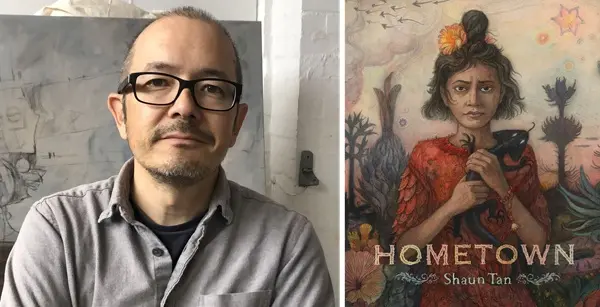
Four years after his previous major release, internationally celebrated author, illustrator, and Astrid Lindgren Memorial Award laureate Shaun Tan returns with Hometown (Levine Querido), a complex graphic novel exploring the intersection of identity, dogma, and familial devotion. Known worldwide for his surreal, wordless masterwork The Arrival and his Academy Award–winning animated adaptation of The Lost Thing, Tan’s latest work interrogates the fragile ecosystem of a non-traditional family when confronted by an uninvited outsider claiming to hold absolute truth.
Set against a dense, otherworldly landscape rendered in ethereal watercolors, Hometown centers on a brown-skinned young girl raised in a cozy, grotesque domesticity. Her family consists of a father with retracting tentacles, a mother boasting a multitude of limbs, and siblings armed with fangs. The narrator’s worldview—grounded in her declaration, “Gravity keeps me here. Or love, which is kind of the same thing”—is disrupted when a human spacefarer crash-lands near her dwelling. Identifying the girl as a fellow human, the visitor insists she belongs in his world, initiating a confrontation between fixed external dogma and deeply rooted, organic belonging.
This long-form investigation traces the seven-year evolution of Hometown, analyzing Tan’s narrative and technical choices. It examines the real-world historical and cultural phenomena that shaped the story—ranging from missionary zeal and theatrical satire to the syncretic survival strategies of marginalized societies—while documenting Tan’s technical transition back to watercolor illustration after a four-decade hiatus.
Detailed Chronology: The Seven-Year Genesis of ‘Hometown’
2017                       2018–2022                   2023                       Sept 2024               Nov 2024
  |                            |                           |                          |                       |
  v                            v                           v                          v                       v
Anthology Request          Exploratory Drafting        Puppet Show Adaptation     Book Launch            Melbourne Exhibition
20-page, 1-month panic     Iterative world-building    Audience feedback shapes   Levine Querido release  Archival sketches &
sketching phase            and character development   narrative resolution       of *Hometown*           gallery exhibition
Phase 1: The 2017 Crisis and Deadline-Driven Inspiration
The origin of Hometown traces back to 2017, when an editor invited Tan to contribute to an anthology centered on the theme of machines and emotions. Constrained by a strict one-month deadline to produce a 20-page sequence, Tan entered a state of rapid creative output—a stark contrast to his typical multi-year development cycles, where a single finished page can require up to two weeks of painstaking production.
Faced with severe time constraints, Tan relied on panic-driven sketching. He developed the core narrative engine: a young girl living contentedly among monstrous kin who encounters a human visitor from another universe. The sheer speed required to hit the deadline prevented over-deliberation, forcing Tan to bypass analytical hesitation and focus entirely on sequential visual pacing (panel, panel, panel, panel). This initial draft established the blunt, feisty, yet wise voice of the narrator and laid the world-building groundwork for the finished novel.
Phase 2: The Stage Adaptation and Structural Shifts
Recognizing the latent potential in the draft, Tan expanded the concept beyond the anthology framework into a full-length graphic novel. During this multi-year development period, Tan shared his preliminary sketches with a Melbourne-based theater company director. This led to a local puppet show adaptation of the unreleased material.
The live theatrical production provided an unexpected feedback loop. The director observed a distinct generational split in audience reactions to the central dilemma—whether the narrator should leave her non-human family to join her human counterpart:
- Young children and parents reacted with protective alarm, urging the girl to remain with her family ("Don’t go, don’t go!").
- Adolescent audience members viewed the arrival of the stranger as an opportunity for independence and self-actualization ("Go!").
This tension prompted Tan to re-engineer the novel’s climax. He intensified the psychological weight of the protagonist’s decision, introducing a layer of strategic subterfuge that allowed her to navigate the stranger’s dogmatic expectations while preserving her home life.
Phase 3: Technical Mastery and Completion (2024)
Over seven years, Tan meticulously revised the story, testing different visual mediums and narrative structures. In September 2024, Hometown was officially published by Levine Querido. The release marked the conclusion of Tan’s longest development cycle for a single graphic narrative since The Arrival, culminating in a planned November 2024 retrospective exhibition in Melbourne featuring original watercolors, developmental sketchbooks, and preparatory notes.
Supporting Context & Metrics
Philosophical and Historical Frameworks: Missionaries, Dogma, and Syncretism
+-----------------------------------------------------------------------------------+
|                            THEMATIC INFLUENCE MATRIX                              |
+------------------------------------+----------------------------------------------+
| INFLUENCE SOURCE                   | NARRATIVE IMPACT IN 'HOMETOWN'               |
+------------------------------------+----------------------------------------------+
| Broadway Musical:                  | Conceptualization of ideological certainty;  |
| *The Book of Mormon*               | shared belief as a driver of community.      |
+------------------------------------+----------------------------------------------+
| Historical Syncretism:             | The mechanics of covert cultural survival;   |
| Indigenous/Catholic Architecture   | subverting dominant frameworks from within.  |
+------------------------------------+----------------------------------------------+
| 19th-Century Romanticism:          | Visual landscape design; transforming familiar |
| Samuel Palmer, Rackham, Doré       | topographies into alien environments.        |
+------------------------------------+----------------------------------------------+
The underlying thematic structure of Hometown reflects Tan’s ongoing inquiry into how human groups construct, enforce, and export ideological belief systems. Two distinct sources influenced the narrative framework:
- The Psychology of Fundamentalism: Tan drawn inspiration from an unexpected source: a viewing of the satirical musical The Book of Mormon. The performance prompted him to analyze the psychological mechanisms that drive missionary work and fundamentalist zeal. Tan observed that dogmatic certainty often stems less from empirical proof than from a desire for collective belonging and shared purpose. In Hometown, the human astronaut represents this absolute mindset. Armed with an authoritative text that he treats as indisputable fact, he is unable to perceive the value or validity of the girl’s local ecosystem.
- Subterfuge and Cultural Syncretism: To resolve the central conflict without resorting to open warfare or complete submission, Tan drew on historical precedent. He referenced the architectural history of colonial Mexico, where indigenous builders incorporated traditional religious symbols into the stone walls of Catholic cathedrals constructed over destroyed Aztec temples. This allowed the builders to outwardly comply with colonial authority while secretly preserving their original heritage. In Hometown, the narrator employs a similar tactic, executing a quiet act of deceit that satisfies the invader’s rigid world-view while safeguarding her underlying reality.
Technical Evolution: Returning to Watercolor After Four Decades
+-----------------------------------------------------------------------------------+
|                        MEDIUM COMPARISON IN TAN'S ATELIER                         |
+----------------------------------+------------------------------------------------+
| OPAQUE MEDIA (Acrylics / Oils)   | WATERCOLOR (Used in 'Hometown')                |
+----------------------------------+------------------------------------------------+
| Dark-to-light application        | Light-to-dark transparency                     |
| High opacity; easy overwrite     | Fluid bleeding; organic edge control           |
| Rigid, controlled form building  | Accidental marks integrated into composition   |
| Heavy sculptural feel            | Atmospheric, ethereal, twisting organic forms  |
+----------------------------------+------------------------------------------------+
For nearly 40 years, Tan’s visual style relied on opaque mediums, primarily oil paints and acrylics. These allowed him to build compositions from dark to light, layering highlights over established medium tones. He long considered watercolor an overly rigid, unforgiving medium that resisted major structural revisions.
However, during the development of Hometown, experimental tests revealed that watercolor offered unique fluidity and visual texture well-suited for depicting a living, surreal environment:
- Fluid Dynamics: The bleeding properties of watercolor enabled Tan to render twisting, organic landforms and hybrid biological entities with a soft lightness that opaque paints could not replicate.
- Incorporation of Error: Rather than destroying compositions, unintended pigment pooling and water marks added textural complexity, mirroring the messy, unpredictable nature of the protagonist’s domestic environment.
- Historical Stylistic Lineage: Tan drew visual inspiration from 19th- and early 20th-century Romantic illustrators, including Arthur Rackham, Gustave Doré, and British Romantic painter Samuel Palmer. Palmer’s monochrome work Early Morning—which transforms a standard English countryside into a densely knotted, otherworldly topography—served as a key reference point for Tan’s atmospheric world-building.
Visual Lineage of 'Hometown':
[Gustave Doré] ----> (Complex Compositional Structure)
[Arthur Rackham] ---> (Linear Organic Detail)            +--> [Shaun Tan: *Hometown*]
[Samuel Palmer] ----> (Atmospheric Alien Landscapes)   /
Structural and Literary Metrics
| Metric / Dimension | Value / Description | Context / Significance |
|---|---|---|
| Development Duration | 7 Years (2017–2024) | Longest solo project cycle for Tan since The Arrival. |
| Publishing Hiatus | 4 Years | Marks Tan’s first standalone visual narrative since 2020. |
| Initial Production Pace | 2 Weeks per finished page | Highlights the contrast between his normal process and his initial 1-month panic draft. |
| Lead Medium | Watercolor & Ink | Tan’s first full-length graphic project using watercolor in nearly 40 years. |
| Primary Publisher | Levine Querido | Released in September 2024 for global distribution. |
Official Statements: Shaun Tan on Narrative, Medium, and Intent
On the Genesis and Panic-Driven Creativity
Reflecting on the initial 2017 deadline that sparked the concept, Tan described how severe time constraints helped overcome creative hesitation:
"In 2017, a friend of mine was putting together an anthology around the theme of machines and emotions. I said, ‘I don’t really have anything, but I’ve been thinking about this idea of a girl who encounters this person from another universe, another human, for the first time in her life,’ and he said, ‘Yeah, sounds good, you’ve got 20 pages and about a month.’
I kind of freaked out. It takes me about two weeks to do one page. I just sketched out this story as fast as I could. I think that state of panic was quite good for me because it stopped me from thinking too hard about the story or little inconsistencies. I just had to go panel panel panel panel.
But I kind of fell in love with the world once I sketched it out. I thought, I really like this place, I love this family, I love the people, and I love the narrator. She’s so feisty and kind of innocent, but wise, and pretty blunt. So I spent seven years working on it, just plotting it out again and again."
On Ideology, Missionaries, and Historical Parallelism
Discussing the thematic conflict between the narrator and the human visitor, Tan explained his interest in missionary work and fundamentalist mindsets:
"I was interested in missionaries—what drove somebody to do that kind of work. Oddly, an early source of inspiration was seeing The Book of Mormon with my wife… the thought that really struck a chord was about why people believe things that are basically unbelievable. The answer is love and community; you feel special in believing it with another person who also feels special, and you have this secret thing that brings you together and separates you from other people.
In Hometown, [the boy’s] approach is dogmatic. He’s a fundamentalist. We don’t know if he’s a fundamentalist rationalist scientist or if it’s religious fundamentalism. But he’s got a book and the book is fact.
I remember someone in Mexico describing how some Catholic churches were built from the stones of Aztec temples, and in some cases the local enslaved builders would hide their images in the walls of the church so that when they were worshipping, they could still be paying homage to their own gods and ancestors. That’s an element in my story… a kind of a subterfuge. The girl does something in the story… that means that she can be happy and the boy can be happy. But it involves a kind of deceit."
On Re-encountering Watercolor
Addressing his technical departure from acrylics and oils, Tan recounted his re-evaluation of watercolor:
"I hadn’t touched watercolor for almost 40 years. I had been working from dark to light, using acrylics and oils—opaque media where you have a dark or medium ground and you do the highlights last, so you’re sort of drawing the images up. I always thought of watercolor as a very fussy medium. It’s terrible for revision, or so I thought.
I did some experiments and it’s actually quite flexible. You can fix things if you make a mistake, and the mistakes are often good. So, watercolor’s really great for this world that you see, where it’s got all these twisting forms. It’s just the way it bleeds."
Visual Influence Pipeline:
19th Century Romanticism (Palmer/Rackham)
  --> Unconventional Medium Shift (Watercolor Exploration)
    --> Complex Topography & Hybrid Visual Character Design
Future Outlook
The publication of Hometown represents a key milestone in Shaun Tan’s ongoing exploration of contemporary graphic literature. By using visual metaphor to address real-world phenomena—ideological certainty, colonial history, and the emotional complexity of family—the novel reframes how picture books engage with mature philosophical themes.
Tan’s upcoming commitments focus on the archival and exhibition stages of the project:
+-----------------------------------------------------------------------------------+
|                           IMMEDIATE FUTURE ROADMAP                                |
+-----------------------+-----------------------------------------------------------+
| TIMELINE              | PROJECT / INITIATIVE                                      |
+-----------------------+-----------------------------------------------------------+
| Late 2024             | Comprehensive solo exhibition in Melbourne, featuring     |
|                       | original watercolor spreads and development sketchbooks.  |
+-----------------------+-----------------------------------------------------------+
| Ongoing               | Compilation of an archival companion notebook detailing  |
|                       | raw visual research and rejected narrative iterations.     |
+-----------------------+-----------------------------------------------------------+
| Long-term             | Exploratory sketchbook synthesis; synthesizing isolated   |
|                       | narrative fragments into future long-form graphic projects.|
+-----------------------+-----------------------------------------------------------+
Looking ahead, Tan continues to explore new material in his personal sketchbooks. Reflecting on his ongoing creative process, Tan compares developing new works to baking: "It’s like a cake that’s missing a critical ingredient. It’s about finding the time to sit down and do the hard work of pushing ideas together."
Through Hometown, Tan demonstrates that graphic storytelling can bridge deep philosophical inquiry with accessible visual narrative. The book offers a timely study on how individuals preserve their heritage and emotional truths when confronted by absolute dogma.
