Reporting supported by the Pulitzer Center and the United Nations Foundation.
Executive Overview
For generations, the nightmare of a healthy toddler waking up paralyzed has been confined to the yellowed pages of history books. Thanks to the monumental medical breakthroughs of Dr. Jonas Salk and Dr. Albert Sabin in the 1950s—followed by decades of relentless international cooperation—polio was systematically driven to the absolute margins of human society. In 1979, the United States became a pioneer by declaring the disease eliminated within its borders, a historic milestone later matched by nations worldwide.
Today, that hard-won victory stands on the precipice of collapse. A convergence of abrupt geopolitical shifts, sweeping international aid dismantlements, and surging domestic vaccine hesitancy has created a dangerous vacuum in global health infrastructure. Following rapid funding cuts to institutions like the World Health Organization (WHO), the United Nations, and the U.S. Agency for International Development (USAID), independent monitors have issued dire warnings: the eradication of polio is facing an "existential threat."
As once-vanquished pathogens stage quiet, aggressive comebacks in wastewater systems and under-vaccinated communities, public health experts warn that the world is flying blind. Without immediate course corrections, the terrifying question is no longer whether polio will return to developed nations, but how devastating the resurgence will be.
Detailed Chronology: Anatomy of a Resurgence
July 2022: The Alarm Sounds in Upstate New York
Eleven days after developing a fever and eight days after his legs went limp, a young man in upstate New York presented a deeply confounding medical mystery. With no history of immune deficiencies, his illness had morphed from a suspected stomach bug into a condition mimicking meningitis.
Because the patient was unvaccinated, local physicians were forced to cast their nets wider than standard diagnostic protocols, considering infections that had not been documented in the United States in a generation. When specialized laboratory tests returned, they delivered a chilling confirmation: this was the first case of community-acquired polio in the United States in nearly a decade. Subsequent sewage surveillance revealed that nearly one in twelve wastewater samples in nearby treatment plants tested positive for the virus, signaling an active, silent chain of transmission.
January 2025: The Machinery of Aid is Dismantled
The fragile safety net holding the virus at bay suffered a seismic shock on January 20, 2025. On the first day of Donald Trump’s second administration, the White House announced its intention to withdraw from the World Health Organization, immediately halting funding, recalling staff, and severing diplomatic negotiations.
Within weeks, the administration expanded its isolationist pivot by withdrawing from critical branches of the United Nations, including UNICEF, under the allegation that their operations ran contrary to U.S. interests. Simultaneously, the newly formed Department of Government Efficiency (DOGE) targeted the U.S. Agency for International Development (USAID).
"We spent the weekend feeding USAID into the wood chipper," DOGE leader Elon Musk posted on social media.
By the time the political dust settled, approximately $230 million specifically dedicated to global polio eradication had vanished. In response, Nicholas Enrich, then acting assistant administrator for global health at USAID, issued an internal memo warning that the cuts could trigger up to 200,000 severe polio cases annually in the U.S. amid historically low vaccination rates. Enrich was placed on administrative leave shortly after distributing the warning.
Late 2025–2026: The Warning Signs Realized
One year following Enrich’s warnings, public health data paints a bleak picture. In 2025, detections of wild-type and variant polioviruses via environmental screening jumped 60 percent compared to 2019 levels. In September 2025, the Independent Monitoring Board (IMB) of the Global Polio Eradication Initiative (GPEI) concluded with "stark clarity" that key strains of the virus were no longer under control.
Parallels to other vaccine-preventable diseases quickly materialized. Susan Goldstein, a South African public health expert and IMB member, pointed to ongoing domestic measles outbreaks—which infected thousands of American children, hospitalized hundreds, and proved fatal in multiple cases—as a clear preview of what awaits vulnerable populations if polio surveillance and immunization rates continue to erode.
Supporting Context & Metrics: The Mechanics of Eradication
To understand why the dismantling of international aid poses such an acute threat, one must examine the grueling, unglamorous mechanics of polio eradication.
Polio is an enterovirus typically transmitted via food, water, or objects contaminated with infected fecal matter. While most cases present as mild gastrointestinal illness, the virus possesses a terrifying neurotropic property: it targets the neurons in the brain and spinal cord responsible for movement. Only one out of every 1,900 infections results in irreversible paralysis. While this statistical rarity shields the majority of infected individuals from permanent disability, it creates an epidemiological nightmare. For every paralyzed child, roughly 1,899 others experience mild, cold-like symptoms, quietly spreading the virus through schools, playgrounds, and communities.
+-------------------------------------------------------------------------+
|                  THE POLIO INFECTION PYRAMID                            |
+-------------------------------------------------------------------------+
|  1 Paralytic Case       -> Permanent disability or death                |
|  1,899 Silent Infections -> Asymptomatic or mild cold-like symptoms     |
|                             (The Epidemiological Blind Spot)            |
+-------------------------------------------------------------------------+
The Frontline Foot Soldiers
For decades, organizations like UNICEF, the WHO, and Rotary International financed the "soft aspects" of global health: the grassroots infrastructure required to find and neutralize the virus.
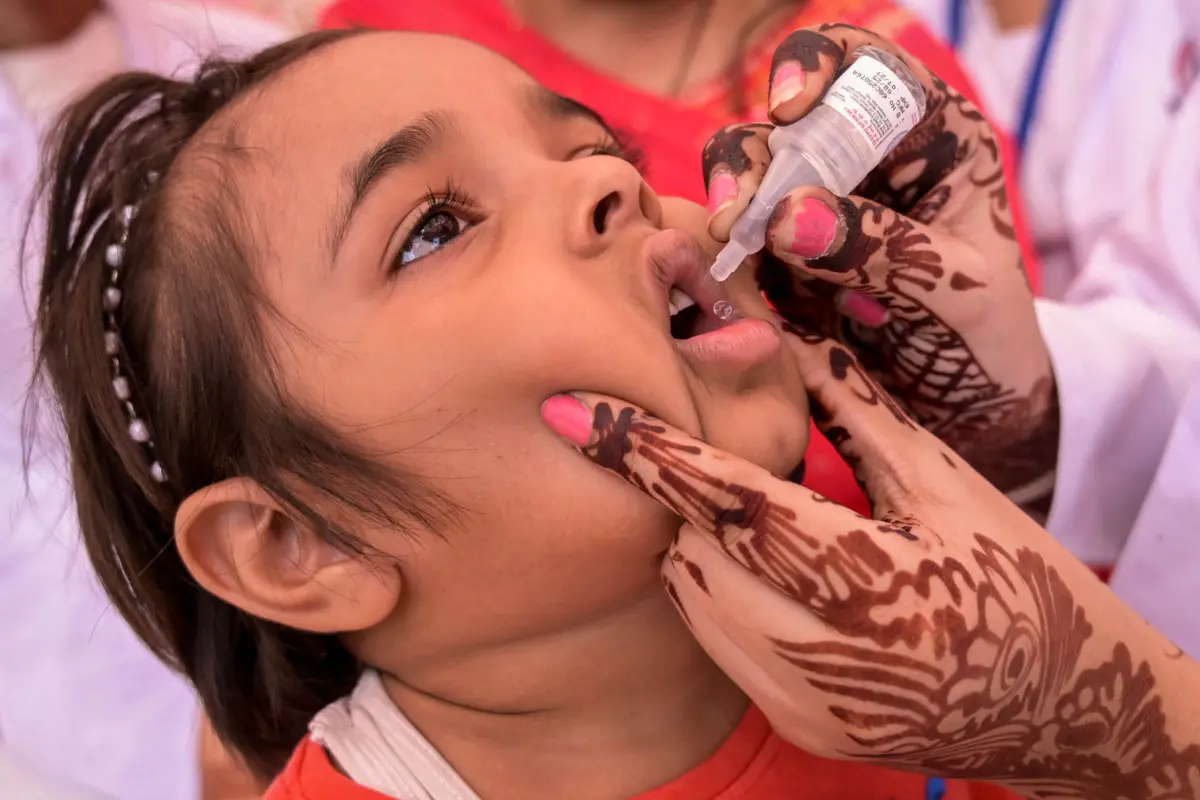
In India—which was declared polio-free in 2014 after a monumental national effort—armies of local "social mobilizers" were deployed into resistant, hard-to-reach communities. Women like Azmi Rani and physicians like Roma Solomon went door-to-door, administering oral polio vaccine drops ("Two Drops of Life") while battling deeply entrenched conspiracy theories. These workers documented community movements, tracked vaccination statuses, and served as the indispensable early-warning eyes and ears for national health authorities.
The USAID funding cuts directly defunded these grassroots networks. Programs that trained nearly 30,000 polio workers worldwide—workers who identified over 40 percent of potential polio cases in 2025 alone—were effectively left without resources.
The Vaccine Dilemma: Wild-Type vs. Vaccine-Derived
Eradicating polio involves navigating a complex paradox regarding the vaccines themselves.
The Inactivated Polio Vaccine (IPV): Administered via injection using a dead version of the virus, IPV safely builds immunity but cannot stop an active, ongoing outbreak.
The Oral Polio Vaccine (OPV): Administered via drops containing a weakened, live version of the virus, OPV acts as foundational "target practice" for the immune system and can halt active transmissions in their tracks.
However, in extremely rare instances (approximately one in 2.7 million doses), the weakened live virus in the oral vaccine can mutate and cause paralytic cases, known as "vaccine-derived" polio. Today, the vast majority of global polio cases are vaccine-derived. Public health experts emphasize that true eradication requires successfully transitioning away from the oral vaccine to the injection-based model worldwide—a feat made nearly impossible when funding gaps prevent vaccines from reaching arms.
Official Statements and Political Polarization
The pivot in U.S. health policy has sparked intense debate among lawmakers, international observers, and administration officials.
Proponents of the administration’s new approach defend the changes as necessary reforms. In its 2027 budget proposal, the White House criticized traditional global health frameworks for relying on "duplicative administrative costs, unwieldy supply chains, and layers of endless bureaucracy." Under the newly established America First Global Health Strategy (AFGHS), spearheaded by Secretary of State Marco Rubio, the focus has shifted toward streamlined bilateral agreements designed to "end inefficiencies, waste, and dependency."
However, critics argue that bilateral agreements are an inadequate substitute for multilateral health architectures. While the WHO maintains relationships with 194 member states, the AFGHS had secured memoranda of understanding with only 34 countries as of mid-2025. Crucially, neither Afghanistan nor Pakistan—the world’s two remaining endemic strongholds—nor India have signed these bilateral pacts.
Senator Jeanne Shaheen (D-NH) emphasized the domestic security implications in a statement to Press:
"This is not just a humanitarian issue—it’s a matter of U.S. national security. If polio spreads unchecked abroad, it increases the risk of resurgence here at home, putting American families at risk."
Conversely, Senator Jim Risch (R-ID) defended the administration’s overarching commitment:
"No one wants polio to reemerge as a major threat to the American people or to children around the world. That’s why President Trump has set ambitious goals to combat polio."
Domestic health rhetoric has further complicated the landscape. Under the Department of Health and Human Services (HHS), led by Secretary Robert F. Kennedy Jr., federal messaging has increasingly emphasized individual autonomy over public health mandates. In early 2026, Dr. Kirk Milhoan, chairman of the CDC’s advisory vaccine committee, publicly stated that Americans "need to not be afraid" of polio, highlighting a broader shift toward dismantling school vaccine mandates. Polling data from KFF (formerly the Kaiser Family Foundation) reflects a swift erosion of public confidence, with parental trust in the safety of the polio vaccine dropping from 85 percent to 77 percent over a four-month span.
Future Outlook: A Precarious Future
High above the bustling bazaars of Old Delhi, inside the orthopedic unit at St. Stephen’s Hospital, sits India’s last remaining dedicated polio ward. Surgeon Mathew Varghese has spent decades operating on limbs, fitting braces, and managing the lifelong disabilities of polio survivors.
While the ward has grown quieter in recent years, Dr. Varghese watches the global resurgence with profound apprehension.
"One slip-up is enough—it will take no time for the virus to spread," Varghese warns, adding grimly of his ward, "I am not ‘worried about’ it filling up. I know it will fill up."
As global health funding dwindles and domestic vaccination exemptions reach record highs—with states like Idaho reporting that over 20 percent of kindergartners lacked polio immunity during the 2025–2026 school year—the structural defenses built over the past half-century are fracturing.
Tom Frieden, former CDC director under President Barack Obama, delivered a blunt assessment of the current trajectory:
"With the U.S. abruptly pulling the rug out from under the system, many parts of the system are collapsing."
Without sustained international solidarity, robust environmental surveillance, and universal childhood immunization, the hard-fought triumph over polio risks being squandered. As survivors like Bilal Ahmad—who spent his life navigating the social and economic isolation of post-polio paralysis—continually remind the world: the virus does not negotiate, and once permitted to return, its consequences echo across generations.