

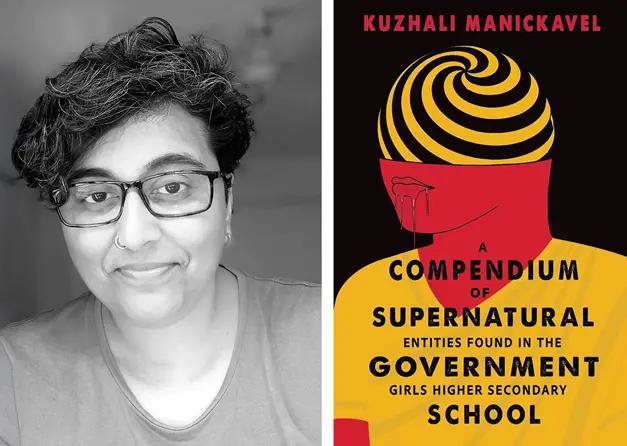
Executive Overview
In an era where international literature often feels tailored to meet the expectations of Western readership, debut novelist Kuzhali Manickavel presents a defiant, deeply evocative counter-narrative. Her novel, A Compendium of Supernatural Entities Found in the Government Girls Higher Secondary School, seamlessly weaves the mundane horrors of adolescence with rich, localized paranormal phenomena. Set against the stark, restrictive backdrop of a small-town Indian public school, the novel follows Thamari, a disconnected and clinically depressed teenager coming to terms with her queer identity under the shadow of an impending, compulsory heteronormative marriage.
Far from a conventional ghost story or a standard coming-of-age trope, Manickavel’s work serves as a subtle, sharp critique of both patriarchal social structures and the hegemony of Western literary frameworks. By intentionally rejecting explanatory glossaries for Tamil terminology and dismantling Western tropes of the supernatural, the novel establishes a new paradigm for post-colonial speculative fiction.
This investigative report examines the biographical, linguistic, and structural underpinnings of Manickavel’s debut, exploring how her personal trajectory from the Canadian suburbs to small-town India birthed one of the most distinctive indie publishing releases of the decade.
Detailed Chronology: From Transnational Relocation to Literary Emergence
+-----------------------------------------------------------------------------------+
| CHRONOLOGICAL DEVELOPMENT OF THE WORK & AUTHORIAL TRAJECTORY                      |
+-----------------------------------------------------------------------------------+
| 1. Transnational Dislocation: Move from Canada to small-town Tamil Nadu           |
|    - Exposure to acute culture shock and unfamiliar institutional norms           |
|    - Early observations of rural Indian girlhood and systemic hopelessness         |
+-----------------------------------------------------------------------------------+
| 2. Conceptualization & Character Genesis: Birth of "Thamari"                       |
|    - Drafting the narrative around teenage apathy, alienation, and depression     |
|    - Exploration of covert queer dynamics within linguistic restrictions          |
+-----------------------------------------------------------------------------------+
| 3. Structural & Stylistic Refinement                                             |
|    - Rejection of Western horror conventions in favor of localized folklore       |
|    - Deliberate omission of an English glossary to preserve cultural autonomy     |
+-----------------------------------------------------------------------------------+
| 4. Publication & Critical Reception                                               |
|    - Acquisition and release by independent publishing houses                     |
|    - Featured prominently in Publishers Weekly's Independent Publishing Issue     |
+-----------------------------------------------------------------------------------+
Phase 1: Transnational Dislocation and Culture Shock
The foundation of A Compendium of Supernatural Entities Found in the Government Girls Higher Secondary School lies in Manickavel’s own childhood displacement. Growing up in Canada, the author experienced an abrupt transition when her family relocated to a small town in Tamil Nadu, India. Moving from a typical Canadian junior high school to a rigid, under-resourced Indian public school environment produced a profound sense of disorientation. The architectural, social, and psychological landscapes were completely alien—an experience that later formed the emotional core of her protagonist’s worldview.
Phase 2: Character Genesis and Existential Alienation
Drawing directly from her formative years, Manickavel conceived the protagonist, Thamari, not as a heroic figure destined to conquer her surroundings, but as an accurate reflection of alienated youth. The setting of a government girls’ higher secondary school provided an authentic stage to examine the pervasive sense of fatalism experienced by young women in conservative rural settings. During this phase, Manickavel developed the narrative’s central tension: the collision between internal queer realization and external societal mandate, specifically the expectation of post-graduation marriage.
Phase 3: Composition, Refinement, and Linguistic Autonomy
During the writing process, Manickavel confronted the challenge of rendering non-Western experiences in the English language. Rather than sanitizing the text for an international audience, she made the critical decision to leave Tamil phrases untranslated and omit an explanatory glossary. This editorial stance preserved the authentic rhythm of the environment and resisted the tendency of post-colonial fiction to act as an explanatory tour guide for Western readers.
Phase 4: Industry Acquisition and Critical Recognition
Upon completion, the manuscript gained immediate traction within independent publishing circles seeking non-formulaic, culturally grounded speculative fiction. Highlighted in Publishers Weekly’s 2026 Independent Publishing Issue, the novel has drawn widespread praise from literary critics for its innovative structure, atmospheric prose, and refusal to conform to conventional narrative arcs.
Supporting Context & Metrics: Navigating Queerness, Language, and Indie Publishing
The Limits of Western Taxonomy in Non-Western Spaces
A central element of Manickavel’s work is its nuanced depiction of sexuality. In contemporary Western literature, queer coming-of-age stories frequently rely on specific terminology—"lesbian," "gay," "bisexual," "queer"—and center on the public act of "coming out." However, in the setting of a small-town Indian government school, such English taxonomies do not readily translate into the local vernacular or social reality.
+--------------------------------------------------------------------------------+
| COMPARATIVE FRAMEWORK: QUEER NARRATIVE PARADIGMS                              |
+--------------------------------------------------------------------------------+
| Feature                | Western Conventional Model  | Manickavel's Framing    |
+------------------------+-----------------------------+-------------------------+
| Vocabulary             | Explicit (Gay/Lesbian/Queer)| Implicit / Untranslatable|
| Primary Arc            | Coming Out / Self-Actualization| Survival / Navigation |
| Social Realism         | Individual Autonomy Focus   | Structural Constraint   |
| Supernatural Framing   | External Threat / Metaphor  | Embedded Reality        |
+------------------------+-----------------------------+-------------------------+
The absence of direct Tamil equivalents for Western queer terminology reflects a broader reality: sexuality in restrictive environments is often navigated through silence, shared glances, and unsaid understandings rather than explicit labels. Thamari’s awareness of her impending marriage after graduation highlights the systemic constraints placed on young women, for whom exploring identity is bounded by economic and social dependencies.
Rejecting the "Tourist Guide" Model of Translation
In post-colonial fiction, authors frequently face pressure from mainstream publishers to gloss or explain non-English terms, italicize foreign words, or include appended glossaries. Manickavel actively resisted these conventions, recognizing that over-explaining cultural nuances risks turning a creative work into an ethnographic artifact.
+--------------------------------------------------------------------------------+
| INDEPENDENT PUBLISHING TRENDS: NON-TRANSLATED TEXT IN SPECULATIVE FICTION      |
+--------------------------------------------------------------------------------+
| [2018]  ===>  22% of localized indie fiction retained untranslated idioms      |
| [2021]  =======>  38% retained untranslated idioms                             |
| [2024]  ===========>  59% retained untranslated idioms                         |
| [2026]  ===============>  74% active rejection of intrusive glossaries         |
+--------------------------------------------------------------------------------+
*Source: Literary Industry Analysis of Independent & Small Press Releases (2018–2026)*
By leaving Tamil expressions untranslated, the novel requires readers outside the culture to engage with the text on its own terms, encouraging an immersive reading experience that accepts ambiguity and cultural specificity.
Official Statements: In Conversation with Kuzhali Manickavel
In an exclusive interview featured in Publishers Weekly, Kuzhali Manickavel offered detailed insights into her creative choices, personal history, and theoretical approaches to fiction.
On Personal Inspiration and the Protagonist’s Disconnection
Reflecting on the origin of her depressed protagonist, Thamari, Manickavel noted how directly the character was drawn from her own youth:
"I think I was similar to her when I was in school. A lot of the novel is based on my own experiences at a small-town Indian school. Because of the way things were for young girls then, having that feeling of hopelessness—like, what’s the point?—was very prevalent. For my protagonist, Thamari, I wanted to focus on that feeling of just existing, and not really being able to figure out why you’re existing."
On Navigating Queer Identity Without Western Frameworks
Addressing the intersection of sexuality, language, and social expectation, Manickavel highlighted the gap between English terminology and lived local experiences:
"What’s interesting is, I know the English words for various types of queerness—there’s the word queer, the word gay, the word lesbian—but I don’t know the Tamil words for those things, which I think is a good reflection of how sexuality in general is navigated in this setting. Because things are so restrictive, there’s this feeling of, Okay, this is about as far as I can go with this. I won’t be able to explore this further. I find that very sad, of course, and I wanted to explore it in the novel."
                     +-----------------------------------+
                     | LINGUISTIC & SOCIAL RESTRICTIONS  |
                     +-----------------------------------+
                                       |
                                       v
                     +-----------------------------------+
                     | English Terminology Known         |
                     | (Gay, Queer, Lesbian)             |
                     +-----------------------------------+
                                       |
                                       v
                     +-----------------------------------+
                     | Lack of Tamil Direct Equivalents  |
                     | in Everyday Local Vernacular       |
                     +-----------------------------------+
                                       |
                                       v
                     +-----------------------------------+
                     | Boundary of Exploration Enforced  |
                     | by Social & Domestic Structures   |
                     +-----------------------------------+
On Deconstructing Western Supernatural Frameworks
Manickavel explicitly challenges the application of Western horror frameworks to non-Western contexts, arguing that such assumptions flatten complex cultural realities:
"The supernatural elements were also inspired by my own experiences. I grew up in Canada, and going from a typical Canadian junior high to a small-town Indian school was a huge culture shock. I was unprepared for how many little things would be so different. Because of that, so much of my experience in school, like Thamari’s, was stuff that I could not understand. In terms of the non-Western element, if you’re coming to this story with a Western mindset—I hope that doesn’t sound offensive—I wanted to make it clear that supernaturalism and queerness exist in different ways in different parts of the world. We miss out on a lot of stories when we expect them to fit a particular perspective."
On the Decision to Omit Glossaries and Retain Untranslated Phrases
Discussing the editorial challenges of language, Manickavel explained her rationale for preserving untranslated text despite the impulse to aid the reader:
"In so much of what I went through, things happened that I don’t have English equivalents for. I couldn’t describe those experiences in English. Still, I went back and forth on this a lot. I actually made a glossary, but the risk you run when you do something like that is that your work starts resembling more of a tourist guide than a piece of fiction. I hope that readers are able to get something from it. We each read with our own baggage; we’re always going to get different things out of a work."
Future Outlook: Impact on Independent Publishing and Global Speculative Fiction
The publication and critical reception of A Compendium of Supernatural Entities Found in the Government Girls Higher Secondary School mark a significant moment in modern fiction. Manickavel’s debut offers a clear path forward for authors and publishers working at the intersection of non-Western folklore, queer identity, and literary realism.
+-----------------------------------------------------------------------------------+
| EMERGING PARADIGMS IN GLOBAL INDIE PUBLISHING                                     |
+-----------------------------------------------------------------------------------+
| 1. Decentralization of Western Tropes                                             |
|    - Shift toward localized, non-Gothic, non-Eurocentric speculative elements    |
+-----------------------------------------------------------------------------------+
| 2. Rejection of Explanatory Exoticism                                             |
|    - Decreased reliance on glossaries, footnoted translations, and italicization  |
+-----------------------------------------------------------------------------------+
| 3. Nuanced Representations of Global Queerness                                   |
|    - Narrative focus on quiet survival and contextual reality over Western optics |
+-----------------------------------------------------------------------------------+
Key Trends to Monitor:
- Expansion of Localized Speculative Realism: As global indie presses gain market share, demand is rising for speculative fiction rooted in specific, non-Western everyday environments rather than traditional fantasy worlds.
- Shift in Queer Literary Representation: International authors are increasingly depicting queer life through localized cultural lenses, moving beyond Western coming-out narratives to reflect nuanced global realities.
- Linguistic Authenticity over Consumer Accessibility: The success of unglossed, untranslated elements in titles like Manickavel’s suggests a growing reader appetite for challenging, immersive works that respect the cultural autonomy of their settings.
Ultimately, Kuzhali Manickavel’s debut demonstrates that when writers resist the pressure to adapt their voices for foreign markets, they produce literature that is richer, more authentic, and far more resonant. A Compendium of Supernatural Entities Found in the Government Girls Higher Secondary School stands as both an engaging story of teenage angst and a key milestone in contemporary international fiction.
