

Executive Overview
On a breezy Sunday morning in March, Higgs Beach in Key West presents a postcard-perfect snapshot of coastal serenity. The Straits of Florida glisten beneath a hazy, contented sun, while bright pink flags and yellow banners announce the Key West Orchid Society’s annual exhibition at the historic West Martello Tower. A freckled purple orchid, contestant No. 298, competes for top honors just yards away.
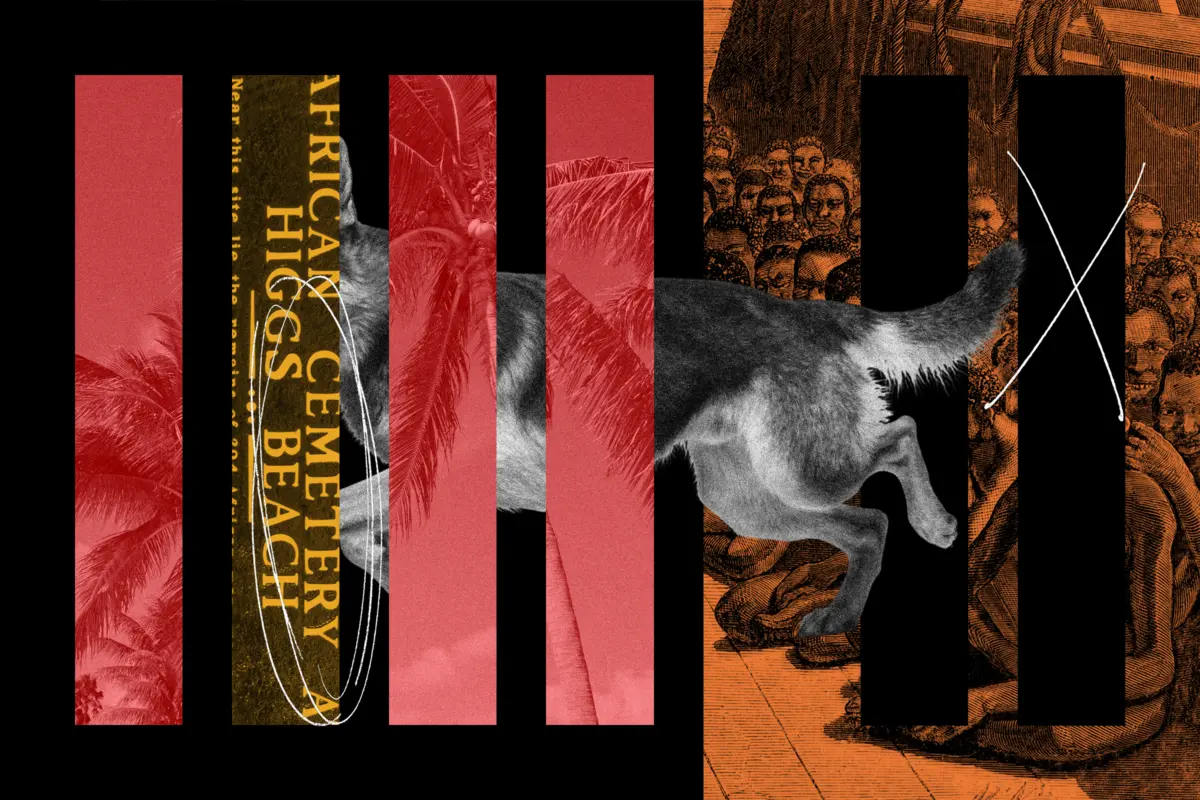
Yet, this veneer of tropical tranquility masks a profound historical oversight. Just across the sidewalk from the Civil War-era fort lies an unkempt patch of grass, withered by foot traffic and drought. Beneath this plot rest six unmarked graves. Across the busy asphalt of Atlantic Boulevard sit over a hundred more, currently functioning as a fenced-in dog park where local pets frolic.
For more than a decade and a half, officials in Key West and surrounding Monroe County have known about these unmapped resting places. Dating back to 1860, the ground holds the remains of approximately 295 African men, women, and children. Rescued from illegal slave ships by the U.S. Navy and brought ashore, they perished weeks later from virulent diseases such as yellow fever and dysentery. While a decorative concrete memorial marks the initial 15 graves discovered in 2002, the vast majority remain entirely unidentified, resting quietly beneath a popular local amenity.
The story of why these graves remain unmarked is a complex narrative of bureaucratic inertia, local political maneuvering, and historical neglect. It raises uncomfortable questions about structural equity, cultural memory, and whose histories a community chooses to honor. As Key West navigates its identity as a progressive enclave within a fiercely conservative state, the struggle over the Higgs Beach burial ground has become a crucible for broader national debates regarding race, public space, and historical accountability.
Detailed Chronology: From Tragedy to Modern Indifference
The Tragedy of 1860
The history of the Higgs Beach burial ground is rooted in the twilight of the illegal international slave trade. In 1860, U.S. Navy vessels intercepted several slave ships violating the federal ban on importing enslaved people. The ships—Wildfire, Wm. R. Kirkpatrick, and Bogota—were carrying nearly 1,500 captive Africans bound for the Americas.
The Navy diverted the vessels to Key West, which served as a federal port and a key base for anti-slavery operations. The survivors, traumatized and weakened by the horrific conditions of the Middle Passage, were placed in a makeshift camp on the island. However, the respite came too late for many. Stripped of adequate medical care, nutrition, and sanitation, nearly 300 captives—including men, women, and children—succumbed rapidly to epidemics of yellow fever and dysentery. They were hastily buried in the sandy soil near the southern coast of the island.
Rediscovery and Early Tributes (2001–2005)
For over a century, the exact location of the cemetery faded from public consciousness, obscured by urban development and shifting landscapes. It was not until the early 2000s that marine archaeologist Corey Malcom and his colleagues undertook the painstaking archival and field research that pinpointed the site.
On a hot, clear day in September 2002, a small crowd gathered at Higgs Beach for a solemn dedication ceremony. A wobbly fence enclosed a small patch of sand near two palm trees, bearing a makeshift sign that read, "African Cemetery 1860." Adegbolu Adefunmi, a Yoruba religious leader, performed traditional purification and memorial rituals.
A year prior, a state historic marker had been erected nearby, reading: “Near this site lie the remains of the 294 African men, women and children who died in Key West in 1860.” (The count was later corrected to 295 to account for a six-week-old infant who died shortly after arrival).

Despite these acknowledgments, momentum quickly stalled. In April 2005, the county opened a dual-section dog park directly across the street from the fenced-off gravesite. Aside from this recreational addition, the surrounding grounds received little sustained attention or institutional investment.
The 2010 Radar Survey and Bureaucratic Roadblocks
When Heather Carruthers was elected to the Monroe County Board of Commissioners in 2008, Higgs Beach was in severe disrepair. A former classical vocalist and guesthouse owner, Carruthers set out to revitalize the neglected waterfront. She tapped local architect William Horn to lead a community-inclusive master planning process.
During preliminary stakeholder meetings in 2010, marine archaeologist Corey Malcom and artist Dinizulu Gene Tinnie—who designed the existing African Cemetery Memorial—sounded an alarm. They warned planners that historical records indicated a much larger burial footprint.
Commissioned by the county, a subsequent ground-penetrating-radar (GPR) survey revealed startling results. The radar diagrams exposed rows of anomalies indicating more than 100 distinct graves beneath the small-dog park, with additional remains extending underneath Atlantic Boulevard.
In December 2010, officials unveiled an ambitious master plan: the small-dog park would be relocated, and Atlantic Boulevard—a primary coastal thoroughfare—would be shifted northward to unify the entire historic cemetery into a single, respectful green space.
Yet, local resistance materialized almost immediately. The "Higgs Beach Preservation Committee," a coalition of nearby residents, voiced numerous objections, ranging from traffic concerns to the aesthetic quality of the proposed dog park fencing. Compromises were negotiated, and revised plans cleared the Key West Planning Board, resulting in a formal interlocal development agreement between the county and the city in 2012.
Just as construction seemed imminent, a fatal bureaucratic obstacle emerged. An opposing community member discovered a 1983 federal grant from the U.S. Department of the Interior’s Land and Water Conservation Fund. The grant strictly governed permitted land uses within the park and mandated federal approval for any major structural alterations. Because shifting Atlantic Boulevard required federal sign-off, the project ground to an indefinite halt. Rather than pursuing the complex federal waiver process, county officials shelved the redevelopment plans, leaving the dog park operating directly atop the unmarked graves.
The Documentary Catalyst (2017)
The issue languished in administrative obscurity until 2017, when Naja and Arnaud Girard, publishers of the independent local investigative outlet The Blue Paper, stumbled upon the unmarked graves during an annual Day of Remembrance ceremony.
Shocked by the revelation, the Girards—alongside journalist Amber Nolan—embarked on producing a short documentary titled Do All Graves Matter? The film featured interviews with local leaders, including then-City Commissioner Clayton Lopez, who advocated for the relocation of the dog park, and community activist Veronica Stafford.

According to the filmmakers, local politicians attempted to intervene and delay the documentary’s release, citing ongoing, delicate negotiations with federal authorities. Unswayed, the Girards published the film in August 2017. The public pressure yielded immediate results: within a week, Monroe County announced plans to relocate the small-dog park out of "an abundance of caution," finally leaving the land directly over the contested gravesite undisturbed.
Supporting Context, Metrics, and Sociopolitical Pressures
The controversy surrounding the Higgs Beach African Cemetery cannot be viewed in isolation; it is deeply intertwined with the shifting political and cultural landscape of the Florida Keys.
- The Demographic & Historical Weight: The 295 individuals buried at Higgs Beach represent one of the only documented cemeteries for rescued African refugees in the United States. Their presence anchors a vital, yet frequently erased, chapter of the transatlantic slave trade’s final years.
- The Political Landscape: Key West operates as a progressive, liberal enclave within a deeply conservative state. This ideological friction has tangible consequences for municipal governance and public funding.
- Legislative Threats: Recent legislative actions by the Florida government—including laws restricting public funding for projects, events, or initiatives deemed to promote Diversity, Equity, and Inclusion (DEI)—cast a long shadow over Key West. Local festivals, historical preservation efforts, and future educational initiatives at the African burial ground now face potential financial strangulation or legal challenges.
- Infrastructure and Ownership Shifts: On May 1, official control of Higgs Beach Park was transferred from Monroe County to the City of Key West. This administrative handoff has reignited local debates regarding the park’s future use, funding sustainability, and the long-delayed physical demarcation of the unmarked graves.
Official Statements and Institutional Perspectives
The institutional response to the Higgs Beach gravesite reveals a striking divergence between administrative pragmatism and community demands for restorative justice.
-
Monroe County Administration: Current County Administrator Christine Hurley expressed skepticism regarding the definitive nature of the GPR data. Speaking from her office in the historic E. H. Gato Cigar Factory, Hurley remarked:
"I don’t think it’s ever been proven that they are graves… I don’t think we want to excavate it to figure out if it’s really graves or not. Anomalies are not for sure remains."
Hurley also confirmed that plans to relocate Atlantic Boulevard had been permanently abandoned, noting that the road shift was initially proposed solely to secure infrastructure funding. With the Tourism Development Council subsequently agreeing to fund improvements on both sides of the thoroughfare, the county dropped the road-movement initiative. Regarding physical signage over the 100 unmarked plots, Hurley maintained that the existing concrete memorial sufficiently represents the entire site.
-
Former Local Leadership: Heather Carruthers defended the county’s historical efforts, emphasizing the logistical nightmares of bureaucratic red tape.
"At some point, you don’t keep expending taxpayer money on something that’s not going to come to fruition," Carruthers stated. Reflecting on her tenure, she insisted that the county’s intentions were always to honor the dead properly, but that federal restrictions and funding shortfalls proved insurmountable.
-
Elected Municipal Officials: Newly inaugurated Key West Mayor Sam Kaufman, who voted against the recent county-to-city park transfer over fiscal liability concerns, has expressed openness to rectifying the oversight.

"Would I do anything? One hundred percent… First and foremost, better signage, not just for the graves, but also for the history," Kaufman affirmed, adding that he would defer heavily to local historians, the Art and Historical Society, and the African American community.
-
Grassroots Activists: Local leaders remain deeply critical of official inaction. Veronica Stafford captured the sentiment of many residents when she pointed to institutional avoidance:
"Since it is a Black cemetery and it has the stigma of slavery, nobody wants to touch it."
Stafford envisions a much more prominent physical and educational presence at the site, advocating for dedicated docents to guide visitors and a major informational billboard. Similarly, Arida Wright, an organizer of the annual Day of Remembrance, emphasizes the precarious nature of community-funded tributes:
"It would be nice just to have a grant… the performers we want to bring, the speakers we want to bring, not every year needing money and never having [it], having to raise the money."
Future Outlook: Hope, Uncertainty, and the Fight for Recognition
As control of Higgs Beach settles into the hands of the City of Key West, the site stands at a critical crossroads. The ownership transfer, coupled with a potentially sympathetic mayoral administration, offers a renewed window of opportunity for local advocates.
However, formidable obstacles remain. The persistent reluctance of municipal and county leaders to definitively acknowledge the unexcavated graves—compounded by the chilling effect of Florida’s anti-DEI statutes—threatens to keep the site in a state of administrative limbo. For artists and historians like Dinizulu Gene Tinnie, the dream of a unified sacred space—complete with an obelisk or roundabout marker near the African Cemetery Memorial—remains an unfinished blueprint.
Ultimately, the fight over the Higgs Beach African Cemetery transcends zoning laws, traffic routing, and municipal budgets. It is a fundamental struggle over historical integrity. Until the ground where 295 souls rest is definitively marked, respected, and protected from the pounding paws of domestic pets and the indifference of bureaucracy, the legacy of slavery in Key West will continue to echo across the island community—a haunting reminder of history waiting to be fully acknowledged.
