

Executive Overview
In the modern landscape of front-end engineering and user experience (UX) design, the impulse to reach for an established physics engine when building a tactile, bouncy, or destructive web interface is practically second nature. For years, the industry standard has dictated that immersive, gamified web applications rely on complex physics frameworks like Matter.js, Cannon.js, or heavy custom WebGL pipelines. These tools excel at simulating gravity, collision detection, and realistic momentum, offering developers a ready-made solution for bringing digital environments to life.
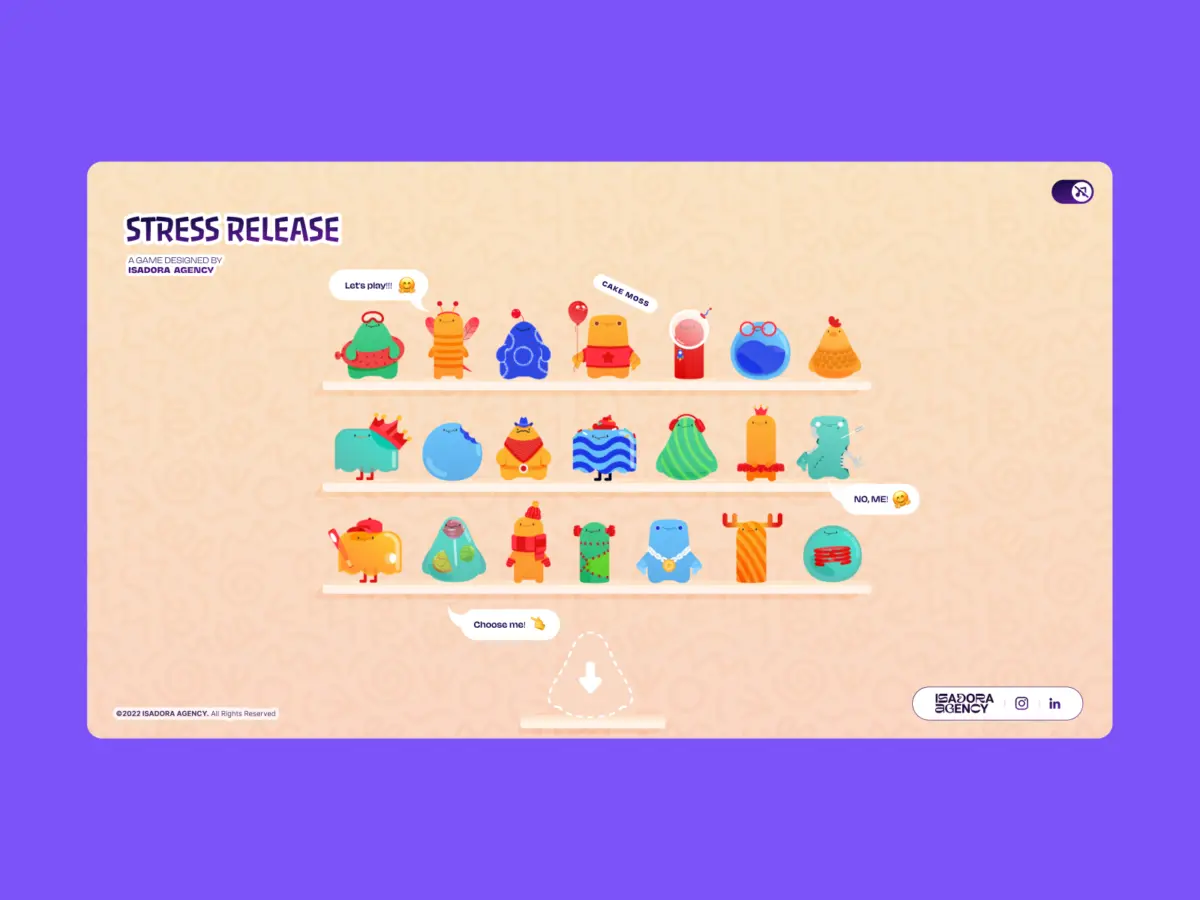
However, a fundamental architectural conflict arises when the goals of technical simulation collide directly with the exact demands of art direction. When the development team at Isadora Agency set out to build Stress Release—a digital stress-relief squeeze toy application designed to let burnt-out creatives smash, stretch, and distort animated UI characters—they initially followed the conventional path. Their primary objective was clear: construct a highly tactile web experience where every single user click yielded a satisfying, squishy reaction.
As prototyping commenced, the team encountered a critical epiphany: physics engines produce plausible motion, but their animators had produced intentional motion.
Rather than allowing characters to behave like generic rubber balls bouncing unpredictably across a canvas, the design vision demanded specific, heavily stylized, frame-by-frame character reactions. To achieve absolute control over this bespoke motion without sacrificing performance, Isadora Agency made a bold architectural choice. They scrapped the physics engine entirely.
Instead, they pioneered a lightweight, highly responsive architecture built on programmatic Lottie state controls, standard DOM manipulation, and precise distance-based math. This technical case study explores how front-end engineers can successfully map native timeline capabilities to the DOM to deliver rich, tactile interactions while preserving absolute artistic fidelity.
Detailed Chronology: From Physics Experimentation to DOM-Driven Precision
The development lifecycle of Stress Release progressed through distinct phases of technical evaluation, prototyping, constraint discovery, and eventual architectural refinement.
Phase 1: The Initial Physics Exploration
At the inception of the project, the engineering team assumed that a convincing squeeze toy required true physical simulation. They implemented early prototypes using traditional canvas-based particle systems and momentum libraries. The rationale was standard: users expect objects to deform dynamically based on the velocity and angle of an impact.
However, this approach immediately exposed a major disconnect. Physics engines calculate movement algorithmically based on mass, velocity, and restitution. Conversely, the agency’s motion designers had meticulously crafted custom vector animations featuring bespoke keyframes, character-specific expressions, and dramatic anticipation loops. An algorithmic physics engine consistently overrode or distorted these carefully plotted micro-interactions, stripping away the hand-drawn personality of the characters.

Phase 2: Pivot to Deterministic Control
Recognizing that algorithmic approximation was diluting the art direction, the team reassessed their technical requirements. They needed absolute deterministic control. For instance, the signature "mega squeeze" sequence required an exact 181-frame build-up followed by a precisely timed release sequence.
The team realized that the tighter the click-feedback loop (click $rightarrow$ squish $rightarrow$ score), the greater the need for exact frame control. By shifting to programmatic state control via Lottie’s native API, the interaction layer transformed into a flawless trigger for the animation layer, ensuring that every user input mapped directly to a hand-crafted visual reaction.
Phase 3: Mathematical Mapping and Spatial Accuracy
With the decision made to leverage Lottie and standard DOM elements, the engineering challenge shifted to hit detection and spatial feedback. Without a physics engine handling collisions, the team had to mathematically determine where a user clicked relative to a character and translate that data into scoring metrics and visual feedback.
The team utilized radial input mapping. By capturing click events and converting page coordinates into the character’s local coordinate space, they calculated the exact distance from the center of the character using the Pythagorean theorem:

// Character's center point in its own coordinate space
var x_center = parseFloat($("#playChar").width()  / 2);
var y_center = parseFloat($("#playChar").height() / 2);

// Click position relative to the character's top-left corner
var offset = $("#playChar").offset(); // document-relative position
var X = parseFloat(e.pageX - offset.left);
var Y = parseFloat(e.pageY - offset.top);

// Vector from center to click point
var a = parseFloat(X - x_center);
var b = parseFloat(Y - y_center);

// Straight-line distance from the center
var distance = Math.hypot(a, b);
This single numerical value governed multiple systems simultaneously: point allocation based on concentric scoring zones (akin to a dartboard), feedback intensity, and the exact positioning of an explosion Lottie animation. By dynamically repositioning the explosion asset to the $(a, b)$ vector coordinates, the interface produced an unmistakable, tactile "I hit that" sensation entirely through mathematics and DOM manipulation.
Phase 4: Animation State Management and Segment Scripting
Handling interactions meant moving away from continuous simulation loops and toward discrete, state-driven animation segments. Each character asset was provisioned with a defined set of frame ranges housed within structured JSON files:
const play_segments = [
  charId: 0,
  sections:
    idle:     [0,  40],   // looping idle state
    squeeze1: [41, 80],   // light reaction
    squeeze2: [81, 120],  // medium reaction
    squeeze3: [121, 160], // heavy reaction
  ,
  playOrder: ["squeeze1", "squeeze2", "squeeze3"],
  endAnimation: [161, 200]
];
Upon every user interaction, the application executed a step function that halted ongoing loops, disabled looping temporarily, forced playback of the targeted frame segment, and locked out subsequent clicks until the animation cycle naturally resolved back to the idle state.
Supporting Context & Metrics: Performance and Optimization
While abandoning WebGL and external physics libraries significantly streamlined the rendering pipeline, relying heavily on Lottie vector animations introduced unique performance hurdles—specifically concerning file size and memory management.

The Mobile Performance Equation
Stress Release featured 21 distinct character animations alongside multiple explosion variants. Loading every asset at maximum fidelity simultaneously would cripple mobile performance and introduce debilitating frame drops. To combat this, Isadora Agency implemented a multi-tiered optimization strategy:
- Quality Scaling (
lottie.setQuality): On the multi-character selection shelf where 21 animations played concurrently, quality was scaled down to0.5, reducing vector interpolation calculations by half. Concurrently, animation speed was throttled to0.6to minimize frame calculations per second. - Focused Resource Allocation: When a user transitioned to the primary play screen featuring a single active character, quality was restored to full resolution (
1.0), ensuring razor-sharp vector rendering where user focus was concentrated. - DOM Responsiveness: Bypassing complex WebGL canvas setups allowed the team to handle responsive scaling entirely through CSS custom properties (
--doc-heightand--doc-width). Lottie SVGs scaled naturally inside their fluid containers upon window resize events without requiring heavy matrix recalculations.
Official Statements and Architectural Rationale
Reflecting on the philosophy driving the project, the engineering consensus emphasized that technology choices must always serve the overarching creative vision rather than dictating it.
Alexey Kopytin, detailing the architectural rationale behind the build, noted that developers frequently fall into the trap of adopting trendy frameworks simply because they exist, rather than evaluating whether their underlying mechanics align with product requirements. In the case of Stress Release, introducing a physics engine would have actively sabotaged the nuanced timing and artistic intent baked into the vector assets.
By choosing programmatic state control over emergent simulation, the development team successfully bridged the gap between engineering logic and artistic expression. As summarized in the core architectural takeaway:

"By mapping Lottie’s native timeline capabilities to the DOM, you can deliver incredibly rich, tactile user experiences while maintaining absolute control over the art direction."
This approach proves that high-end, gamified interactivity does not inherently require GPU-heavy WebGL implementations or complex physics solvers. Standard web technologies, when leveraged creatively through math and state management, can yield exceptional results.
Future Outlook: The Evolution of Tactile Web Experiences
The architectural model established by Isadora Agency with Stress Release points toward a broader trend in front-end development: the hybridization of bespoke motion design with lightweight, deterministic code structures.
As web applications continue to prioritize emotional engagement, micro-interactions, and gamification to combat digital fatigue, developers will increasingly face the choice between simulated realism and curated art direction. While physics engines will always retain their rightful place in open-world simulations and sandbox games, interface design demands a different philosophy.

Future iterations of tactile web design will likely see deeper integrations between CSS containment layers, optimized vector runtimes, and event-driven mathematics. By respecting the nuances of intentional motion and resisting over-engineering, front-end teams can build web experiences that are not only performant and cross-device compatible, but deeply satisfying and human-centric.