When a high-stakes branding project ultimately falls flat, the autopsy almost always points to a failure that occurred long before a single vector was drawn in Figma. The breakdown typically happens deep within the strategy phase—a territory where abstract adjectives like "modern," "trustworthy," "premium," "friendly," and "disruptive" are enthusiastically embraced by stakeholders yet left entirely undefined.
This semantic vagueness creates a treacherous chasm between what a brand is ostensibly engineered to communicate and what a designer is implicitly expected to conjure. To eliminate this friction, creative directors and brand strategists must master the "pre-concept" phase: the rigorous, foundational work that takes place after the project kickoff but strictly before the first visual design direction is minted.
By systematically researching brand context, unearthing hidden stakeholder assumptions through interactive frameworks, and translating shared verbal direction into a tangible visual foundation, teams can dramatically elevate the efficacy of their brand identity systems. Rather than treating design as a speculative guessing game, the pre-concept methodology transforms subjective opinions into measurable creative boundaries.
Detailed Chronology: Navigating the Pre-Concept Roadmap
The journey from a blank page to a cohesive visual identity is rarely linear, but it requires a disciplined chronology. Moving past the initial project kickoff involves stepping through distinct, deliberate milestones designed to align business objectives with psychological perception.
Stage 1: Researching and Refining the Brand Context
A traditional brand workshop inevitably covers the foundational pillars of discovery: the core business model, overarching goals, product architecture, competitive landscape, and target demographics. However, elite branding practitioners go beyond collecting dry business facts. They interrogate perception.
As legendary designer Marty Neumeier famously observed in The Brand Gap, "A brand is a person’s gut feeling about a product, service, or company." Because a brand fundamentally lives within the minds and perceptions of its audience, internal discovery sessions must isolate what precise perception the stakeholder team intends to manufacture.
When a health-tech startup insisted they wanted to look "disruptive," a superficial interpretation might have pushed designers toward neon colorways, asymmetric layouts, and rebellious iconography. However, context revealed that their primary buyers were conservative government medical institutions. In that strict ecosystem, a visually loud or overly experimental identity would actively destroy trust. Their version of "disruptive" required clinical precision, unwavering clarity, and understated confidence—proving that language must always be rigorously contextualized.
Stage 2: Facilitating Stakeholder Alignment via Immersive Exercises
Words alone are notoriously slippery. To bridge the gap between verbal strategy and visual execution, designers must deploy interactive frameworks that force stakeholders to anchor abstract concepts into concrete realities. As GV partner Jake Knapp notes in his framework for the Three-Hour Brand Sprint, the objective is to force abstract corporate ambitions into tangible forms.
Competitor Perception Mapping: Before the workshop, design leads curate a diverse cross-section of competitor touchpoints—websites, mobile apps, social campaigns, and marketing collateral. During the exercise, stakeholders plot these entities across strategic axes (e.g., Understated vs. Bold or Accessible vs. Exclusive). This exercise exposes fractured internal realities: one executive might view a competitor as progressive, while another dismisses them as generic. Uncovering these misalignments early prevents them from sabotaging later design reviews.
The Visual Brand Driver Exercise: Moving inward, stakeholders are asked to assign the company to unrelated categories—such as transportation, architecture, fauna, and furniture (e.g., choosing between a quiet electric vehicle, a high-speed bullet train, or a heavy boardroom table). Crucially, participants must justify their choices using specific adjectives. This substitution of metaphor for direct self-description helps divorce personal aesthetic preferences from objective brand requirements.
Stage 3: Establishing the Three-Tiered Visual Foundation
Once discovery insights and stakeholder assumptions have been aggregated, the team constructs a practical bridge to design via three distinct layers:
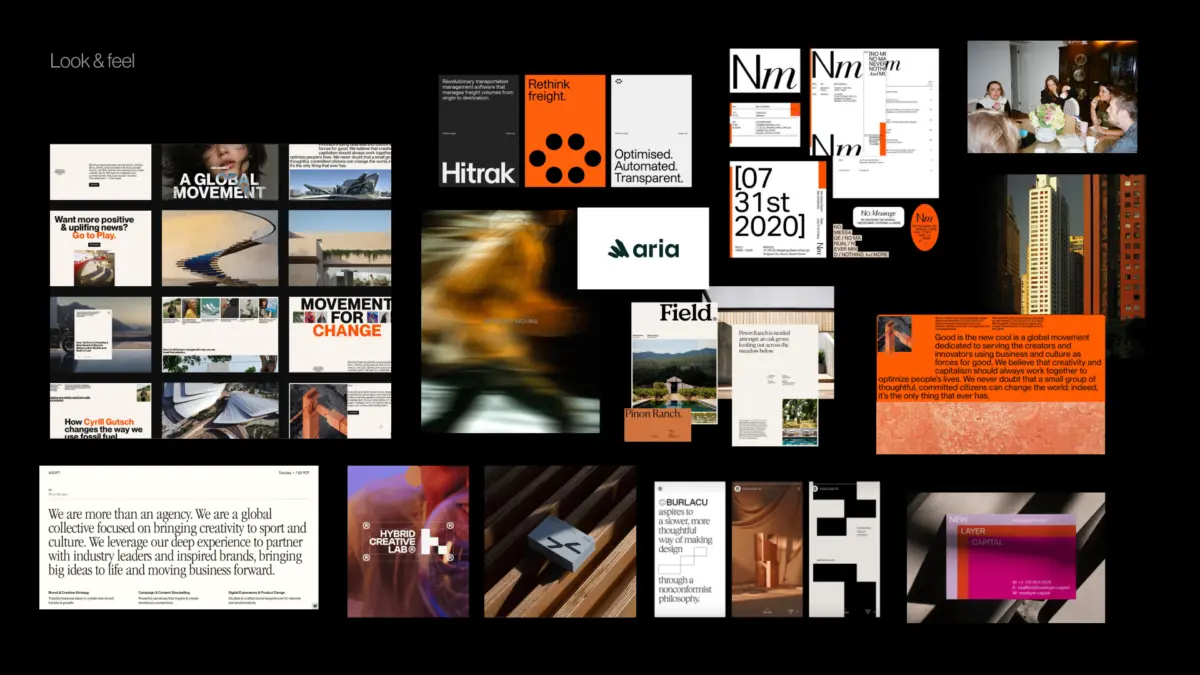
Look and Feel Boards: Curated purely as perception boards rather than mood boards of "liked" imagery, these references help the team debate the exact flavor of qualitative attributes like modernity or humanity.
Design Code: This layer codifies brand strategy into actionable visual metaphors. For instance, a parenting app built on the pillar of "personalized support" might translate strategy into organic shapes and gentle gradients, while "research-backed safety" introduces clinical data snapshots and structured editorial layouts.
Brand Asset Direction: The final foundational layer addresses core primitives: typography palettes, color theory parameters, photographic treatments, and logo styling archetypes.
Supporting Context & Metrics: The Cost of Ambiguity
The financial and operational toll of skipping the pre-concept phase is substantial. Industry benchmarks suggest that up to 60% of brand identity revisions stem entirely from unaligned stakeholder expectations established during early-stage briefings.
When branding projects proceed without defined design codes, teams frequently suffer from:
The "I Know It When I See It" Trap: Without agreed-upon perception metrics, executive reviews degrade into subjective battles of personal taste rather than strategic evaluations.
Market Mismatches: Brands that fail to map their visual codes against category expectations frequently alienate core audiences, requiring expensive rebranding initiatives down the road.
Conversely, organizations that invest heavily in pre-concept alignment report significantly higher stakeholder satisfaction, faster sign-off phases, and more durable, flexible visual identities that scale seamlessly across digital product ecosystems.
Official Industry Perspectives
Leading voices in design systems and brand strategy emphasize that structured pre-concept alignment is the hallmark of mature agency practice.
"The point of these exercises is to make the abstract idea of ‘our brand’ into something concrete. When clients remain passive recipients of strategy decks, hidden assumptions fester. Active participation in the pre-concept phase neutralizes friction before the first pixel is pushed."
— Jake Knapp, Design Partner & Author
Furthermore, design directors point out that setting explicit boundaries—defining what a brand should not look or feel like—is just as vital as prescribing its positive attributes. By eliminating dead-end visual territories early, creative teams are granted the psychological safety to take calculated, high-impact creative risks later in the process.
Future Outlook: The Evolution of Brand Strategy in Digital Products
As digital products become increasingly complex—spanning multi-platform interfaces, spatial computing, AI-driven interactions, and dynamic typography systems—the traditional static brand guidelines PDF is rapidly becoming obsolete.
Looking forward, the pre-concept phase will evolve from static mood boards and FigJam exercises into dynamic, tokenized design-system foundations. Strategy will be directly coupled with design tokens, ensuring that brand attributes like "trustworthiness" or "boldness" are mathematically and programmatically tied to accessibility standards, motion curves, and interface components.
However, the core human challenge will remain unchanged. Technology can accelerate execution, but it cannot replace the deep, empathetic stakeholder alignment required to turn vague corporate aspirations into authentic, resonant visual identities. Mastering the pre-concept phase ensures that the brands of tomorrow are built not on guesswork, but on a rock-solid foundation of shared understanding.