

Executive Overview
The dream of interstellar travel—reaching across the yawning chasms of deep space to visit neighboring star systems within a human lifetime—has long captured the imaginations of scientists, science fiction writers, and space enthusiasts alike. However, the physics governing the cosmos imposes severe limitations. Traditional chemical propulsion systems, which rely on the explosive combustion of propellants, are fundamentally incapable of bridging interstellar distances in a practical timeframe. Even the most advanced chemical rockets would take tens of thousands of years to reach even the closest stellar neighbor, Alpha Centauri.
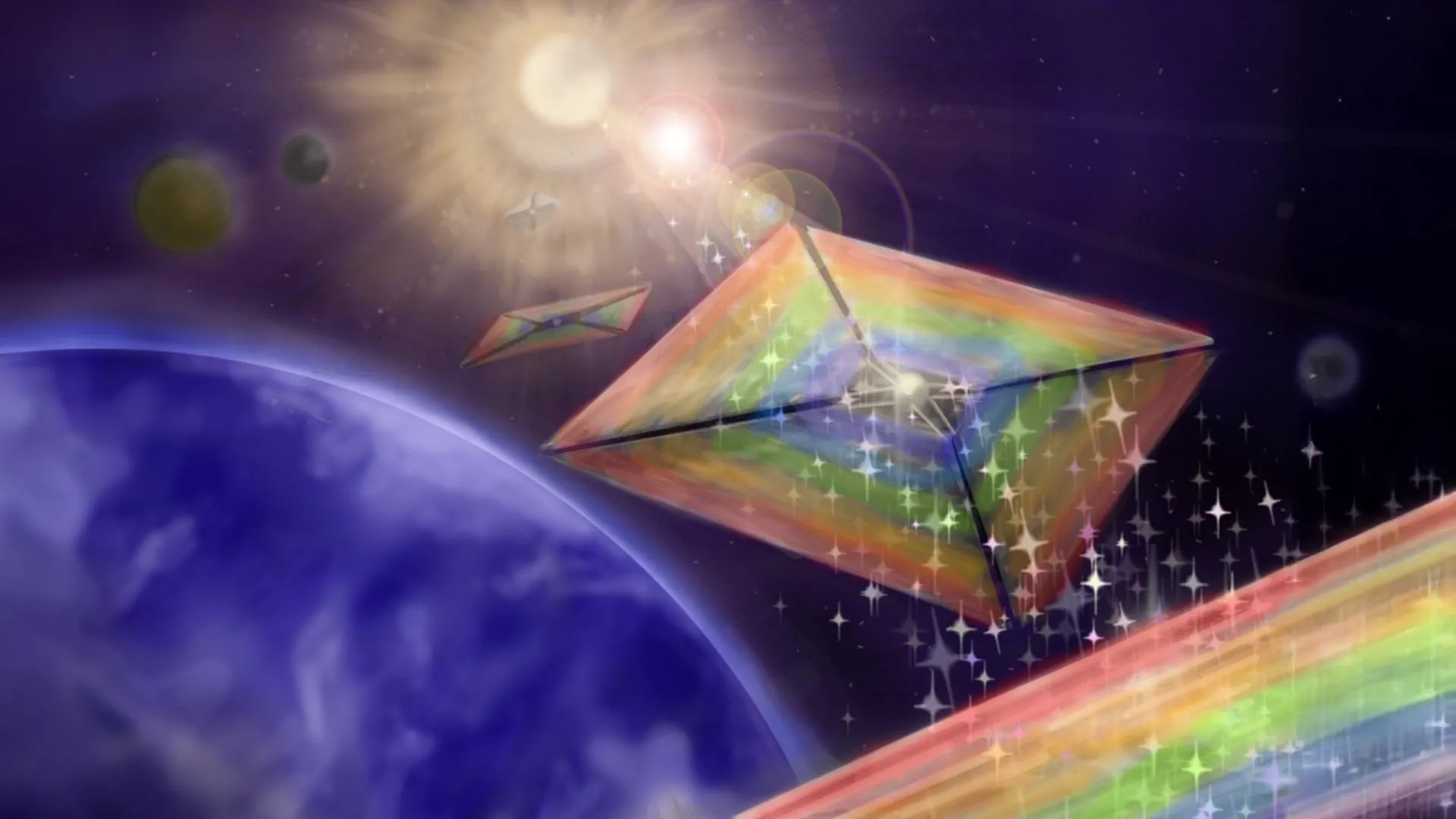
To bypass this cosmic roadblock, theoretical physicists and aerospace engineers have increasingly turned to beamed-energy propulsion, most notably the concept of the solar sail or lightsail. Powered not by onboard fuel, but by massive, Earth- or space-based laser arrays aimed at a large, highly reflective structure, a lightsail could theoretically be accelerated to a significant fraction of the speed of light. By continuously pumping raw momentum into the sail via intense photon pressure, humanity could finally dispatch high-speed probes across the interstellar void.
Yet, a new theoretical study published on the arXiv preprint server by researchers Chao Shen and Jiaze Li of the Harbin Institute of Technology reveals an unexpected and fundamental roadblock on the path to the stars. According to their rigorous hydrodynamic and electrodynamic modeling, as a lightsail accelerates to relativistic speeds—reaching velocities where Einstein’s theory of relativity dictates the rules—the very light used to propel the spacecraft will begin to work against it.
Specifically, the study highlights how relativistic phenomena, including the Doppler effect and light aberration, conspire to degrade propulsion efficiency and ultimately generate an aerodynamic-like radiative drag. Once a sail surpasses approximately 75 percent of the speed of light, scattered photons begin exerting a backward retarding force. While the driving laser beam will still maintain a net positive forward thrust, the efficiency penalties and dynamical instabilities uncovered by Shen and Li mean that engineers must rethink the materials, design paradigms, and navigation strategies of interstellar spacecraft long before humanity launches its first deep-space probe.
Detailed Chronology of the Discovery and Theoretical Framework
To understand the gravity of the Harbin Institute of Technology findings, one must trace the evolution of beamed-energy propulsion concepts and how theoretical physicists analyze the interaction between light and matter at extreme speeds.
The Evolution of Beamed-Energy Propulsion
The concept of utilizing radiation pressure for propulsion dates back to the early 20th century, famously championed by visionary Russian scientist Fridrikh Tsander and later expanded upon by science fiction pioneers and modern physicists like Robert Forward. In the decades following the dawn of the space age, the lightsail evolved from a speculative daydream into a serious engineering pursuit. Programs such as Breakthrough Starshot galvanized global interest, proposing the launch of gram-scale "nanocrafts" propelled by a 100-gigawatt laser array toward the Alpha Centauri system at 20 percent the speed of light ($0.2c$).
As institutional focus shifted toward relativistic velocities—speeds where classical Newtonian mechanics break down and special relativity takes over—the physics of photon momentum transfer became increasingly complex. While previous studies primarily modeled lightsails under low-speed conditions or simplified vacuum interactions, Shen and Li sought to investigate the fine-grained radiative dynamics experienced by a sail traversing the deep relativistic regime (approaching and exceeding $0.5c$ to $0.8c$).
Deconstructing Photon Pressure: Incident, Specular, and Diffuse Forces
In their paper, Shen and Li dissect the total mechanical force imparted by a photon beam onto a reflective surface by categorizing the interaction into three distinct mechanical components:
- Incident Light (Primary Momentum Contribution): This represents the raw, unadulterated momentum delivered by photons as they first strike the surface of the sail. It provides the foundational push, accounting for the largest share of the forward momentum vector.
- Specular Reflection: This is the momentum transferred when photons bounce off the mirror-like surface of the sail in a predictable, angle-equal-to-reflection manner. Because photons carry momentum proportional to their energy ($p = E/c$), their elastic reflection doubles the momentum transfer relative to complete absorption.
- Diffuse Scattering: This constitutes the weakest contribution to the forward thrust. It arises from photons that are not cleanly reflected, but are instead absorbed by imperfections in the sail material and subsequently re-emitted isotropically (in random directions).
At low, Earth-bound or near-Earth speeds, all three of these vectors work harmoniously in the same direction, combining to push the lightsail away from the laser source. However, Shen and Li demonstrated that this harmonious cooperation shatters once the spacecraft begins racing away from the laser emitter at relativistic speeds.
The Relativistic Shift: Doppler Degradation and Aberration
As the lightsail accelerates deeper into the cosmos, two primary relativistic phenomena begin to warp the mechanical interplay between the laser and the spacecraft:
- The Relativistic Doppler Effect: Because the sail is fleeing the incoming photon stream at an ever-increasing velocity, the frequency of the light reaching the sail undergoes a severe redshift. According to Planck’s relation ($E = hf$), a drop in frequency translates directly to a drop in photon energy and momentum. Consequently, the thrust produced by all three components (incident, specular, and diffuse) degrades progressively. The faster the sail travels, the harder the laser has to work to yield diminishing accelerative returns.
- Relativistic Light Aberration: More dramatic is the geometric transformation that occurs once the sail passes approximately 75 percent of the speed of light ($0.75c$). From the perspective of a stationary observer in the laser’s reference frame, relativistic aberration causes diffusely scattered light—photons absorbed and re-emitted by the sail—to no longer scatter randomly or backward. Instead, they begin to be beamed forward, in the exact direction of travel.
Because every action has an equal and opposite reaction, shooting scattered radiation forward imparts a reactive force in the opposite direction. Thus, diffuse scattering—which initially provided a minor positive push—undergoes a directional phase shift and transforms into a localized drag force. While the primary laser beam’s incident and specular forces still overpower this radiative drag (preventing the net force from becoming entirely negative), the efficiency of the propulsion system takes a severe, quantifiable hit.
Supporting Context & Metrics
Evaluating the feasibility of interstellar flight requires translating theoretical relativity into concrete physical metrics. The Harbin Institute study highlights several crucial parameters that engineers must account for when designing deep-space probes.
Breakdown of Forces at Relativistic Velocities
| Force Component | Low-Speed Behavior ($v ll c$) | Relativistic Behavior ($v approx 0.75c$ and above) | Net Impact on Propulsion |
|---|---|---|---|
| Incident Light | Pushes forward; maximal momentum transfer. | Downward shift due to relativistic Doppler effect. | Decreased thrust efficiency; requires higher laser output. |
| Specular Reflection | Pushes forward; doubles momentum via elastic bounce. | Frequency reduction diminishes net reflective kick. | Diminishing returns on acceleration over distance. |
| Diffuse Scattering | Weak forward push via scattered photon absorption/re-emission. | Aberration redirects scattered photons forward. | Acts as Drag: Generates a retarding force opposing motion. |
Neglected Real-World Variables
It is essential to note that Shen and Li’s paper deliberately isolates radiative dynamics to establish a baseline mathematical model. By focusing exclusively on electrodynamics and momentum transfer, the researchers temporarily excluded several compounding environmental and material challenges that real interstellar spacecraft will face:
- Interstellar Gas and Dust Collisions: At $0.75c$, even tenuous clouds of interstellar hydrogen or microscopic cosmic dust grains do not merely bounce off a spacecraft; they impact it with catastrophic kinetic energy, causing physical erosion, ionization, and mechanical drag.
- Thermal Limits and Material Degradation: To achieve relativistic speeds, laser arrays must deliver petawatts of continuous energy onto sails spanning kilometers but weighing only grams. The thermal loading is immense. Without advanced cooling or perfect reflectivity, real materials would instantly vaporize or melt.
- Spacetime Curvature: Over interstellar distances, the gravitational wells of stars, rogue planets, and dark matter distributions introduce minute relativistic shifts in spacetime geometry, which were smoothed out in the Harbin team’s simplified model.
Official Statements and Expert Perspectives
While the paper by Chao Shen and Jiaze Li represents a theoretical exploration rather than an institutional mission statement, its implications have riounded through the aerospace propulsion and theoretical physics communities.
Dr. Elena Vance, a computational astrophysicist specializing in beamed-energy systems who was not involved in the study, noted the elegance and necessity of the Harbin Institute’s work:
"For years, conceptual designs of lightsails treated photon pressure as a static, linear input. We calculated how many gigawatts hit the sail and assumed a straightforward $F = 2P/c$ equation. Shen and Li have reminded us that special relativity is an active participant in the journey. When you are pushing a spacecraft to three-quarters the speed of light, the universe plays by a different set of geometric and energetic rules. Discovering that diffuse scattering flips into a drag force is a classic example of why theoretical groundwork must precede engineering hubris."
Meanwhile, propulsion engineers are already looking past the limitations highlighted by the study, viewing the radiative drag problem not as a dealbreaker, but as an engineering specification that must be mastered. Aerospace engineer Marcus Thorne remarked:
"Every mode of transport discovers its own form of drag. Maritime vessels deal with hydrodynamic skin friction; aircraft deal with compressible aerodynamic drag at the sound barrier. It should not surprise us that light sails face a radiative drag barrier at the relativistic threshold. The good news is that identifying this drag now allows us to design active countermeasures decades before we cut metal for an actual star-probe."
Future Outlook: Engineering Solutions for Interstellar Flight
The identification of relativistic radiative drag does not spell the doom of lightsail technology; rather, it marks the transition of the field from rudimentary physics to sophisticated systems engineering. To overcome the efficiency drops and directional instability caused by Doppler shifts and light aberration, researchers are already investigating advanced material sciences and dynamic control architectures.
Advanced Metamaterials and Photonic Crystals
Traditional reflective materials—such as thin aluminum or gold coatings—are ill-equipped to handle the thermal and optical extremes of relativistic laser propulsion. In response, modern materials scientists are developing engineered metamaterials and photonic crystals tuned to specific laser wavelengths.
These microscopic structures can be engineered to manipulate the phase, polarization, and scattering angles of incident light. In principle, advanced metamaterials could be designed to minimize diffuse scattering altogether, suppressing the formation of the radiative drag force identified by Shen and Li. Alternatively, smarter sails could selectively absorb or redirect specific photon frequencies to optimize momentum transfer dynamically as the spacecraft’s velocity changes.
Self-Stabilizing Trajectories and Beam-Riding Optics
One of the most profound secondary implications of the Harbin Institute study involves trajectory stability. Maintaining a lightsail centered within a laser beam millions of kilometers wide is an extraordinarily difficult targeting problem; even a microscopic drift could cause the sail to slip out of the beam, stranding the probe in deep space.
However, the aberration and scattering effects described in the paper may offer a silver lining. Engineers suggest that asymmetric metamaterial designs could harness these relativistic aberration effects to create an autonomous restoring force. By intentionally allowing controlled, directional scattering, a lightsail could automatically correct its orientation and center itself within the laser beam—acting, in effect, as an optical self-steering mechanism.
The Long Road Ahead
A fully operational interstellar mission remains a distant horizon. The logistical hurdles of constructing gigawatt-scale laser infrastructure in space, combined with the immense financial and political commitments required, mean that humanity’s first interstellar probe is likely decades, if not centuries, away.
Yet, theoretical breakthroughs like the one achieved by Chao Shen and Jiaze Li are indispensable stepping stones. By mapping the invisible traps of the relativistic regime—where light itself exerts drag—science ensures that when humanity finally casts its first sail toward the stars, the vessel is built to withstand not just the vacuum of space, but the fundamental laws of the cosmos itself.
