

Executive Overview
At the May News Emmy Awards ceremony in New York City, the traditional fanfare of self-congratulation and network networking was abruptly upended by an unexpected voice. Stepping off the stage after accepting the prestigious Mike Wallace Scholarship from CBS News—backed by an additional $20,000 award over four years from the National Press Club—18-year-old Santiago Campos did not offer standard words of polite gratitude. Instead, he delivered a blistering critique of corporate media, explicitly calling out CBS News for what he described as a betrayal of legendary journalist Mike Wallace’s legacy.
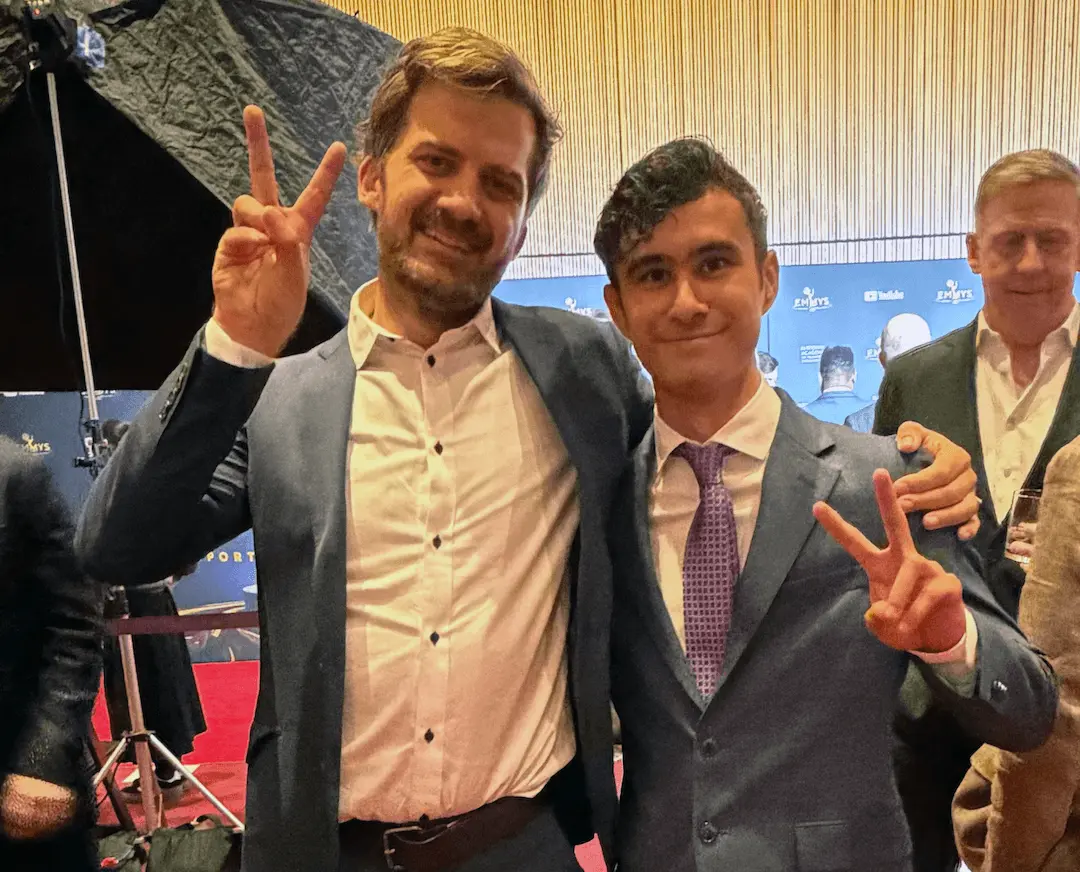
In a matter of minutes, Campos—then just months away from beginning his freshman year at Georgetown University—transitioned from a promising student documentarian into a lightning rod for broader discussions concerning journalistic ethics, corporate media capture, and generational disillusionment. Surrounded afterward by producers, reporters, and media personalities (including a bemused journalist from Playboy and YouTube creator Johnny Harris, whom Campos actually recognized), the young scholar navigated a whirlwind of attention that would overwhelm even seasoned veterans.
Yet, the most startling aspect of Campos’s sudden prominence is not his willingness to challenge media conglomerates, but his personal history. As a child, Campos was diagnosed with selective mutism, an anxiety disorder that rendered him virtually incapable of speaking to adults outside his immediate family. Through years of dedicated intervention with speech specialists and social workers, he gradually reclaimed his voice. Today, that voice is being utilized not just to speak, but to indict the very institutions that historically defined American journalism.
Now settled into his freshman year at Georgetown, where he is majoring in international politics and minoring in journalism, Campos stands at the intersection of a rapidly evolving media ecosystem. This deep-dive investigation explores his unlikely trajectory from a profoundly quiet child in Washington, D.C., to a viral critic of network news, examining how his background, his unorthodox media diet, and his deep-seated commitment to rigorous storytelling are shaping a new generation’s expectations of the press.
Detailed Chronology: From D.C. Classrooms to the Emmy Stage
The Roots of a Storyteller
Santiago Campos’s journey into video production and reporting began not with a romanticized ambition to break hard-hitting news, but with a fascination for the mechanics of video editing and post-production. Growing up in a self-described NPR-oriented household in Washington, D.C., Campos attended the D.C. International School, a public charter institution known for emphasizing social activism and global citizenship.
His mother, Elizabeth Reavley, a speech pathologist, notes that her son inherited a strong-willed, opinionated streak from both sides of the family. However, this outward confidence belied a formidable early obstacle: severe childhood social anxiety characterized by selective mutism.
"I had this huge social anxiety when it came to speaking," Campos reflects. "It’s a fear you have in your mind that isn’t entirely valid. You mostly grow out of it, but you definitely need a specialist to help."
Working through this anxiety in third and fourth grade with the help of social workers, Campos slowly built the confidence to articulate his thoughts. Ashley Porter, his video production teacher at D.C. International School, recalls him as "one of the quietest students I’ve ever had." Despite his introverted nature, Porter recognized an underlying tenacity. "You can tell that he’s just so dedicated to everything he does, his friends, and his schoolwork. I’ve seen him open up in terms of being willing to share things that he is passionate about through his storytelling."
Breaking Through: The PBS NewsHour Connection
Campos initially gravitated toward behind-the-scenes technical roles in video production. However, his perspective shifted when he stepped in front of the camera for a deeply personal project. Through his school’s partnership with PBS NewsHour Student Reporting Labs, Campos produced and reported a story examining his family’s multi-generational history with immigration and deportation.
The project required him to interview his grandfather, who recounted his deportation to Mexico during the Eisenhower administration. It also explored how his great-grandmother was forced to report undocumented family members and friends, and how his father, Marco Campos, grew up under the constant psychological shadow of potential deportation.
Rather than treating the reporting as a purely emotional exercise, Campos applied rigorous journalistic standards to his family’s narrative. "You have to separate yourself," Campos explains. "Just because you want to tell the story in a certain way and believe people at face value, you have to maintain the same journalistic integrity. I worked pretty hard to match things up with known facts."
This foundational piece was followed by another impactful student report focusing on a classmate’s family navigating her father’s detention and subsequent release by Immigration and Customs Enforcement (ICE). For Campos, these projects proved that video could serve as an effective vehicle for social accountability. Yet, paradoxically, he views high school journalism as a manageable, almost therapeutic outlet compared to academic pressures. "When you’re doing stuff in high school, you also have to focus on your schoolwork and on extracurriculars… So, journalism isn’t the No. 1 thing that’s stressing me out. As of right now, it’s the pastime I enjoy doing to not have to worry about the other stuff."
The Viral Moment in New York
Campos’s selection as the recipient of the $10,000 Mike Wallace Scholarship from CBS News brought him to New York City in May for the News Emmy Awards. The honor was accompanied by a $20,000 four-year award from the National Press Club.
When he took the stage to accept the recognition, Campos bypassed polite pleasantries. Instead, he issued a direct critique of network television, asserting that CBS News’s recent institutional trajectory "stains the legacy of Mike Wallace."
The speech immediately reverberated through the industry. Stepping offstage, Campos found himself surrounded by an eclectic mix of traditional print journalists, network producers, and digital creators. While his mother scanned the crowd trying to spot ABC News anchor David Muir—a figure entirely unknown to Campos—the young freshman eagerly sought out independent journalist Johnny Harris, whose YouTube channel boasts nearly 8 million subscribers. He also fielded interview requests from unexpected quarters, including a representative from Playboy, an outlet Campos admitted he was only "very slightly familiar" with.
Supporting Context & Metrics: The Generational Media Diet
To understand Santiago Campos’s critique of legacy media, one must examine how Gen Z consumes information. Unlike previous generations whose media diets were anchored by evening network broadcasts and daily metropolitan newspapers, Campos and many of his peers operate within a decentralized, algorithmically curated digital ecosystem.
Rejection of the Mainstream Echo Chamber
Campos rarely watches traditional cable news or broadcast networks. Before applying for the Mike Wallace Scholarship, he had never even heard of Mike Wallace—an omission that underscores the widening chasm between legacy institutions and younger demographics. When Campos eventually researched Wallace, however, he developed a deep respect for his investigative rigor.
"The issue with CBS is not exclusive to CBS," Campos observes. "It’s been a thing since we started deregulating public media and deregulating the news in general, which introduced this whole privatization and corporatization of the media, and this focus on what gains traction and clicks rather than being a trustworthy source for the American people."
Curating an Independent Digital Diet
Campos’s daily media intake reflects a deliberate effort to bypass traditional corporate filters in favor of independent, analytical creators. His regular rotation includes:
- More Perfect Union: An Emmy-winning digital outlet focusing on labor news and working-class perspectives. Campos praises their clear messaging regarding how economic policies impact everyday citizens.
- Johnny Harris: The geography-focused independent journalist known for deeply researched, highly visual explanatory videos.
- CaspianReport: A geopolitics channel offering granular analysis of international relations and global conflicts.
- Channel 5 with Andrew Callaghan: A gonzo-journalism platform known for documenting fringe and grassroots American subcultures.
Curiously, Campos also monitors conservative outlets like Fox News when they surface in his social media feeds. Rather than dismissing them outright, he studies how different political factions frame unfolding events. "I like to think I have a non-echo-chambered algorithm," he says. "I consume a wide variety of content from different perspectives."
Navigating the Tension Between Advocacy and Objectivity
This media diet informs Campos’s developing philosophy as he begins his formal journalism training at Georgetown University. Faculty members and mentors recognize that today’s student journalists are acutely aware of the structural crises facing the industry.
Ashley Porter, his former video teacher, notes: "Eighteen-year-olds who supposedly aren’t watching 60 Minutes are paying attention… Some of those concepts that we talk about—ethics and objectivity—seem so old school in some ways. But it still shows up in new-school journalism. That’s what I try to teach students. If you are going to do a story that has a side, how can you make sure that you’re covering them all and not injecting your opinion into it?"
Campos openly acknowledges the internal friction between his robust political convictions and the journalistic imperative to remain fair and detached. "I have strong political opinions and am just trying to separate myself from that while also prioritizing the truth and not giving in to the corporate media side of things," he admits.
Official Statements & Industry Reactions
Campos’s Emmy speech and subsequent media appearances generated substantial fallout across both traditional and digital commentary spaces. His critique was not restricted to CBS; he also targeted prominent network figures, including CNN anchor Jake Tapper, whose coverage of the Israel-Hamas war Campos characterized as "dishonest" and reflective of a worldview disconnected from the everyday realities of ordinary Americans.
In subsequent written commentary published in The Nation and interviews with The Guardian, Campos doubled down on his rhetoric. Addressing controversies surrounding editorial shifts at major networks and high-profile commentator appointments—such as Bari Weiss’s alignment with new leadership structures—Campos adopted an uncompromising tone: "If Bari Weiss has a problem with what I said and doesn’t want me to receive the scholarship, then she can talk to me."
The response from the journalistic establishment has been mixed. While some traditionalists view his public rebukes as ungracious or overly combative for an entry-level scholarship recipient, others see his intervention as a necessary, long-overdue reckoning. Veteran journalists and media critics have pointed out that scholarship programs named after legendary muckrakers like Mike Wallace inherently invite institutional self-reflection. By holding networks to the very standards their namesakes championed, Campos demonstrated precisely the kind of fearless questioning that journalism schools hope to instill.
Mark Simon, host of the journalism appreciation podcast The Journalism Salute, who interviewed Campos following his viral speech, noted that the young student’s clarity of purpose is indicative of a broader generational shift. "What you see in Santiago is an insistence that journalism return to its core public-service mission," Simon observed. "He isn’t interested in maintaining corporate pleasantries when the credibility of the fourth estate is actively eroding."
Future Outlook: Georgetown and Beyond
As Santiago Campos steps onto the campus of Georgetown University for his freshman year, his schedule reflects a rigorous academic balancing act. Alongside Spanish, economics, and religion, his fall course load includes Introduction to Journalism.
Yet, unlike many of his peers entering undergraduate programs with tentative career aspirations, Campos arrives with an established national profile, financial backing from the National Press Club and CBS News, and a clear-eyed skepticism of the industry he intends to enter.
Whether he chooses to pursue investigative documentary production, digital media entrepreneurship, or international reporting, Campos has already established a clear operational philosophy: challenge institutional complacency, interrogate personal biases, and prioritize the public interest over corporate bottom lines.
As he works through the complex tension between political activism and journalistic detachment, Campos remains focused on the fundamental mechanics of storytelling. For a young man who once struggled to speak above a whisper outside his immediate family, his voice has undeniably arrived—and the media establishment is listening whether it wants to or not.
