The passing of Gloria Steinem at the age of 92 marks the conclusion of an era in American journalism and social activism. A towering figure of second-wave feminism and a pioneer of cultural reporting, Steinem reshaped the discourse surrounding gender, power, and human rights for over six decades. While her public persona was forged on podiums, protest lines, and television broadcasts, her most enduring battlefield was the printed page.
As a co-founder of Ms. magazine in 1972, Steinem revolutionized commercial publishing by demonstrating that an unapologetically feminist magazine could command mainstream success without compromising its political integrity. Beyond her editorial stewardship, Steinem’s bibliography—spanning foundational political essays, candid memoirs, intergenerational children’s literature, and late-career reflections—provides a comprehensive taxonomy of the modern struggle for equality.
Her written output was never merely observational; it served as a tactical handbook for grassroots organizing and an intellectual framework for dismantling systemic oppression. From early polemics dissecting the gendered mechanics of economics to late-life writings emphasizing global solidarity and the transformative power of empathy, Steinem’s canon remains an indispensable archive for historians, activists, and literary scholars alike.
+-----------------------------------------------------------------------------------+
|                            GLORIA STEINEM: LITERARY CANON                         |
+-----------------------------------------------------------------------------------+
| 1972 | Co-founds 'Ms.' Magazine (Redefining political & cultural media)            |
| 1994 | 'Moving Beyond Words' (Deconstructing economic valuation & patriarchy)     |
| 2015 | 'My Life on the Road' (The methodology of grassroots listening)           |
| 2023 | '50 Years of Ms.' (Archival retrospective ed. by Katherine Spillar)        |
| 2024 | 'Rise, Girl, Rise' (Intergenerational picture book w/ Leymah Gbowee)      |
| 2024 | 'An Unexpected Life: A Memoir' (Late-career essayistic manifesto)          |
+-----------------------------------------------------------------------------------+
Detailed Chronology: A Life Written in the Pages of Social Reform
Steinem’s intellectual trajectory mirrored the evolution of the global feminist movement, transitioning from sharp investigative journalism to sweeping personal and political retrospectives.
    [1930s-1950s]          [1970s-1990s]          [2010s-2020s]
  Itinerant Childhood &  --> Founding 'Ms.' &   --> Global Alliances &
  India Fieldwork           Polemics on Power       Late Memoirs
The Early Horizon and the Birth of Ms. (1960s–1970s)
Before becoming the face of a movement, Steinem established her reputation as a formidable freelance journalist. Her 1963 undercover expose on the exploitative working conditions of Playboy Bunnies demonstrated her commitment to investigative rigor. By 1971, recognizing that mainstream publications routinely sidelined women’s issues, she joined forces with Dorothy Pitman Hughes, Patricia Carbine, and other visionaries to found Ms. magazine.
Debuting as an insert in New York magazine before launching independently in 1972, Ms. immediately broke commercial publishing precedents by refusing to carry advertisements that objectified women or promoted harmful products, establishing an independent editorial voice that tackled institutional domestic abuse, reproductive freedom, and workplace discrimination.
Middle-Period Polemics and Economic Critiques (1990s)
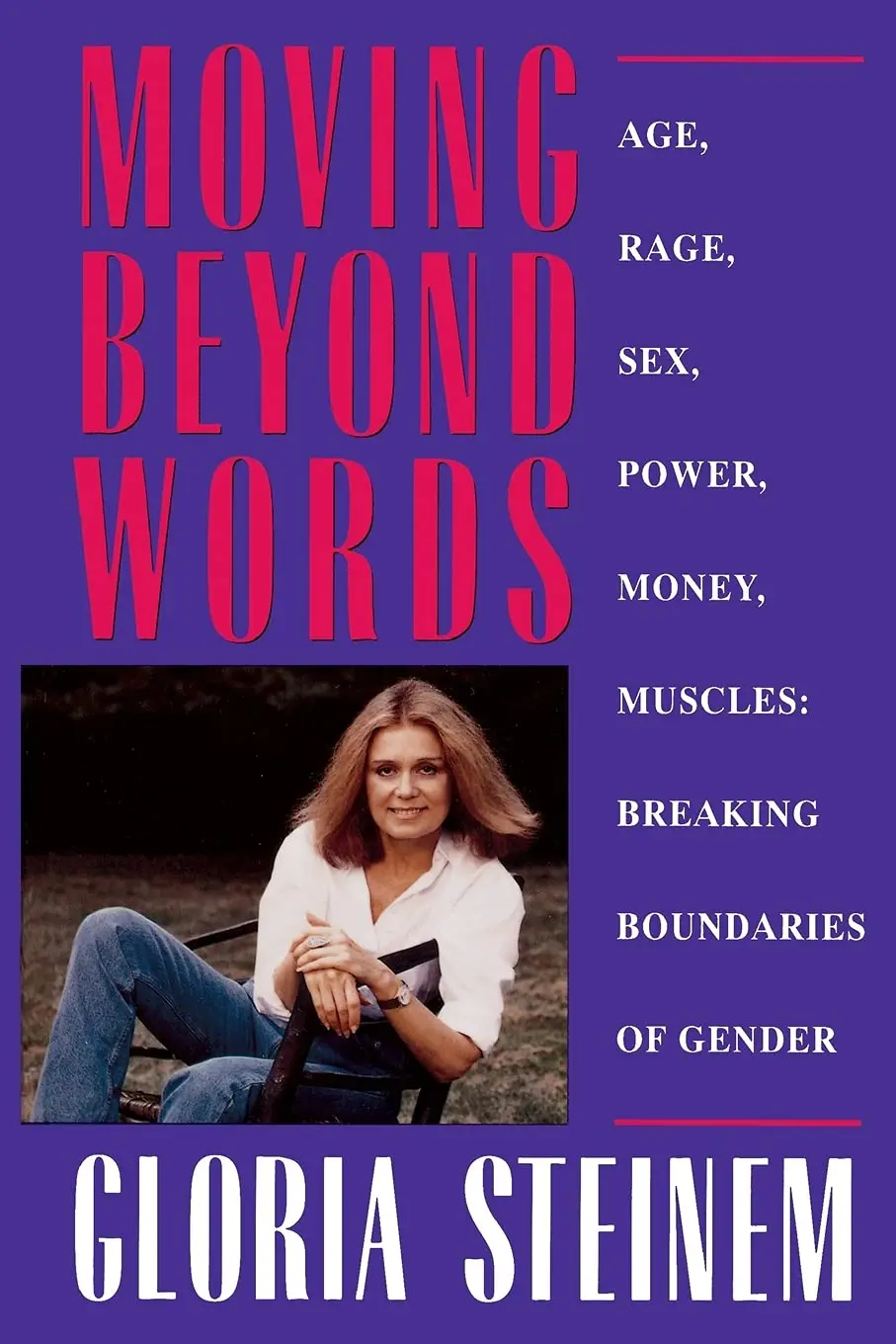
By the 1990s, Steinem turned her attention toward deconstructing the systemic, socio-economic underpinnings of gender inequality. In her seminal 1994 essay collection Moving Beyond Words (Simon & Schuster), she applied satire, economic analysis, and sociological reporting to expose the cultural biases surrounding gender roles.
During this period, her writing actively challenged the co-optation of feminist terminology, demanding that true equality account for unpaid domestic labor, systemic wage disparity, and the intersectional realities of race and class.
The Wandering Organizer and Late-Life Memoirs (2010s–2020s)
In her later years, Steinem increasingly turned to the memoir format to articulate her organizing methodology. Her 2015 book My Life on the Road (Random House) detailed four decades of continuous travel across college campuses, union halls, and international summits, positioning open-ended listening as the foundational discipline of sustained political change.
This retrospective period culminated in her final works, including her 2024 memoir-in-essays An Unexpected Life (Random House), which synthesized a lifetime of political lessons into an accessible framework for future generations.
Supporting Context & Structural Analysis of Key Works
Steinem’s literary output is defined by its genre-spanning versatility. A close examination of her key publications highlights the breadth of her intellectual engagements.
+-----------------------------------------------------------------------------------+
|                        KEY LITERARY WORKS & THEMATIC FOCUS                        |
+-----------------------------------------------------------------------------------+
| Title                        | Publisher / Year      | Core Subject / Significance |
+------------------------------+-----------------------+----------------------------+
| Moving Beyond Words          | Simon & Schuster 1994 | Socio-economic satire,     |
|                              |                       | aging, gender constructs   |
+------------------------------+-----------------------+----------------------------+
| My Life on the Road          | Random House 2015     | Itinerant organizing,      |
|                              |                       | power of grassroots conversation|
+------------------------------+-----------------------+----------------------------+
| 50 Years of 'Ms.'            | Knopf 2023            | Historical archive of      |
|                              | (Ed. K. Spillar)      | investigative feminist media|
+------------------------------+-----------------------+----------------------------+
| Rise, Girl, Rise             | Orchard 2024          | Intergenerational youth    |
|                              | (w/ L. Gbowee)        | solidarity, global peace   |
+------------------------------+-----------------------+----------------------------+
| An Unexpected Life: A Memoir | Random House 2024     | Lifelong synthesis,        |
|                              |                       | anti-racist history & hope |
+------------------------------+-----------------------+----------------------------+
Deconstructing Patriarchy and Economics: Moving Beyond Words
Published in 1994 (Simon & Schuster, 319p, ISBN 978-0-671-64972-2), Moving Beyond Words showcases Steinem at her polemical peak. The volume gathers six essays—three original and three substantially revised from Ms. magazine—that critique social structures through brilliant satire and rigorous analysis.
The Satirical Lens: In one of her most celebrated satirical inversions, Steinem conceives "Dr. Phyllis Freud," the hypothetical matriarchal founder of psychoanalysis. Through Freud’s theoretical framework, men’s lack of wombs is diagnosed as an incurable source of envy, providing a pseudo-scientific rationale for male subjugation in a matriarchal society.
Challenging Physical Assumptions: Through an extensive profile of Bev Francis, the world champion women’s weightlifter, Steinem dismantles traditional biological determinism, forcing a re-evaluation of cultural definitions regarding female physical capacity.
Economic Re-evaluation: Steinem exposes the traditional discipline of economics as an arbitrary construction designed to obscure women’s unpaid and underpaid labor. She provides an early, incisive critique of the feminization of poverty and the concentration of capital within male-dominated institutions.
Reclaiming the Aging Process: Reframing her own 60th birthday, Steinem argues that as women age and shed societal expectations of sexual availability and reproductive duty, they become inherently more radical, rebellious, and politically dangerous.
The Itinerant Activist: My Life on the Road
Steinem’s 2015 memoir, My Life on the Road (Random House, 304p, ISBN 978-0-679-45620-9), serves as both an autobiography and a primer on organizing. The narrative unpacks the paradox of her life: despite growing up with an itinerant, nomadic father and a self-sacrificing mother—a dynamic she vowed to avoid—she ultimately embraced a life defined by continuous travel.
                              [ Childhood Nomadism ]
                                         │
                                         ▼
                             [ Vow of Local Stability ]
                                         │
                                         ▼
                       [ Realization of Grassroots Need ]
                                         │
                                         ▼
                      [ Four Decades of Travel & Listening ]
The book details key historical touchstones, such as the historic 1977 National Women’s Conference in Houston, Texas, while reflecting on thousands of informal exchanges with taxi drivers, flight attendants, and student organizers across North America. Steinem highlights how hostile environments—such as a 1971 Harvard Law School dinner where her calls for equal rights were met with outright open animosity—strengthened her commitment to empathetic dialogue and decentralizing movement leadership.
Documenting Half a Century of Feminist History: 50 Years of ‘Ms.’
Edited by Katherine Spillar, executive editor of Ms., 50 Years of ‘Ms.’: The Best of the Pathfinding Magazine That Ignited a Revolution (Knopf, 2023, 544p, ISBN 978-0-593-32156-0) offers a comprehensive archival record of the periodical Steinem helped launch. Organized chronologically by decade, the anthology maps the magazine’s role in shaping public discourse:
1970s: Coverage centered on challenging systemic grooming standards, exposing domestic FBI surveillance of civil rights activists, and documenting Shirley Chisholm’s historic presidential run.
1980s: Pioneering reporting on the legal frameworks of no-fault divorce, workplace sexual harassment, and date rape.
1990s: Deep dives into misogyny within mainstream music, systemic media consolidation, and the rise of right-wing talk radio hosts like Rush Limbaugh.
2000s–2020s: Critical analyses of post-9/11 militarism, intersectional coalition-building, same-sex marriage equality, Black Lives Matter, the essential-care crisis during the COVID-19 pandemic, and the legal rollback of reproductive rights post-Dobbs.
By incorporating primary reader correspondence alongside essays from luminaries such as Angela Davis and Barbara Ehrenreich, the volume proves that Ms. was not merely a passive recorder of history, but an active, participatory forum.
+-----------------------------------------------------------------------------------+
|                        '50 YEARS OF MS.' DECADAL TIMELINE                         |
+-----------------------------------------------------------------------------------+
| Decades | Key Media Issues & Political Focus Areas                                |
+---------+-------------------------------------------------------------------------+
| 1970s   | Body autonomy, FBI activist surveillance, Shirley Chisholm campaign     |
| 1980s   | Legal recognition of date rape, workplace harassment, no-fault divorce  |
| 1990s   | Media consolidation, hate radio, misogyny in popular culture           |
| 2000s   | Post-9/11 militarism, intersectional race/gender dynamics               |
| 2010s   | Marriage equality, Black Lives Matter, early digital organizing       |
| 2020s   | Pandemic carework economics, response to the overturn of Roe v. Wade   |
+-----------------------------------------------------------------------------------+
Global Sisterhood and Children’s Literature: Rise, Girl, Rise
Co-authored with Liberian peace activist and Nobel Peace Laureate Leymah Gbowee, Rise, Girl, Rise: Our Sister-Friend Journey. Together for All (Orchard, 2024, 40p, ISBN 978-1-338-88894-2, illustrated by Kah Yangni) extended Steinem’s message to early childhood audiences (ages 4–8).
The picture book bridges two distinct backgrounds: Steinem’s childhood in the American Midwest and Gbowee’s coming-of-age amid the Liberian Civil War. By illustrating how both authors recognized systemic injustice early in life, the narrative emphasizes how international solidarity and collective action can overcome violence and inequality.
The Final Testament: An Unexpected Life: A Memoir
Published shortly before her passing, An Unexpected Life: A Memoir (Random House, 2024, 256p, ISBN 978-0-593-97817-7) presents a series of reflective essays synthesizing Steinem’s personal experience with political theory.
The text links formative life experiences—such as a childhood rat bite in 1940s Ohio that exposed her to structural poverty, her education at Smith College, and her transformative years living in India in the late 1950s—to her lifelong commitment to anti-racist, anti-colonial activism. Featuring recollections of her exchanges with intellectuals like James Baldwin and bell hooks, Steinem concludes with an enduring political directive: "Hope is a form of planning."
Official Statements and Industry Tributes
The publishing world, feminist institutions, and civil rights organizations issued formal tributes acknowledging Steinem’s monumental impact on journalism, public policy, and global human rights.
Publishing & Editorial Leaders
"Gloria Steinem did not merely write about social change; she created the infrastructure that allowed thousands of other women to write their own stories. Her work at Ms. transformed commercial publishing from a closed room into an open public square. Her prose was driven by an unyielding precision and profound empathy."
— Katherine Spillar, Executive Editor of Ms. Magazine
"Through her memoirs, political polemics, and decades of journalism, Gloria Steinem redefined American non-fiction. She possessed the rare talent to translate complex systemic critiques into clear, persuasive prose that moved millions to action. Her books will remain foundational texts for generations to come."
— Spokesperson for Random House
Human Rights & Political Leaders
"Gloria understood early on that freedom is a global project. Working alongside her revealed her deep commitment to uplifting voices from every corner of the world. Her capacity to listen was as powerful as her ability to speak."
— Leymah Gbowee, Nobel Peace Laureate and Co-Author
+-----------------------------------------------------------------------------------+
|                        CRITICAL RECEPTION & EDITORIAL IMPACT                      |
+-----------------------------------------------------------------------------------+
| Institutional Domain   | Core Significance & Impact                               |
+------------------------+----------------------------------------------------------+
| Print Journalism       | Desegregated commercial magazine publishing; abolished   |
|                        | objectifying advertising standards.                      |
+------------------------+----------------------------------------------------------+
| Political Philosophy   | Integrated anti-racist and anti-colonial perspectives    |
|                        | directly into second-wave feminist theory.               |
+------------------------+----------------------------------------------------------+
| Non-Fiction Literature | Normalized the reflective activist memoir as a tool for  |
|                        | pedagogical and political instruction.                   |
+------------------------+----------------------------------------------------------+
Future Outlook: The Canon as a Blueprint for Modern Movement Building
As institutions evaluate Steinem’s legacy, her written work is being reassessed not merely as historical documentation, but as an active, strategic resource for contemporary social movements.
In the wake of the Supreme Court’s decision to overturn Roe v. Wade, Steinem’s extensive writings on reproductive autonomy, constitutional guarantees, and judicial accountability have seen a major resurgence in readership. Educational institutions and legal defense funds are increasingly turning to early Ms. archives to rebuild legal strategies and public advocacy frameworks.
Countering Digital Fragmentation Through Print Rigor
In an era dominated by rapid, algorithmically driven media, Steinem’s emphasis on deep, long-form journalism and decentralized face-to-face organizing offers an alternative model for contemporary activists. Her insistence on independent print media as an essential safeguard against corporate control remains an important model for independent media organizations worldwide.
Sustaining Coalition-Based Activism
Perhaps Steinem’s most vital legacy is her insistence that true social movement building requires deep, coalitional solidarity across race, class, and national borders. Her late-life works emphasize that systemic reform cannot succeed through isolated efforts, but requires continuous, deliberate collaboration.
By leaving behind a expansive library—spanning investigative reporting, political treatises, personal memoirs, and youth literature—Gloria Steinem ensured that long after her passing, her voice would continue to inform, challenge, and guide the global fight for human liberation.